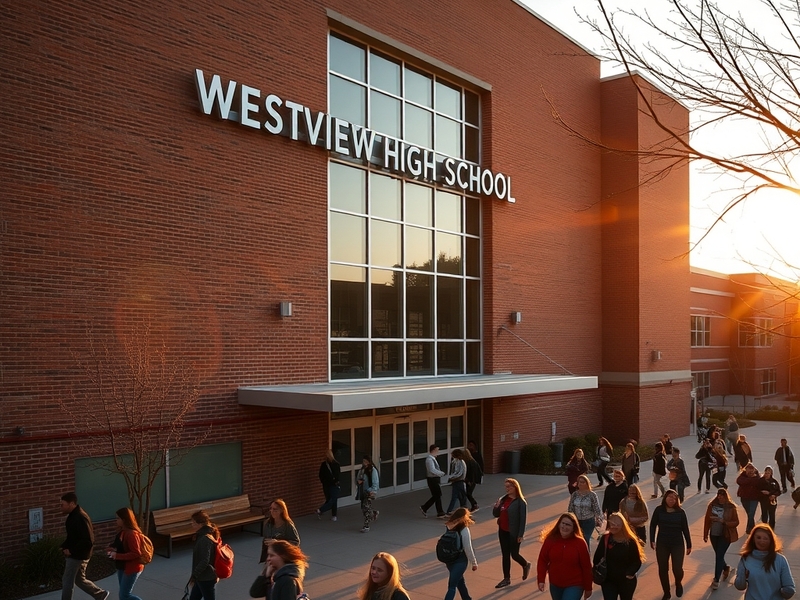
From Humble Beginnings to Community Anchor
Westview High School opened its doors in 1968 with just 350 students, a modest start for what would become one of the region’s most respected public institutions. Located on 32 acres of land donated by the Carter family, the school was designed to ease overcrowding at nearby Lincoln High and serve the rapidly growing neighborhoods of Greenfield and Mill Creek. The original building featured a single-story brick structure with 24 classrooms, a library, and a gymnasium barely large enough for school-wide assemblies. Administrators recall that the first football field was little more than a dirt lot marked with lime, and the marching band practiced on a cracked parking lot until donations funded a proper practice field.
Fifty-five years later, Westview has expanded to accommodate over 2,100 students and nearly 150 staff members. The campus now includes a state-of-the-art STEM wing, a performing arts center with seating for 800, and an Olympic-sized natatorium completed in 2019. Despite these changes, the school’s mission has remained consistent: to provide rigorous academics, competitive athletics, and inclusive extracurricular programs that prepare students for college, careers, and civic life. Principal Maria Vasquez, who began her career at Westview as a biology teacher in 1995, notes that the school’s growth reflects the community’s evolving needs. “We didn’t just build classrooms,” she says. “We built a second home for thousands of families.”
A Tradition of Academic Excellence
Westview’s academic reputation rests on a foundation of high expectations and personalized support. In 2023, the school ranked in the top 15% of U.S. high schools by U.S. News & World Report, with 94% of graduates enrolling in postsecondary education. The Advanced Placement program offers 28 courses, including less common options like AP Computer Science Principles and AP Environmental Science, which attract students from across the district. The school also partners with the local community college to offer dual-enrollment opportunities, allowing juniors and seniors to earn college credits at no cost. According to the most recent data, 78% of Westview students who take AP exams score a 3 or higher, compared to the national average of 58%.
The English department has gained particular attention for its innovative approach to literacy. Since 2020, all ninth- and tenth-grade students participate in a year-long “Reading for Inquiry” project, where they analyze a single text—such as The Things They Carried or The Hate U Give—through multiple lenses, including history, psychology, and social justice. Teachers report that this interdisciplinary focus has improved critical thinking scores on standardized assessments by 12% over three years. The school’s debate team, which competes in both policy and Lincoln-Douglas formats, has won state championships for five consecutive years and produced two national finalists in 2023.
Beyond the classroom, Westview emphasizes real-world skills through its Career Technical Education (CTE) pathways. Students can specialize in fields such as culinary arts, automotive technology, or digital media production. The culinary program, housed in a fully equipped commercial kitchen, partners with local restaurants for internships, and its student-run café serves lunch to faculty and community members every Thursday. “We’re not just teaching recipes,” says Chef Elena Rodriguez, the program’s director. “We’re teaching students how to run a business, manage inventory, and work under pressure—skills they’ll use whether they open their own restaurant or manage a corporate cafeteria.”
Sports, Spirit, and the Westview Way
Westview’s athletic program is a point of pride for the school, with 24 varsity teams competing in the state’s largest classification. The boys’ soccer team has won three state titles in the past decade, while the girls’ volleyball squad has made it to the semifinals four times. The football program, though not as decorated, has developed a reputation for resilience; in 2022, the Warriors finished the season with a 6–4 record after starting 0–3, thanks in part to a revamped offensive scheme and a team-first mentality. Head coach Marcus Dawson, a Westview alum, emphasizes character development as much as athletic skill. “We tell our players that the scoreboard is temporary, but the lessons they learn here will last a lifetime,” he says.
The school’s mascot, the Warrior, has undergone several redesigns since the 1970s, but the spirit behind it has remained constant. The student section, known as the “Warrior Pack,” is one of the most vocal in the state, often filling the stands at home games with chants, drumlines, and coordinated light shows. Pep rallies are legendary, featuring performances by the marching band, dance team, and cheerleaders, as well as surprise appearances by alumni athletes. In 2023, the school introduced a new tradition: the “Senior Walk,” where graduating seniors run through a tunnel of underclassmen before their final home football game. The event, modeled after college ceremonies, drew a standing ovation from the crowd and has since been adopted by other schools in the district.
Athletic success at Westview isn’t limited to traditional sports. The esports team, launched in 2018, competes in League of Legends and Valorant and has qualified for the state championships three times. The team practices in a dedicated gaming lab equipped with high-performance PCs and a streaming setup for live broadcasts. Coach Jason Wu, a former competitive gamer, believes the program teaches skills beyond hand-eye coordination. “Esports is about teamwork, communication, and strategic thinking,” he explains. “Our players learn to analyze opponents, adapt to meta shifts, and handle pressure—skills that translate directly to college and careers.”
Challenges and Controversies
Like many public schools, Westview has faced its share of challenges. In 2020, the district faced backlash after reallocating funds from the music program to support a new STEM initiative. Parents and alumni organized protests, arguing that the cuts would diminish the school’s cultural offerings. The school board ultimately compromised, restoring partial funding for the band and choir programs while increasing support for robotics and coding. The incident highlighted tensions between traditional and modern priorities, but it also sparked a broader conversation about how to balance innovation with tradition.
Another ongoing issue is the achievement gap between student subgroups. While Westview’s overall graduation rate is 96%, the rate for Black and Hispanic students lags behind by 8–10 percentage points. Administrators have responded with targeted interventions, including after-school tutoring, mentorship programs, and culturally responsive teaching training for staff. The school also partners with local nonprofits to provide wraparound services, such as mental health counseling and college application assistance. “We’re not where we want to be,” says Assistant Principal David Chen, “but we’re committed to closing the gap through data-driven strategies and community partnerships.”
The COVID-19 pandemic posed unprecedented challenges, forcing Westview to pivot to remote and hybrid learning models within days. Teachers scrambled to adapt, with some recording lessons in empty classrooms while others livestreamed from their living rooms. The school distributed over 500 Chromebooks to students in need and partnered with internet providers to offer free hotspots. Despite these efforts, learning losses were inevitable; standardized test scores in math and reading dropped by 15% and 9%, respectively. The school responded with intensive summer bridge programs and Saturday review sessions, and while scores have rebounded somewhat, educators acknowledge the long-term impact on student progress.
Looking Ahead: The Future of Westview
As Westview approaches its 60th anniversary in 2028, the school is focused on three key priorities: modernizing facilities, expanding mental health resources, and strengthening community ties. A $50 million bond measure passed in 2022 will fund a new STEAM (Science, Technology, Engineering, Arts, and Mathematics) building, set to open in 2025. The facility will include makerspaces, a black-box theater, and a rooftop greenhouse for environmental science projects. “We’re not just building a building,” says Superintendent Linda Park. “We’re creating a hub for creativity and collaboration that will serve students for generations.”
Mental health has become a cornerstone of the school’s strategic plan. In 2023, Westview hired two full-time counselors and launched a peer mentorship program called “Warrior Wellness.” The initiative trains upperclassmen to lead stress-management workshops, organize mindfulness sessions, and serve as trusted confidants for younger students. Early data shows a 20% increase in student-reported feelings of support and belonging. “We realized that academic success starts with emotional well-being,” says counselor Priya Mehta. “Our goal isn’t just to get students to graduation—it’s to help them thrive.”
Community engagement is also a priority. Westview’s annual “Career Day” brings in over 100 professionals from fields as diverse as aerospace engineering, social work, and culinary arts to speak with students. The school’s “Adopt-a-Freshman” program pairs incoming ninth-graders with upperclassmen mentors, while the “Warrior Alumni Network” connects graduates with current students for internships and job shadowing. These efforts reflect a growing emphasis on lifelong learning and networking. “We’re not just educating students for the next four years,” says Principal Vasquez. “We’re preparing them for the next 40.”
The school’s future may also include a renewed focus on sustainability. A student-led “Green Team” has proposed installing solar panels, expanding recycling programs, and creating a campus-wide composting system. Their efforts have already led to a 30% reduction in waste and earned the school a “Green Ribbon” designation from the state. “Students today are more aware of their environmental impact than any generation before,” says Green Team advisor Tom Alvarez. “Giving them a voice in these decisions isn’t just good for the planet—it’s good for their education.”
Beyond the Classroom: Westview’s Lasting Impact
Westview High School’s influence extends far beyond its graduation rates or state championships. For many alumni, the school is remembered not just for its academics, but for the relationships formed and the lessons learned. Take, for example, the story of Marcus and Elena, twins who graduated in 2015. Marcus went on to become a civil engineer, while Elena pursued a career in culinary arts. Both credit Westview’s CTE programs for giving them practical skills and real-world experience that set them apart in college and the workforce. “I didn’t just learn how to balance chemical equations,” Marcus says. “I learned how to solve problems, work in teams, and communicate my ideas—skills I use every day.”
The school’s impact is also felt in the broader community. Westview’s football stadium hosts youth leagues and adult recreational sports, while the performing arts center welcomes local theater groups, choirs, and dance companies. The library is open to the public on weekends, and the culinary café partners with food banks to provide meals for those in need. These efforts reflect a commitment to serving not just students, but the entire region. “Education doesn’t end at the school doors,” says Principal Vasquez. “We’re part of something bigger, and that’s something we take seriously.”
As Westview continues to evolve, one thing remains clear: the school is more than just a building or a set of programs. It’s a living, breathing entity shaped by the students, teachers, parents, and alumni who have passed through its halls. From the dirt football field of 1968 to the solar-paneled campus of 2028, Westview’s story is one of adaptation, resilience, and community. And as long as there are Warriors wearing blue and gold, that story will continue to be written.