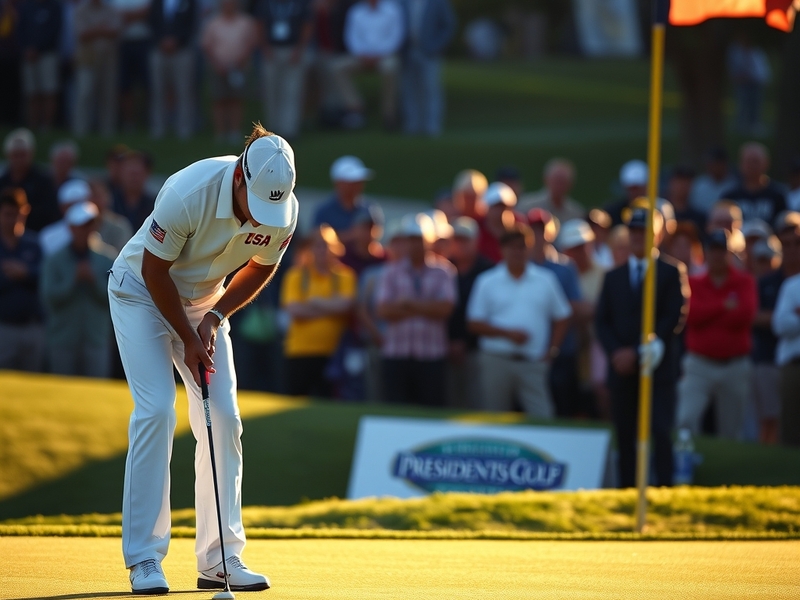
The Presidents Cup stands as one of golf’s most compelling international team competitions, blending elite competition with diplomatic undertones. Unlike the Ryder Cup, which pits the United States against Europe, the Presidents Cup features a U.S. team taking on an International side made up of players from outside Europe—primarily from Asia, Australia, Africa, and South America. First held in 1994, the event was created to expand global golf’s reach and foster camaraderie among the sport’s top talents.
The tournament rotates biennially between venues in the United States and international locations, with the next edition scheduled for 2026 at Medinah Country Club near Chicago. This rotation reflects the event’s commitment to growing the game beyond traditional golf strongholds in the U.S. and Europe. While it may lack the Ryder Cup’s century-old tradition, the Presidents Cup has carved out its own identity: a celebration of diversity, sportsmanship, and the global appeal of golf.
The Origins and Evolution of the Presidents Cup
The Presidents Cup was conceived in the early 1990s by then-PGA Tour Commissioner Deane Beman and golf legend Arnold Palmer. Frustrated by the Ryder Cup’s geographic limitations, they sought to create a team event that welcomed all non-European professionals. The inaugural tournament took place at Robert Trent Jones Golf Club in Gainesville, Virginia, in 1994, with a 12-player U.S. team led by captain Hale Irwin defeating an International squad captained by David Graham.
Early editions were dominated by the United States, thanks in part to the strength of its core players and the relative nascency of the International team. But by the late 1990s and early 2000s, the gap began to narrow. Players like Ernie Els, Retief Goosen, and Greg Norman brought star power and consistency to the International side, while the U.S. relied on a rotating cast led by Tiger Woods, Phil Mickelson, and Davis Love III.
One defining moment came in 2003 at Firestone Country Club, when the Internationals secured their first-ever victory—a 15½ to 14½ win that marked a turning point in the event’s history. Since then, the competition has grown more competitive, with the U.S. reasserting dominance in recent cycles, including a dominant 20-10 victory in 2022 at Quail Hollow Club in North Carolina.
How the Presidents Cup Works: Format and Key Rules
The Presidents Cup follows a familiar team format, with 12 players per side competing over three days in a mix of match play and stroke play. The event is structured as follows:
- Day 1 (Thursday): Four four-ball (better-ball) matches and four foursomes (alternate-shot) matches
- Day 2 (Friday): Four more four-ball and four more foursomes, alternating formats
- Day 3 (Sunday): Twelve singles matches, one per player, with all 24 points on the line
A total of 24 points are available, with 12½ points required to win. If the score is tied at 12-12, the U.S. retains the Cup—a rule that has led to some dramatic finishes, including the 2015 tie at Jack Nicklaus’s Muirfield Village.
Unlike the Ryder Cup, there are no automatic qualifiers based on the Official World Golf Ranking. Instead, players earn points through performance in the preceding two years on the PGA Tour, with the top six players from each side qualifying automatically. The remaining six spots are selected by each team’s captain, allowing for strategic picks based on form and conditions.
Captains play a crucial role, often selecting players not just for their current form but for their compatibility in team formats. The captains also have the authority to make mid-event adjustments, such as swapping players into key matches to shift momentum.
Why the Presidents Cup Matters Beyond the Scoreboard
The Presidents Cup is more than a golf tournament—it’s a cultural bridge. In a sport often criticized for its lack of diversity, the event showcases talent from six continents. Players from countries like South Korea, Japan, Thailand, and Australia have become household names in golf through their participation, helping to globalize the game’s fanbase.
Economically, the Presidents Cup injects millions into host communities, with past editions drawing over 100,000 spectators and generating significant tourism revenue. For smaller markets, it offers a rare opportunity to showcase local golf infrastructure on a world stage.
Diplomatically, the event fosters connections between players who might otherwise never meet. The camaraderie is palpable, with players sharing meals, training together, and even forming lasting friendships. This spirit was on full display in 2019 at Royal Melbourne, where the Internationals’ 16-14 win was celebrated as a triumph of global unity over geographic division.
From a competitive standpoint, the Presidents Cup serves as a proving ground for rising stars. Young players like Collin Morikawa, Viktor Hovland, and Tom Kim have used the event to build confidence in match play, a format that demands mental resilience and strategic thinking—skills that translate directly to success on the PGA Tour.
The Future of the Presidents Cup in a Changing Golf Landscape
As golf continues to expand globally, the Presidents Cup faces both opportunities and challenges. The rise of LIV Golf has disrupted traditional pathways to elite competition, with some top players now excluded from PGA Tour events—and thus ineligible for Presidents Cup qualification. This has led to calls for reform in the selection process, including the potential inclusion of LIV players or adjustments to the point system.
Meanwhile, the growth of golf in Asia, particularly in China and India, presents a long-term opportunity. A future Presidents Cup in Shanghai or New Delhi could tap into vast new audiences and elevate the event’s global profile even further.
Another evolution may come in the form of technology and fan engagement. With younger audiences increasingly consuming sports through digital platforms, the Presidents Cup could enhance its broadcast presentation with augmented reality, player caddie cams, and interactive social media features to deepen engagement.
One thing is certain: the Presidents Cup will continue to evolve while staying true to its core mission—celebrating the best of global golf with sportsmanship, passion, and a shared love of the game.