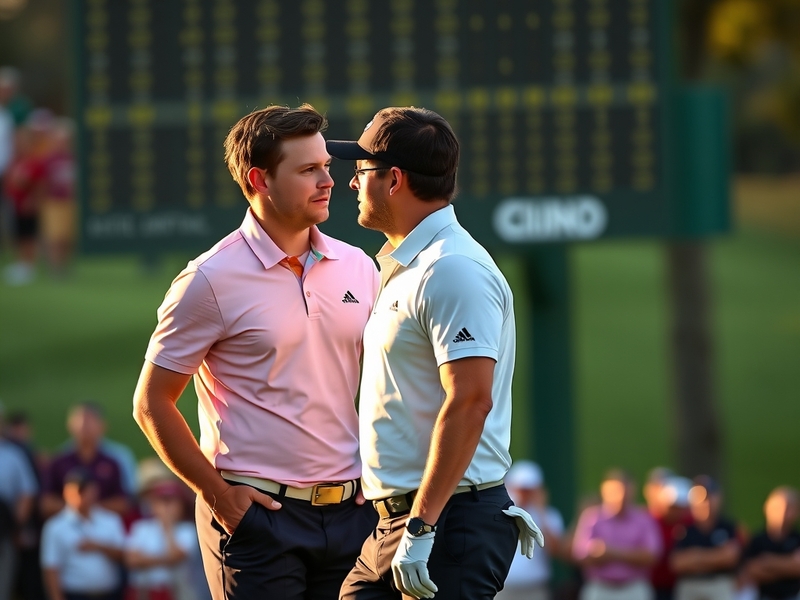
The Tour Championship Showdown: Hovland and Scheffler’s Global Golf Rivalry Takes Center Stage
The final major of the PGA Tour season always draws intense focus, but this year’s Tour Championship carried extra weight. Viktor Hovland and Scottie Scheffler, two of the sport’s brightest stars, delivered a weekend of high-pressure golf that transcended traditional American golf narratives. Their rivalry isn’t just about strokes and leaderboards—it’s a reflection of how the sport is evolving globally.
Hovland, the Norwegian sensation with a fluid swing and ice-cold demeanor, has redefined what it means to be a modern European golfer. Meanwhile, Scheffler, the Texan who blends relentless consistency with a quiet intensity, represents the enduring strength of American golf. Their duel at East Lake Golf Club wasn’t just a battle for a FedEx Cup title; it was a cultural moment. One where precision met power, strategy clashed with execution, and the world watched as two different golfing philosophies collided under the Atlanta autumn sky.
A New Era of Global Golf Dominance
Golf has long been dominated by players from the United States, but the rise of Hovland—alongside Jon Rahm, Rory McIlroy, and others—signals a shift. The 2023 Tour Championship finale underscored this transition. While Scheffler entered the week as the world’s top-ranked player, Hovland’s ascent over the past two seasons has been impossible to ignore. His victory at the 2023 FedEx Cup marked the first time a European player claimed the title since Henrik Stenson in 2013.
This isn’t just a one-off. The European Tour’s growing influence, combined with improved fitness regimens, data-driven training, and international junior development programs, has created a more competitive global field. Players like Hovland benefit from systems that prioritize technical refinement and mental resilience—traits he demonstrated repeatedly during the final round.
- Scheffler’s Strengths: Unshakable ball-striking, meticulous course management, and a calm under pressure.
- Hovland’s Edge: A natural swing, exceptional putting in key moments, and a competitive fire that surfaces in high-stakes rounds.
The contrast between the two players extends beyond nationality. Scheffler’s game is built on repetition and control, almost mechanical in its precision. Hovland, on the other hand, plays with a fluidity that makes the difficult look effortless. Their styles reflect broader trends in golf instruction—where data analytics meet artistry, and where athleticism reshapes traditional expectations.
The Cultural Impact of Their Rivalry
Golf has often been perceived as an insular sport, steeped in tradition and resistant to change. Yet the Hovland-Scheffler dynamic challenges that perception. Their rivalry has introduced a new narrative: one where globalism isn’t just a buzzword but a tangible force reshaping the sport’s landscape.
Hovland’s success resonates deeply in Scandinavia, where golf participation has surged in recent years. Norway, a country more associated with winter sports, now boasts one of the fastest-growing golf communities in Europe. Meanwhile, Scheffler’s dominance has reinforced the PGA Tour’s reputation as the sport’s premier stage. His rise mirrors the endurance of American golf culture, which continues to produce elite talent despite increasing international competition.
Off the course, their contrast in personalities has also captivated fans. Scheffler is often described as reserved, almost stoic, while Hovland is more expressive—smiling after clutch putts, engaging with fans, and embracing the moment. These differences make their rivalry compelling not just for what they do with a club, but for who they are as figures in the sport.
In Asia, where golf’s popularity has exploded thanks to stars like Hideki Matsuyama and the rise of LIV Golf, their performances are dissected with equal intensity. Golf’s global audience is no longer confined to its traditional strongholds. Platforms like YouTube, Instagram, and regional sports networks have turned players into international icons, and events like the Tour Championship now draw millions of viewers worldwide.
The Final Round: Strategy, Pressure, and Decisive Moments
The final round of the Tour Championship was a masterclass in pressure golf. Scheffler started the day with a one-stroke lead, but Hovland’s birdie barrage on the front nine shifted the momentum. By the time they reached the 10th hole, the tension was palpable. Every fairway hit, every green in regulation, every putt that lipped in or out was magnified on screens across the globe.
Scheffler’s ability to grind through adversity was on full display. He made crucial up-and-downs on the 14th and 16th holes, keeping himself in the hunt even as Hovland appeared to seize control. But golf, as it often does, had one final twist. Hovland’s bogey on the 17th allowed Scheffler to close within one stroke. The 18th hole at East Lake became a microcosm of their entire season—Scheffler needed a par to force a playoff, while Hovland needed a birdie to secure the title.
Hovland delivered. His approach to the 18th green landed just past the pin, and his birdie putt rolled in with authority. The roar of the crowd echoed across the lake, a moment that encapsulated the drama of the weekend. Scheffler, ever composed, extended a hand in congratulations—a gesture that spoke volumes about mutual respect in a sport sometimes divided by tour loyalties.
For golf purists, the playoff that never happened was a disappointment. But for the casual fan, the final round delivered everything they could ask for: drama, skill, and a definitive conclusion. Hovland’s victory wasn’t just a win; it was a statement. One that the next generation of golfers—regardless of nationality—can rise to the occasion when the stakes are highest.
What’s Next for Golf’s Global Stage?
The Tour Championship may be over, but the implications of Hovland and Scheffler’s rivalry extend far beyond East Lake. Their performances have set the stage for what promises to be an even more competitive 2024 season. With the Ryder Cup looming in 2025, the stakes couldn’t be higher. Both players are likely to be central figures in that biennial event, where national pride and individual excellence collide.
Golf’s governing bodies are also taking notice. The PGA Tour’s merger with LIV Golf has already reshaped the landscape, bringing new audiences and financial resources to the sport. While traditionalists may lament the changes, the influx of talent and star power can only benefit the game in the long run. Hovland and Scheffler, each representing different philosophies and generations, embody this evolution.
As for the fans? They’re the real winners. Golf has always been a sport of patience and precision, but the emotional highs of a Tour Championship finale remind us why we love it. Whether you’re cheering for the precision of Scheffler or the artistry of Hovland, their rivalry has given the sport a new heartbeat—one that echoes from the fjords of Norway to the fairways of Texas.
One thing is certain: this won’t be the last time we see these two at the top. And when they do, the world will be watching.