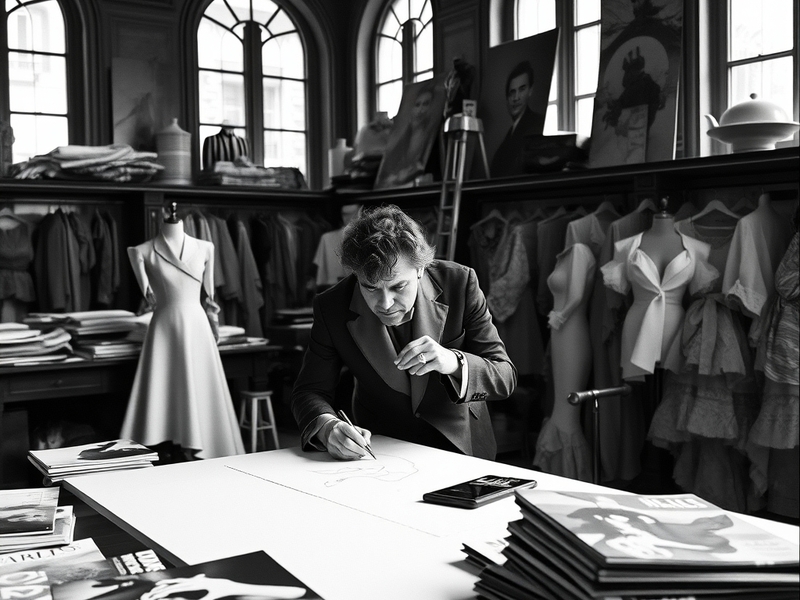
Few names in fashion carry the weight of John Galliano’s. A designer whose career spans four decades, Galliano reshaped the industry’s relationship with history, spectacle, and controversy. His runway shows became theatrical events, blending haute couture craftsmanship with provocative storytelling that often blurred the line between art and fashion. Yet, his legacy remains as complex as his designs—celebrated for innovation but repeatedly overshadowed by personal and professional scandals.
From London to Paris: The Making of a Fashion Revolutionary
Born in Gibraltar in 1960, Galliano grew up in London, where his fascination with history and costume began early. He studied at Central Saint Martins College of Art and Design, graduating in 1984 with a collection inspired by the French Revolution. The show’s raw, romantic aesthetic caught the attention of critics, establishing a signature style that would define his career: dramatic silhouettes, opulent fabrics, and a deep reverence for the past.
By the late 1980s, Galliano had moved to Paris, the epicenter of haute couture. Financial struggles nearly derailed his ascent until his 1993 “Les Incroyables” collection, inspired by the French Revolution’s dandies. The show was a turning point. It wasn’t just clothing; it was a manifesto. Galliano draped models in corsets, frock coats, and tattered lace, reimagining history as wearable art. Fashion houses took notice. In 1996, he was named head designer of Givenchy, marking his first major appointment at a storied maison.
His tenure at Givenchy lasted only two years, but his impact was immediate. He infused the brand with his signature theatricality, though his vision clashed with Givenchy’s conservative clientele. The transition to Christian Dior in 1996 was even more transformative. At Dior, Galliano found a canvas to fully realize his ambitions. His first collection for the house, inspired by the 1950s New Look, was a homage to Christian Dior’s legacy—but with Galliano’s irreverent twist. The show featured models in corseted waists, voluminous skirts, and headpieces that looked plucked from a baroque painting. It was a love letter to fashion’s past, filtered through a modern, avant-garde lens.
The Runway as Stage: Spectacle and Subversion
Galliano’s runway shows were less about selling clothes and more about crafting immersive experiences. He transformed the catwalk into a theater of excess, often drawing from marginalized histories or controversial figures. His 2006 Dior couture show, inspired by the Parisian cabarets of the 1900s, featured models in feathered headdresses and sequined bodysuits, evoking the glamour of Paris’s Belle Époque. But it was his 1998 Dior show, inspired by the homeless, that sparked debate. Models walked in tattered, layered clothing, challenging notions of luxury and privilege. Critics were divided: some praised the social commentary, while others accused Galliano of romanticizing poverty.
His 2001 “Bal des Artistes” collection for Dior was another masterclass in spectacle. The show, held in a Parisian train station, featured models in designs inspired by surrealist artists like Dali and Picasso. The finale, a recreation of Dior’s iconic “Bar” suit, was draped in a giant, glittering canvas, blurring the line between clothing and art. These shows weren’t just fashion—they were performances, complete with live orchestras, choreographed dances, and sets that cost millions to produce.
Yet, for all their brilliance, Galliano’s shows often courted controversy. His 2006 “African Queen” collection for Dior included designs inspired by colonial-era imagery, drawing accusations of cultural appropriation. Critics argued that the collection exoticized African culture, reducing its complexity to mere aesthetic inspiration. Galliano defended the work as a celebration of global influences, but the backlash underscored the fine line between homage and exploitation in fashion.
The Fall and the Fragility of Genius
In 2011, Galliano’s career imploded after a viral video surfaced showing him verbally abusing patrons at a Paris bar, shouting antisemitic slurs and mocking their accents. The incident wasn’t isolated; it was the culmination of years of erratic behavior, fueled by alcohol and the pressures of the fashion world. Dior swiftly fired him, and the industry turned its back. Galliano’s fall was as dramatic as his rise, a stark reminder of the fragility of even the most brilliant careers in fashion.
His 2013 trial in France revealed the depth of his struggles. Galliano admitted to his behavior but cited alcoholism and mental health challenges as mitigating factors. The court found him guilty of public insults and anti-Semitic remarks, fining him and ordering him to undergo anti-bias training. The verdict was a turning point. For some, it was justice; for others, it was a harsh punishment for a man whose contributions to fashion were undeniable. Galliano disappeared from the public eye, his silence a stark contrast to his earlier flamboyance.
Yet, fashion has a way of forgiving—or at least forgetting. In 2014, Galliano was quietly rehired by Oscar de la Renta, where he worked as a consultant. By 2018, he returned to the spotlight as the creative director of Maison Margiela, a role he held until stepping down in 2023. His tenure at Margiela was marked by a more subdued aesthetic, focusing on deconstruction and minimalism rather than spectacle. It was a far cry from his Dior heyday, but it demonstrated his ability to evolve—and perhaps, to atone.
Legacy: The Galliano Paradox
John Galliano’s legacy is a paradox. He is undeniably one of the most influential designers of his generation, a visionary who redefined the boundaries of fashion. His work challenged conventions, blending history, art, and activism in ways that few designers have matched. Yet, his personal demons and public scandals have left an indelible stain on his reputation. The question remains: Can genius coexist with toxicity? Fashion has often turned a blind eye to the flaws of its icons, but Galliano’s case forces a reckoning.
His influence persists in the work of designers like Alexander McQueen and Vivienne Westwood, who also used fashion as a medium for storytelling and provocation. Galliano’s emphasis on craftsmanship and historical references has seeped into contemporary couture, from Chanel’s Métiers d’Art collections to Iris van Herpen’s avant-garde designs. Even his penchant for spectacle can be seen in the immersive runway shows of brands like Balenciaga and Coperni.
Yet, Galliano’s story also serves as a cautionary tale. It highlights the pressures of the fashion industry—the relentless pursuit of perfection, the cult of personality, and the lack of support for mental health. His fall wasn’t just a personal failure; it was a systemic one. The industry that idolized him turned its back when he needed it most.
Today, Galliano’s work is celebrated in retrospectives and exhibitions, a testament to his impact. But his story is more than a tale of triumph and tragedy. It’s a reflection of the contradictions at the heart of fashion: a world that demands innovation but often rewards excess, that praises individuality but punishes imperfection. Galliano’s legacy, then, is not just about the clothes he made—it’s about the questions he left unanswered.
As fashion continues to evolve, Galliano’s story serves as a reminder of the power—and the peril—of genius.