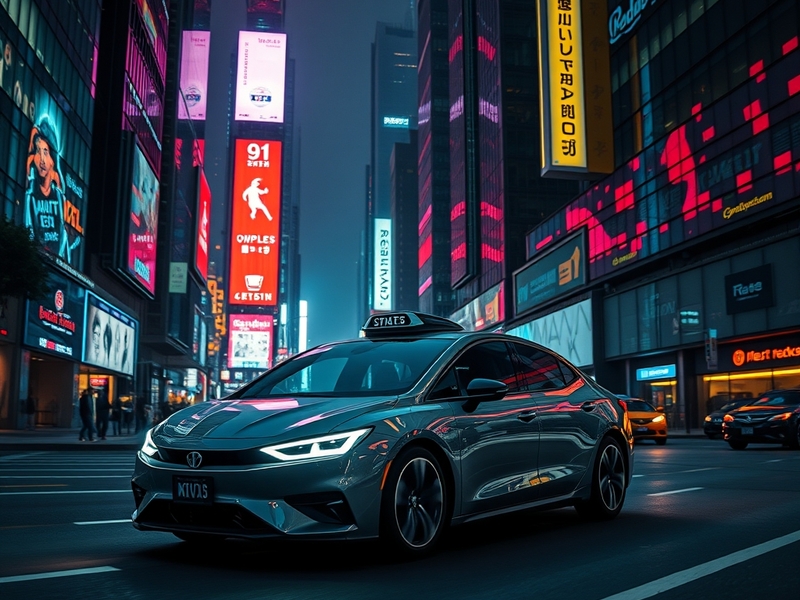
In the quiet hum of a suburban cul-de-sac, a sleek sedan glides to a stop without a driver. Its doors open automatically as a passenger steps forward, smartphone in hand, scanning a QR code displayed on the rear window. Within seconds, the ride is confirmed, and the vehicle merges into traffic with precision, its electric motor purring almost silently. This isn’t a scene from a futuristic film—it’s the reality of the cybercab, a fully autonomous ride-hailing vehicle that’s rapidly reshaping urban mobility.
Cybercabs represent more than just a technological marvel; they’re a potential solution to some of the most pressing challenges in modern transportation. By eliminating the need for human drivers, these vehicles promise to reduce costs, improve safety, and cut emissions. Yet, their rise also raises complex questions about regulation, infrastructure, and the very nature of car ownership. As cities from San Francisco to Singapore begin testing fleets of these autonomous taxis, the question isn’t whether cybercabs will become mainstream—it’s how soon, and what their arrival will mean for the rest of us.
The technology behind cybercabs: How they work
At the heart of every cybercab is a sophisticated suite of sensors, processors, and software that work together to navigate the world without human intervention. Unlike traditional vehicles, which rely on a driver’s reflexes and judgment, cybercabs depend on a combination of LiDAR, radar, cameras, and high-definition maps to perceive their surroundings in real time. LiDAR, or Light Detection and Ranging, uses laser pulses to create a 3D map of the environment, detecting obstacles as small as a pothole or as large as a moving bus. Meanwhile, radar systems monitor speed and distance, while cameras interpret traffic lights, road signs, and pedestrian movements.
The data from these sensors is processed by an onboard computer, often powered by artificial intelligence, which makes split-second decisions about acceleration, braking, and steering. This system is constantly updated with information from cloud-based maps, which provide details about road closures, construction zones, and even temporary obstacles like parked delivery trucks. For example, Waymo, the autonomous vehicle division of Alphabet, uses a combination of these technologies in its cybercabs, allowing them to operate in complex environments like downtown Phoenix, where they’ve logged millions of miles without a single human-driven accident.
But sensors and AI aren’t the only innovations driving the cybercab revolution. Vehicle-to-everything (V2X) communication is another critical component, enabling cybercabs to “talk” to traffic lights, other vehicles, and even pedestrians’ smartphones. This technology helps prevent collisions by alerting the vehicle to a sudden brake from a car ahead or a pedestrian stepping into the street. In cities like Las Vegas, where autonomous shuttles have been tested on public roads, V2X has already demonstrated its potential to reduce traffic congestion and improve safety.
The business model: Who’s investing and why
The push to bring cybercabs to market isn’t coming from a single company—it’s a race involving tech giants, automakers, and ride-hailing platforms. Waymo, a subsidiary of Google’s parent company Alphabet, is one of the most visible players, with a commercial robotaxi service operating in Phoenix, San Francisco, and Los Angeles. The company has partnered with automakers like Jaguar and Volvo to produce purpose-built autonomous vehicles, and it’s also exploring partnerships with traditional taxi services to integrate cybercabs into existing fleets.
Meanwhile, Tesla is taking a different approach with its Full Self-Driving (FSD) technology, which it plans to license to other companies for use in cybercab fleets. Elon Musk has long touted FSD as a way to monetize Tesla’s AI expertise, and the company has already begun testing robotaxis in Texas and Nevada. The appeal for Tesla is clear: by licensing its software, it can generate recurring revenue without the overhead of owning and maintaining a fleet of vehicles.
Not to be outdone, traditional automakers are also making bold moves. Mercedes-Benz has partnered with Bosch to develop an autonomous ride-hailing service in Europe, while Ford has invested in Argo AI, a self-driving technology startup, to accelerate its cybercab ambitions. Even ride-hailing giants like Uber are getting in on the action. Uber’s Elevate division, originally focused on air taxis, has pivoted to ground-based autonomous vehicles, seeing them as a more immediate opportunity to reduce costs and improve efficiency.
So why are these companies pouring billions of dollars into cybercabs? The answer lies in the economics of ride-hailing. Today, drivers account for up to 70% of ride-hailing costs, according to industry estimates. By removing the need for a human behind the wheel, cybercabs could slash those expenses, making ride-hailing services more profitable—or even affordable enough to compete with public transit. For tech companies, cybercabs also offer a way to monetize their AI and data capabilities, while automakers see them as a path to remain relevant in a future where car ownership declines.
The challenges: Safety, regulation, and public trust
Despite the promise of cybercabs, significant hurdles remain before they can become a ubiquitous part of urban life. Chief among these is safety. While autonomous vehicles have made strides in reducing accidents caused by human error, they’re not infallible. High-profile incidents, such as the fatal crash involving a self-driving Uber vehicle in 2018, have highlighted the risks of relying solely on technology. Even minor glitches, like a misinterpreted stop sign or an unexpected lane change, can have serious consequences. Regulators are grappling with how to balance innovation with public safety, and the patchwork of state and local laws governing autonomous vehicles adds another layer of complexity.
Another challenge is infrastructure. Cybercabs require high-definition maps that are updated in real time, as well as robust connectivity to support V2X communication. Many cities, particularly older ones with narrow streets and outdated traffic systems, aren’t equipped to handle this level of technological integration. For example, in San Francisco, where Waymo operates its robotaxis, the company has had to work closely with city officials to address issues like street parking, which can obstruct sensors, and the frequent protests that disrupt traffic patterns. Without significant investment in smart infrastructure, cybercabs may struggle to scale beyond a few select markets.
Public trust is perhaps the biggest obstacle. A 2023 survey by the American Automobile Association found that 60% of Americans are afraid to ride in a fully autonomous vehicle. Concerns about hacking, data privacy, and the unpredictability of AI-driven decisions contribute to skepticism. Some consumers also worry about job displacement, as the rise of cybercabs could eliminate millions of driving jobs worldwide. To overcome these fears, companies like Waymo and Cruise have launched public education campaigns and offered free rides to journalists and officials, hoping to demonstrate the safety and reliability of their technology.
The future of cybercabs: What’s next?
The next five years will be critical for the cybercab industry. By 2027, industry analysts predict that the global autonomous vehicle market could be worth over $200 billion, with cybercabs accounting for a significant portion of that growth. One of the most immediate opportunities lies in partnerships with public transit systems. In cities like Miami and Detroit, pilot programs are exploring how cybercabs can complement buses and trains, providing “last-mile” solutions that connect riders to transit hubs. These programs could reduce the need for personal car ownership, lower emissions, and ease traffic congestion.
Another trend to watch is the emergence of “mobility-as-a-service” (MaaS) platforms, which integrate cybercabs with public transit, bike-sharing, and scooter rentals into a single app. Companies like Germany’s Moovit and Finland’s MaaS Global are already testing these platforms, and their success could make cybercabs a seamless part of daily life. Imagine a morning commute where you take a cybercab to the train station, then rent an e-bike for the final leg of your journey—all booked through a single app with a unified payment system.
Yet, the long-term vision for cybercabs goes even further. Companies like Zoox, acquired by Amazon in 2020, are developing autonomous vehicles designed specifically for ride-hailing, with features like bidirectional seating and no traditional “front” or “back.” These vehicles are built from the ground up to optimize space and efficiency, with the goal of making shared rides more comfortable and practical. If successful, these designs could redefine urban transportation, turning cars from personal assets into shared resources.
But the road ahead isn’t without risks. Cybersecurity remains a major concern, as autonomous vehicles become potential targets for hackers seeking to disrupt traffic or steal data. Governments will need to establish clear regulations around data privacy, liability in accidents, and the ethical considerations of AI decision-making. For example, who is responsible if a cybercab makes a split-second decision that results in a crash—the manufacturer, the software developer, or the city that approved its operation?
Despite these challenges, the momentum behind cybercabs is undeniable. As technology improves and public acceptance grows, these vehicles could become as common as smartphones or streaming services. They won’t just change how we get from point A to point B—they’ll redefine our relationship with transportation itself. For now, the cybercab revolution is still in its early stages, but the destination is coming into view.