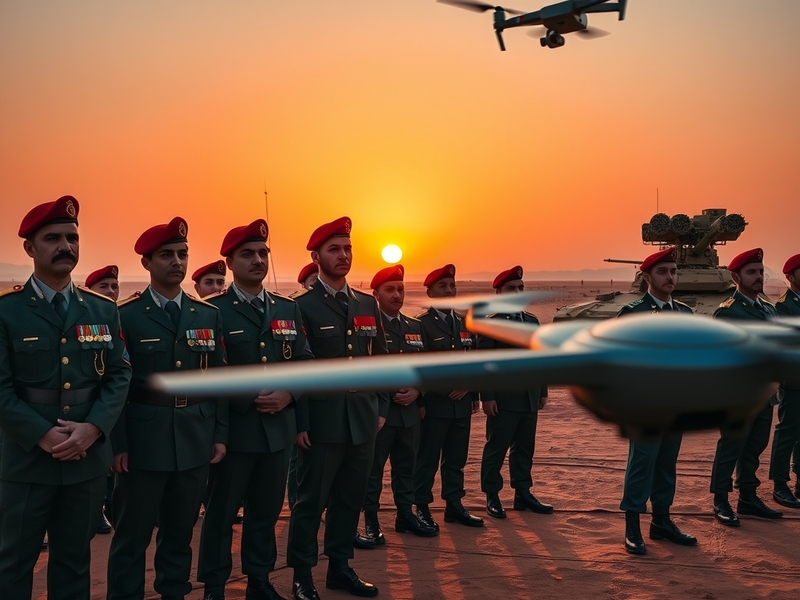
The Structure and Strategy of Iran’s Armed Forces
Iran’s military is a complex and adaptive institution shaped by decades of conflict, sanctions, and geopolitical pressure. Unlike conventional forces, its structure blends formal state institutions with irregular units, creating a layered defense network capable of operating across multiple domains. This hybrid approach has allowed the Islamic Republic to project influence while mitigating vulnerabilities in an increasingly volatile region.
The Islamic Republic of Iran Armed Forces consist of two primary branches: the regular military, known as the Artesh, and the Islamic Revolutionary Guard Corps (IRGC). While both report to the Supreme Leader, their roles, funding, and operational priorities differ significantly. The Artesh focuses on conventional warfare, maintaining tanks, aircraft, and naval assets, while the IRGC prioritizes asymmetric tactics, including missile development, cyber operations, and support for proxy groups across the Middle East. This division of labor ensures Iran can respond to threats ranging from large-scale invasions to covert destabilization efforts.
One of the most distinctive features of Iran’s military is its reliance on decentralized, networked resistance. The IRGC oversees the Basij, a voluntary militia with over 20 million members, many of whom receive basic military training. These forces are not just auxiliary troops; they are embedded within civilian infrastructure, enabling rapid mobilization in times of crisis. This strategy complicates enemy targeting while reinforcing Iran’s doctrine of “forward defense,” which prioritizes deterring threats before they reach its borders.
Key Components of Iran’s Military Apparatus
Understanding Iran’s armed forces requires examining their organizational pillars. Below are the core elements that define their structure and capabilities:
- Islamic Revolutionary Guard Corps (IRGC): Founded in 1979 to protect the Islamic Republic, the IRGC operates independently of the regular military. It controls the Quds Force, responsible for extraterritorial operations, and the Aerospace Force, which oversees ballistic missile programs and drones. The IRGC also dominates Iran’s maritime strategy in the Persian Gulf, deploying fast-attack boats and anti-ship missiles.
- Artesh (Regular Military): The Artesh includes the Ground Forces, Air Force, and Navy, all of which are tasked with defending Iran’s territorial integrity. While often overshadowed by the IRGC, the Artesh maintains critical conventional capabilities, such as the domestically produced Zulfiqar tanks and Saeqeh fighter jets.
- Basij Resistance Force: A paramilitary volunteer network with deep roots in Iranian society. The Basij provides manpower for both combat and social control, participating in military drills, cyber campaigns, and domestic security operations. Their integration into civilian life makes them difficult to dismantle in a conflict.
- Missile and Drone Programs: Iran’s ballistic missile arsenal, estimated at over 3,000 missiles, is the largest in the Middle East. These weapons, including the Shahab-3 and Sejjil, serve as both deterrents and tools for regional power projection. Drones, such as the Shahed-136, have become a cost-effective alternative for precision strikes and surveillance.
The synergy between these components allows Iran to operate across multiple domains—land, sea, air, space, and cyberspace—without relying on traditional alliances. This self-sufficiency stems from decades of international isolation, which forced Iran to develop indigenous defense industries. Today, domestic production of weapons, from rifles to cruise missiles, reduces dependence on foreign suppliers while fueling innovation in asymmetric warfare.
Iran’s Military Doctrine: Deterrence and Deniability
Iran’s military strategy is not designed for direct confrontation with superior conventional forces. Instead, it emphasizes deterrence through denial, punishment, and cost imposition. This doctrine, outlined in official documents and speeches by leaders like General Qasem Soleimani, prioritizes three core objectives: preventing regime change, undermining adversaries’ regional influence, and maintaining strategic depth through proxy networks.
A key tactic is the “forward defense” strategy, which pushes threats away from Iran’s borders by engaging enemies in neighboring states. This approach explains Iran’s support for groups like Hezbollah in Lebanon, the Houthis in Yemen, and militias in Iraq and Syria. By cultivating these proxies, Iran extends its reach while avoiding direct conflict with Israel, the United States, or Saudi Arabia. The IRGC’s Quds Force plays a central role in training, arming, and coordinating these groups, often using smuggling routes and covert supply chains to evade sanctions.
Another cornerstone of Iran’s doctrine is its emphasis on “asymmetric warfare.” This includes cyberattacks, sabotage, and the use of drones and missiles to target critical infrastructure. For example, Iran has been linked to cyber operations against Saudi Aramco, attacks on oil tankers in the Gulf of Oman, and strikes on ISIS positions using ballistic missiles launched from within Iran. These actions are designed to inflict maximum damage with minimal risk, leveraging Iran’s ability to absorb retaliation without collapsing.
The doctrine also incorporates psychological warfare, using state media, social platforms, and even Hollywood-style propaganda to project strength. Chants of “Death to America” and “Death to Israel” during military parades are not merely symbolic; they reinforce Iran’s image as an unyielding adversary. Meanwhile, Iran’s nuclear program, though officially civilian, serves as a latent deterrent, ensuring that any large-scale military action against Iran would carry catastrophic risks.
Regional Implications and Global Reach
Iran’s military posture has reshaped the balance of power in the Middle East, challenging the dominance of U.S. allies like Saudi Arabia and Israel while complicating international efforts to contain its influence. The IRGC’s involvement in Syria, for instance, has been pivotal in preserving the Assad regime, a key Iranian ally. This intervention not only secured a land corridor from Iran to Lebanon but also allowed Iran to test new weapons and tactics in real combat scenarios.
In Yemen, the Houthi rebels’ drone and missile attacks on Saudi Arabia and the UAE have demonstrated Iran’s ability to project power without direct engagement. These strikes, often targeting oil facilities and airports, have forced Gulf states to divert resources toward air defense, undermining their regional ambitions. Meanwhile, Iran’s ballistic missile tests, which violate UN resolutions, have drawn condemnation from Western powers but have not resulted in meaningful penalties, highlighting the limits of international diplomacy.
Iran’s military reach extends beyond the Middle East. In recent years, Iran has deepened ties with Russia, sharing drone technology that has been used in Ukraine. This collaboration has provided Iran with financial resources and political cover, while also giving Russia a new partner in its confrontation with the West. Similarly, Iran’s relationship with China, formalized through a 25-year cooperation agreement, includes military cooperation, including joint naval exercises in the Indian Ocean.
These alliances underscore Iran’s role as a disruptor in global security. By aligning with rogue states and non-state actors, Iran has created a network that complicates traditional military responses. For the United States and its allies, containing Iran requires a multifaceted approach that addresses not just its nuclear ambitions but also its conventional and irregular capabilities. Sanctions, cyber operations, and diplomatic isolation have had mixed results, often pushing Iran to innovate rather than concede.
Challenges and the Future of Iran’s Armed Forces
Despite its resilience, Iran’s military faces significant challenges. Economic sanctions have crippled its ability to modernize, forcing reliance on outdated equipment and improvised solutions. The Artesh, in particular, struggles with maintenance and training due to a lack of spare parts and advanced technology. Meanwhile, the IRGC’s dominance has sidelined professional military officers, creating a culture of loyalty over meritocracy.
Another vulnerability is Iran’s aging leadership. Many IRGC commanders, including those who rose to prominence under Soleimani, are reaching retirement age or have been killed in targeted strikes. Replacing them with equally competent leaders is no small task, especially as younger generations question the regime’s priorities. Protests in 2022 and 2023 revealed fractures within Iranian society, including among Basij members and Artesh conscripts, who are increasingly resentful of compulsory service and economic hardship.
Technological gaps also pose risks. While Iran has made strides in drones and missiles, its air force remains reliant on 1970s-era U.S.-made aircraft, supplemented by Soviet-era MiGs and Chinese imports. Cyber vulnerabilities, such as the 2020 attack on Iran’s Natanz nuclear facility, highlight the need for better digital defenses. The IRGC’s cyber units, though active, lack the sophistication of state-sponsored hackers from Russia or China.
Looking ahead, Iran’s military is likely to adapt rather than collapse. The regime has shown a willingness to embrace hybrid warfare, blending conventional and irregular tactics to offset conventional weaknesses. The drone program, in particular, offers a low-cost, high-impact tool for both defense and aggression. Meanwhile, Iran’s growing ties with China and Russia provide alternative supply chains and political support, reducing its isolation.
For the international community, the challenge will be balancing deterrence with diplomacy. Military strikes, while tempting, risk escalation and could unite Iran’s fractured factions under a nationalist banner. Sanctions, though painful, have not halted Iran’s military advancements. A more effective strategy might involve targeted cyber operations, intelligence-sharing with regional allies, and incentives for Iran to engage in meaningful arms control talks. The goal should not be to dismantle Iran’s military but to ensure that its capabilities do not destabilize an already volatile region.
As Iran continues to refine its military doctrine, the world must recognize that its armed forces are not merely a tool of the state—they are a reflection of Iran’s identity, resilience, and defiance. Whether through parades, proxy wars, or precision strikes, Iran’s military will remain a defining force in the Middle East for years to come.
For more insights into regional military dynamics, explore our Analysis and Politics sections.