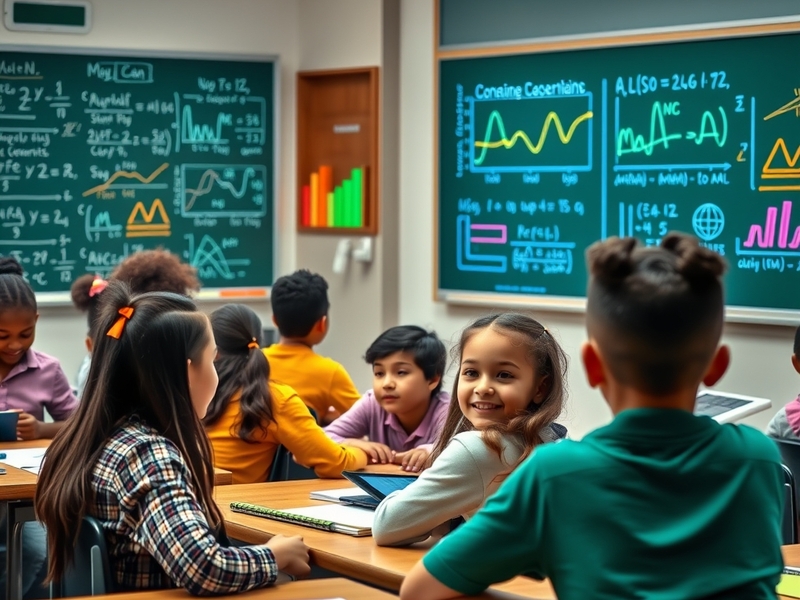
Understanding OpenAI Mathematics
OpenAI has made significant strides in various fields, and mathematics is no exception. The organization focuses on developing AI systems that can perform complex mathematical operations, solve intricate problems, and even assist in educational settings. By leveraging advanced algorithms and machine learning techniques, OpenAI’s mathematical models aim to enhance both computational efficiency and user experience.
Applications of OpenAI in Mathematics
The applications of OpenAI in mathematics are extensive, spanning various domains and industries. Here are some key areas where OpenAI’s mathematical capabilities are making an impact:
- Education: AI-driven tutoring systems can provide personalized learning experiences for students, adapting to their skill levels and learning paces.
- Research: Researchers can utilize AI to analyze data sets, identify patterns, and generate hypotheses, thereby accelerating the pace of discovery.
- Finance: Mathematical models powered by AI can optimize trading strategies, risk assessments, and financial forecasting.
- Engineering: OpenAI can assist in solving complex engineering problems, from structural analysis to algorithm optimization.
How OpenAI Handles Mathematical Problems
OpenAI employs various techniques to tackle mathematical problems. The primary methods include:
- Neural Networks: These networks can learn from vast amounts of data, enabling them to recognize patterns and make predictions about mathematical outcomes.
- Natural Language Processing (NLP): By understanding mathematical language, OpenAI can convert user queries into solvable problems, enhancing user interaction.
- Reinforcement Learning: This technique allows AI to learn from its mistakes and successes, optimizing its mathematical problem-solving abilities over time.
Through these techniques, OpenAI’s models become increasingly adept at understanding and solving mathematical challenges, paving the way for innovative applications across different sectors.
Challenges and Limitations
While OpenAI’s advancements in mathematics are impressive, there are challenges that come with these technologies. Some limitations include:
- Data Dependence: The effectiveness of AI models is heavily reliant on the quality and quantity of data available for training.
- Interpretability: Understanding how AI arrives at specific solutions can be difficult, leading to skepticism about its reliability in critical applications.
- Ethical Considerations: The use of AI in sensitive areas such as finance and healthcare raises concerns about accountability and bias.
Addressing these challenges requires ongoing research and ethical considerations to ensure that the benefits of OpenAI’s mathematical capabilities are realized without compromising on integrity or reliability.
Conclusion
OpenAI’s contributions to the field of mathematics are reshaping how we approach problem-solving across various industries. From enhancing educational tools to optimizing financial models, the potential applications are vast. However, as we continue to integrate AI into mathematical practices, it is crucial to remain aware of the challenges and limitations that accompany these advancements. For more insights into technology and its impact on various sectors, visit our technology section or explore our education category.