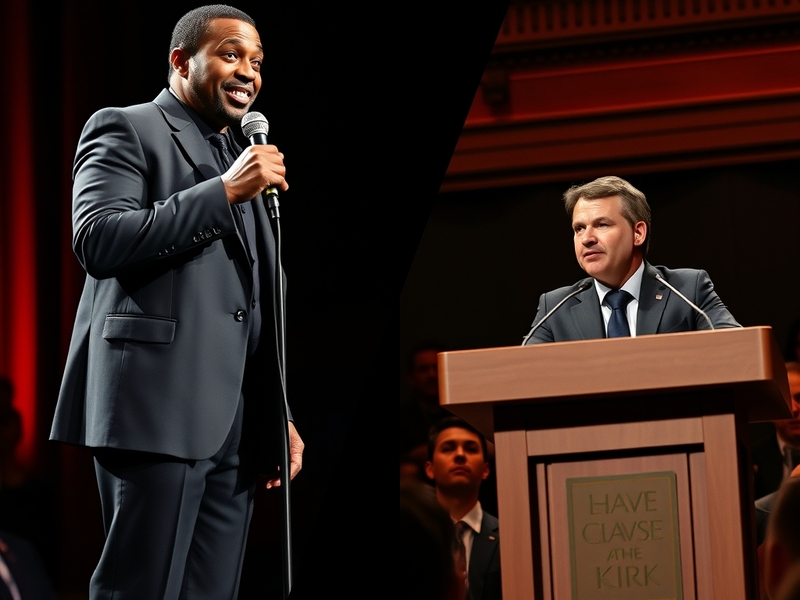
Background on Dave Chappelle and Charlie Kirk
Dave Chappelle, renowned for his sharp wit and incisive social commentary, often addresses contemporary issues through his comedy. Charlie Kirk, a prominent conservative commentator and founder of Turning Point USA, represents a different segment of the American political landscape. Their interactions have sparked interest, particularly when Chappelle referenced Kirk in one of his stand-up performances.
Chappelle’s Comments on Kirk
During a show, Chappelle made a notable remark about Charlie Kirk, which drew attention for its boldness. He criticized the way Kirk and others in his political circle approach discussions about race and identity. Chappelle’s humor often tackles sensitive subjects, and this instance was no exception. He posited that Kirk’s views sometimes oversimplify complex societal issues. This commentary illustrates Chappelle’s commitment to challenging narratives that he believes do not fully encapsulate the nuances of the human experience.
The Context of the Discussion
Chappelle’s remarks did not occur in a vacuum. The backdrop of his comments includes a broader societal discourse on race relations, free speech, and the role of comedy in political conversations. Kirk’s advocacy for conservative values often places him at odds with progressive viewpoints, making Chappelle’s critique particularly poignant.
What Chappelle seems to be highlighting is the need for a more comprehensive dialogue around race, identity, and the implications of political rhetoric. By addressing Kirk directly, Chappelle invites his audience to consider the ramifications of reducing complex social issues to soundbites or slogans.
Reactions and Implications
The response to Chappelle’s comments has been varied. Supporters of Chappelle appreciate his willingness to confront polarizing figures like Kirk directly. They argue that comedy serves as a necessary tool for addressing uncomfortable truths. Conversely, Kirk’s supporters may view Chappelle’s remarks as an unfair attack on conservative viewpoints.
Some of the key reactions include:
- Support from comedians and activists who share Chappelle’s views on race.
- Criticism from conservative commentators who argue that Chappelle misrepresents their stance.
- Mixed feelings among fans who appreciate Chappelle’s humor but are unsure about his political commentary.
This dynamic illustrates the complexities of public discourse in America today, where humor and politics frequently intersect. Chappelle’s ability to provoke thought and discussion is a testament to his skill as a performer and commentator.
The Role of Comedy in Political Discourse
Chappelle’s comments about Charlie Kirk also raise broader questions about the role of comedy in political discussions. Comedy has historically been a platform for challenging societal norms and exposing hypocrisy. Chappelle, with his unique perspective, uses humor to dissect serious issues, encouraging audiences to reflect on their beliefs and assumptions.
Moreover, the interaction between humor and politics can serve to:
- Highlight inconsistencies in political arguments.
- Encourage open dialogue about sensitive topics.
- Provide a unique lens through which audiences can understand complex issues.
Conclusion
Dave Chappelle’s remarks about Charlie Kirk underscore the ongoing tensions in American political discourse. By addressing Kirk directly, Chappelle not only critiques a prominent conservative figure but also encourages a more nuanced conversation around race and identity. The reactions to his comments reflect the polarized nature of contemporary discussions, revealing how humor can both unite and divide audiences.
As society continues to grapple with these issues, the intersection of comedy and politics will likely remain a fertile ground for exploration. Chappelle’s ability to provoke thought through his humor serves as a reminder of the power of comedy in challenging established narratives and fostering dialogue.