austin weather
Austin Weather: When a Texan Heatwave Becomes a Global Mood Ring
By Dave’s Foreign Correspondent, still sweating in yesterday’s linen
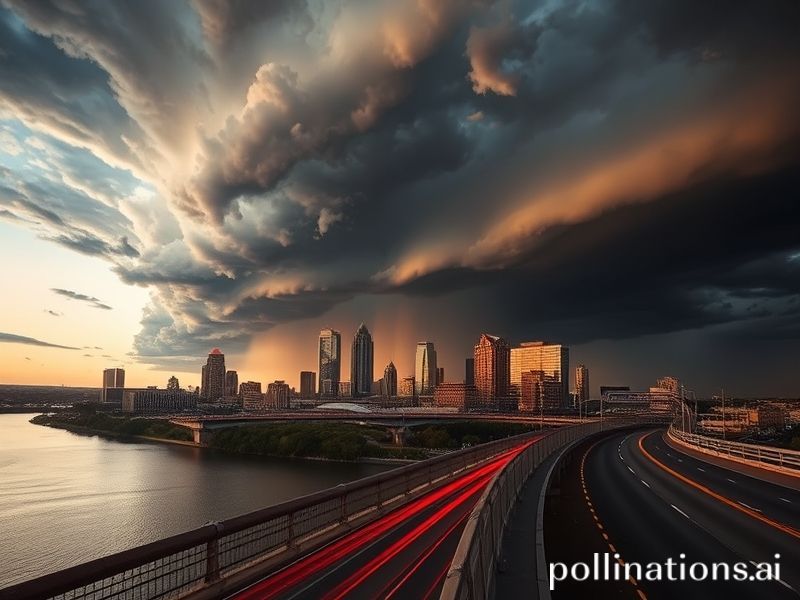
It is 104°F (40°C for the metrically civilized) on South Congress and the air smells of brisket, sunscreen, and lightly sautéed ambition. Tourists queue for overpriced breakfast tacos while their phones flash red weather alerts in six languages, a polyglot panic that would make the United Nations blush. To the rest of the planet—currently busy with floods in Pakistan, permafrost cosplaying as soup in Siberia, and Europe rediscovering coal like an ex who suddenly looks attractive—Austin’s misery might appear provincial. Yet this sweaty little dot on the Colorado River is the planet’s newest mood ring: what happens here no longer stays here, it just gets repackaged as content.
Consider the supply chain, that fragile house of cards we all pretended was solid until 2020. When Austin’s power grid buckles under the deluxe combo of heat dome, crypto-mining server farms, and air-conditioners running at evangelistic intensity, chip plants in South Korea wince. Samsung’s new $17 billion facility on the city’s outskirts is designed to print nanoscale miracles, not endure rolling blackouts ordered by a grid operator whose emergency playbook still references floppy disks. Each 15-minute outage in the Lone Star State translates into a two-week delay for the graphics card that a Berlin gamer needs to ignore the outside world. The planet runs on just-in-time logistics; Texas runs on just-hold-my-beer improvisation. Somewhere, a logistics algorithm quietly weeps into a spreadsheet.
Meanwhile, Europe watches Austin the way one studies a crystal ball made of sweat. The Continent spent last winter rationing kilowatts like wartime butter; now they see Texans arguing on Twitter about whether 78°F is an acceptable thermostat setting or a Marxist plot. In Madrid, utility executives screen-print ERCOT memes onto PowerPoints titled “Scenarios We Must Avoid.” French engineers have started measuring heat stress not in Celsius but in “Austins”—one Austin equals the moment when asphalt becomes a theological concept. By this metric, Paris hit 0.7 Austins last July and immediately scheduled another conference nobody will follow through on.
The global insurance industry, that cheerful vampire squid, has also taken note. Reinsurers in Zurich now price Texan heatwaves the way Lloyd’s once priced Barbary pirates. Premiums on semiconductor fabs have tripled, which means your next smartphone will cost slightly more than a weekend in Gstaad. Analysts at Swiss Re calculate that if Austin records five consecutive days above 105°F, the knock-on claims will exceed Iceland’s GDP. Iceland, a nation that keeps its cool by simply being Iceland, finds this darkly hilarious.
Back on the ground, locals cope with the same entrepreneurial fervor they once reserved for food trucks. Bars sell “heat-tax” margaritas—$2 surcharge earmarked for bartender electrolyte therapy—while ride-share drivers offer “sauna” discounts: sit in the back, windows up, no A/C, save five bucks. A startup is beta-testing sweat-powered phone chargers; the pitch deck claims each jog to Barton Springs can top up an iPhone to 12 percent, or one doom-scroll through Instagram climate threads, whichever comes first. Venture capitalists, themselves marinated in optimism and chilled Sauvignon Blanc, nod approvingly. Somewhere, a polar bear files the paperwork for trademark infringement.
And yet, amid the gallows humor, a broader significance emerges. Austin’s weather is no longer meteorology; it is geopolitics in shorts and flip-flops. When the city council debates whether to mandate cool roofs or merely suggest them politely, diplomats in New Delhi take notes—because if Texas can’t keep the lights on, what hope for Uttar Pradesh? The heatwave is a pop quiz administered by a planet growing tired of excuses. The world is watching to see if a city that put a man on the moon via Houston can keep its own citizens from melting into artisanal puddles.
Conclusion: In the end, Austin’s weather is the latest installment in humanity’s longest-running tragicomedy: the one where we innovate brilliantly right up to the moment we need air-conditioning to survive our own success. The punchline, delivered in 112-degree heat, is that we’re all in this together—whether we measure the temperature in Fahrenheit, Celsius, or sheer existential dread.