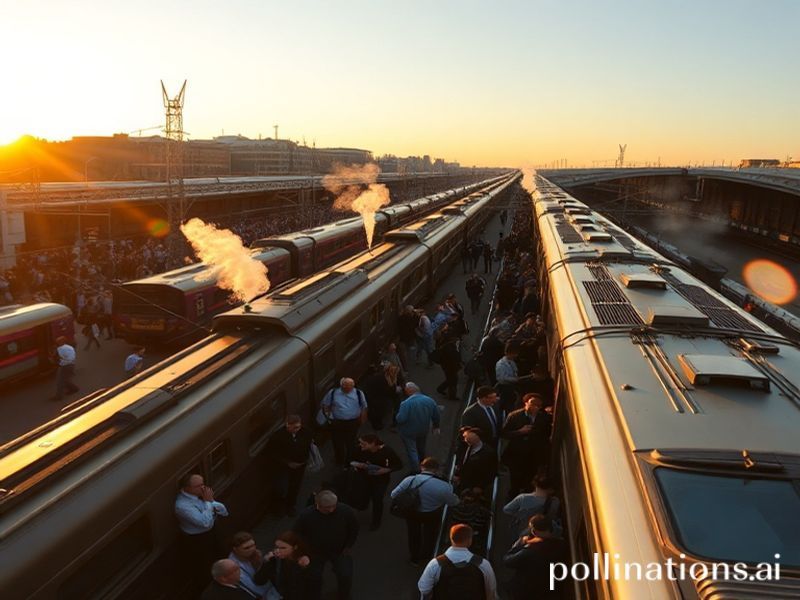
All Aboard the Hype Train: Why National Rail is the New Global Obsession
**All Aboard the Hype Train: Why National Rail is the New Global Obsession**
Buckle up, folks, because we’re about to dive into a topic that’s gaining traction faster than a runaway train—pun very much intended. National rail systems are suddenly the talk of the town, or should we say, the talk of the globe. From the UK’s never-ending Brexit-induced rail woes to India’s ambitious high-speed rail projects, and even the U.S.’s tentative steps towards a green new deal that includes rail, it seems everyone’s got their eyes on the tracks.
**Why the Sudden Fascination?**
First off, let’s address the elephant in the room—or rather, the elephant on the tracks. Climate change is no joke, and as countries scramble to meet their carbon emission targets, rail travel is looking pretty darn attractive. Trains are like the eco-warrior of transportation: efficient, low-emission, and capable of moving masses of people without choking the atmosphere. It’s no wonder that as the world wakes up to the climate crisis, national rail systems are suddenly the belle of the ball.
But it’s not just about saving the planet. Rail travel is also about saving time and sanity. Anyone who’s ever sat in bumper-to-bumper traffic or endured a soul-crushing flight delay knows that sometimes, the journey is half the misery. Trains, on the other hand, offer a chance to stretch your legs, enjoy the scenery, and maybe even grab a decent cup of coffee. In an era where time is money and stress is the enemy, the humble train is suddenly looking pretty swish.
**Cultural Context: The Rail Renaissance**
Let’s not forget the cultural significance of rail travel. Trains have long been a symbol of progress, adventure, and romance. From the Trans-Siberian Railway to the Orient Express, trains have inspired countless stories, songs, and dreams. In an increasingly digital world, there’s something undeniably nostalgic and romantic about hopping on a train and chugging off into the sunset.
Moreover, national rail systems are a reflection of a country’s identity and aspirations. A well-functioning rail network can boost national pride and foster a sense of unity. It’s no coincidence that countries like Japan and France, with their sleek, efficient rail systems, are often held up as examples of modernity and progress.
**Social Impact: Connecting Communities**
But perhaps the most significant impact of national rail systems is their ability to connect communities. In an age of increasing urbanization, trains offer a lifeline to rural and remote areas, providing access to jobs, education, and healthcare. They also facilitate cultural exchange, allowing people from different backgrounds to mix and mingle in a way that’s simply not possible in a car or on a plane.
**The Challenges Ahead**
Of course, it’s not all smooth sailing—or should we say, smooth rail-ing. Building and maintaining a national rail system is a monumental task, requiring significant investment, political will, and public support. There are also issues of safety, efficiency, and accessibility to consider. But as the global trend towards rail travel shows, these challenges are not insurmountable.
**Conclusion: All Aboard!**
So, why is national rail trending globally? Because it’s a win-win-win: good for the planet, good for the people, and good for the economy. It’s a chance to reconnect with our past while embracing the future. It’s a chance to reduce our carbon footprint while increasing our quality of life. And in a world that’s increasingly divided, it’s a chance to bring us together.
So, let’s hop on board and embrace the rail renaissance. After all, as the saying goes, “Get your kicks on Route 66.” But maybe it’s time to update that to, “Get your kicks on the high-speed rail.”
—