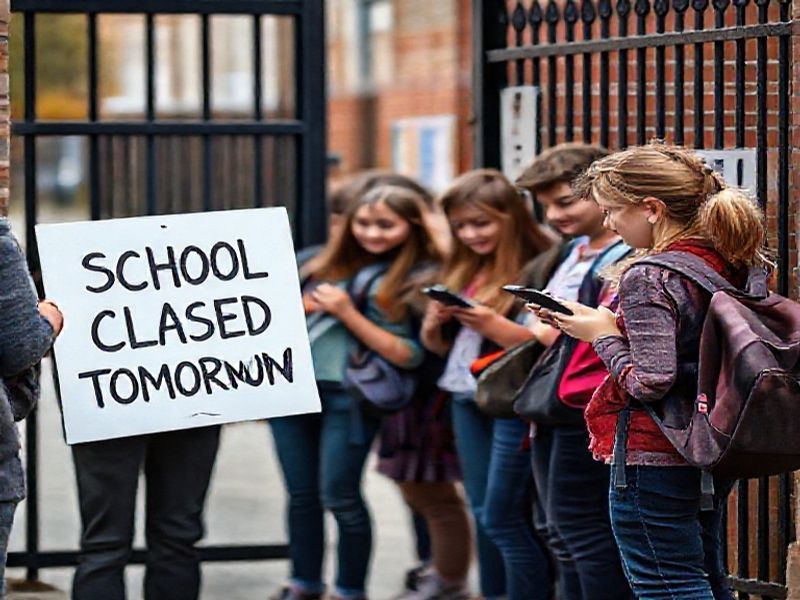
Why ‘Schools Closed Tomorrow’ is the Ultimate Global Meme: A Celebration of Collective Joy
### **When the Bell Tolls: Why “Schools Closed Tomorrow” is the Ultimate Global Meme**
Ah, the sweet, sweet sound of a snow day announcement—or any unexpected school closure. It’s the kind of news that sends students into a frenzy of joy, parents into a panic of last-minute childcare, and teachers into a quiet, satisfied sigh of relief. But why is the phrase “schools closed tomorrow” trending globally? Let’s dive into the cultural phenomenon that turns a simple announcement into internet gold.
#### **The Universal Joy of a Day Off**
First, let’s acknowledge the universal truth: no one, and we mean *no one*, dislikes an unplanned day off. Whether it’s due to snow, extreme heat, a global pandemic, or even a mysterious “facility issue,” the announcement of a school closure is met with collective euphoria. Social media erupts with memes, celebratory posts, and the inevitable flood of “Why can’t every day be like this?” comments. It’s a rare moment of unity across borders, languages, and time zones—because let’s face it, school is hard, and everyone deserves a break.
#### **The Power of Social Media**
In the age of instant gratification, social media has turned school closures into a viral sensation. Platforms like Twitter, TikTok, and Instagram are flooded with posts as soon as the news breaks. Hashtags like #SchoolsClosedTomorrow and #NoSchoolFriday become trending topics, with users sharing their excitement, memes, and even their plans for the day (spoiler: it usually involves sleeping in and binge-watching Netflix). The viral nature of these posts amplifies the excitement, making the announcement feel like a global event rather than a local one.
#### **Cultural Context: A Global Phenomenon**
While the reasons for school closures vary—snow days in the U.S., heatwaves in Australia, or even political unrest in some regions—the reaction is universally the same. In countries where education systems are rigorous and high-pressure, the announcement of a school closure is met with even greater relief. For example, in South Korea, where students often face intense academic pressure, a sudden school closure can feel like a small victory against the system. Meanwhile, in Scandinavia, where education is more relaxed, the announcement might be met with a collective shrug and a plan to go skiing.
#### **The Social Impact: A Brief Respite**
School closures, no matter the reason, offer a brief respite from the daily grind. For students, it’s a chance to catch up on sleep, hobbies, or even just to enjoy the freedom of not having to wake up early. For parents, it’s an opportunity to spend quality time with their kids—or, let’s be real, to finally tackle that pile of laundry that’s been mocking them from the corner of the room. And for teachers, it’s a rare moment to breathe, recharge, and maybe even enjoy a cup of coffee that isn’t microwaved.
#### **The Significance: A Symbol of Collective Relief**
At its core, the trend of “schools closed tomorrow” is a symbol of collective relief. It’s a reminder that, despite our differences, we all crave a break from the routine. It’s a moment of shared joy, a brief escape from the pressures of life, and a chance to appreciate the little things. And in a world that often feels chaotic and divided, that’s something worth celebrating.
So, the next time you see the announcement of a school closure, take a moment to appreciate the global phenomenon it represents. Whether it’s due to snow, heat, or a mysterious “facility issue,” it’s a reminder that sometimes, the best news is the news that school is canceled tomorrow.
—