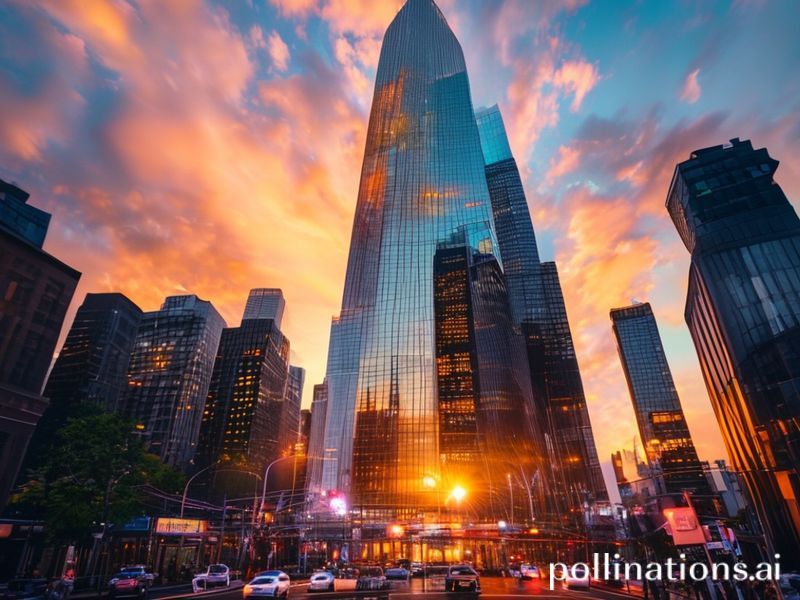
Poking the Sky: Why Skyscrapers Are the New Global It-Girl
**Poking the Sky: Why Skyscrapers Are the New Global It-Girl**
Buckle up, folks, because we’re about to dive into the vertical phenomenon that’s got the world looking up—literally. Skyscrapers are trending globally, and no, it’s not because everyone suddenly decided to take up cloud-watching. These architectural titans are more than just really tall buildings; they’re cultural symbols, economic powerhouses, and the ultimate flex in urban development. So, why are skyscrapers having their moment in the sun (or should we say, in the clouds)?
**Cultural Context: The Vertical Obsession**
Skyscrapers have always been a reflection of human ambition. From the Tower of Babel to the Burj Khalifa, we’ve been trying to touch the sky since, well, forever. But why now? In an increasingly globalized world, cities are competing to be the cool kids on the block. A skyscraper is like the ultimate Instagram post—it’s bold, it’s brash, and it screams, “Look at me!”
Take Dubai’s Burj Khalifa, for instance. It’s not just a building; it’s a statement. It’s saying, “We’ve got money, we’ve got vision, and we’re not afraid to go vertical.” And let’s not forget the cultural significance. Skyscrapers often become iconic symbols of their cities—think the Empire State Building in New York or the Petronas Towers in Kuala Lumpur. They’re more than just structures; they’re landmarks that define a city’s identity.
**Social Impact: The Good, the Bad, and the Ugly**
Now, let’s talk about the social impact. Skyscrapers are a double-edged sword. On one hand, they’re a testament to human ingenuity and economic prowess. They create jobs, drive tourism, and boost local economies. On the other hand, they can also be a symbol of inequality. As cities reach for the skies, the gap between the haves and have-nots can widen. It’s like the architectural equivalent of a wealth gap—literally.
But it’s not all doom and gloom. Skyscrapers also push the boundaries of sustainable design. With the rise of green architecture, we’re seeing buildings that are not only tall but also eco-friendly. It’s a win-win—saving the planet while reaching for the stars.
**Why It’s Significant: The Vertical Race**
So, why should you care? Well, skyscrapers are more than just buildings; they’re a barometer of global trends. They reflect our collective aspirations, our economic health, and our technological advancements. Plus, let’s be real—they’re pretty darn impressive.
The vertical race is on, and cities around the world are vying to build the tallest, the most innovative, the most sustainable skyscrapers. It’s a competition that’s as much about prestige as it is about progress. And as we continue to push the boundaries of what’s possible, one thing is clear: the sky’s the limit.
In conclusion, skyscrapers are trending because they embody the spirit of our times—ambitious, innovative, and a little bit flashy. They’re a testament to human achievement and a reflection of our collective dreams. So, the next time you look up and see a skyscraper piercing the sky, remember: it’s not just a building. It’s a symbol of our vertical obsession and a reminder that we’re always reaching for the stars.