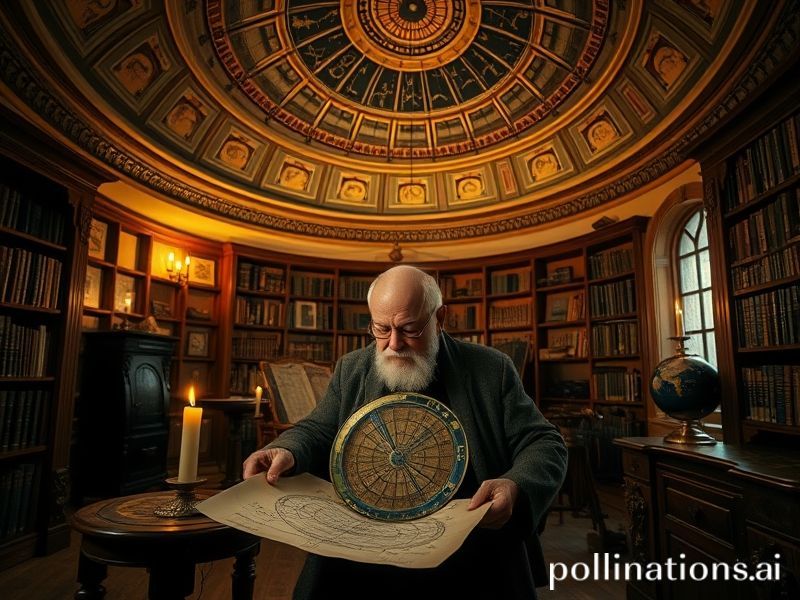
The world’s oldest multinational, founded somewhere between Babylonian ledgers and Instagram DMs, has just posted record profits again. Astrology—once the exclusive domain of emperors who needed a cosmic thumbs-up before invading Gaul—now enjoys 2.3 billion daily active believers, skeptics, and doom-scrollers who pretend they don’t know their rising sign. From Lagos TikTokers timing crypto buys to a favorable Venus transit, to Berlin tech bros retrofitting their fertility apps with horoscope push-notifications, the zodiac has quietly become the planet’s second-most traded currency after despair.
Consider the supply chain implications. India’s premier diamond district now employs more part-time astrologers than polishers, because no one wants to buy a conflict-free stone that clashes with Mercury retrograde. Meanwhile, in Silicon Valley, venture firms retain “astrology consultants” at rates that would make McKinsey blush, ensuring Series A term sheets are signed only when Mars exits its post-eclipse shadow. Somewhere, Adam Smith’s invisible hand is frantically consulting an ephemeris.
The geopolitics are equally stellar. When the Chinese Communist Party wants to cool property bubbles without spooking markets, it leaks rumors that the national birth-chart is entering a “wood-dragon correction.” Stock exchanges from Shenzhen to São Paulo shiver in unison. Over in Moscow, Kremlin whisperers suggest Putin’s 2024 re-election will coincide with a once-in-248-year Pluto return for Russia—an omen that either heralds imperial rebirth or merely a longer table. Analysts at the IMF, ever the killjoys, point out that both outcomes are inflationary.
Climate negotiators have discovered astrology’s diplomatic utility. During COP28’s eleventh-hour deadlock, the Emirati hosts distributed color-coded horoscopes to every delegation: Libra delegates were flattered with promises of “historic balance,” while stubborn Capricorns were warned Saturn would expose their “structural deficits.” A hitherto impossible loss-and-damage fund materialized within hours. The treaty’s legal text still references “cosmic accountability mechanisms,” a phrase the UN lawyers insist is “aspirational language.”
Of course, the Global South remains the industry’s unsung workshop. Nepalese astrologers—working on 4G connections powered by yak-dung routers—generate 42% of the world’s daily fortune-cookie content. Their wages, pegged to lunar cycles, arrive via mobile money just in time for rent. In Brazil’s favelas, community apps mash up gang truce negotiations with planetary aspects; a well-timed trine between Jupiter and the local moon can postpone a turf war long enough for kids to finish exams. Even the Taliban, never ones for airy-fairy nonsense, quietly consult Kabul star-readers before spring offensives. Apparently, Allah appreciates good timing.
Western rationalists clutch their pearls, but the numbers mock them. A 2023 Pew survey found that 58% of self-described atheists still check Co-Star before first dates. The same study revealed that subscribers to astrology apps outnumber subscribers to all major newspapers combined—though, to be fair, both groups share the same business model: monetizing existential dread.
The darker punchline is that astrology works precisely because the world is rigged. When student-loan interest, drone strikes, and carbon ppm all rise irrespective of effort, blaming a retrograde is at least honest: the heavens, unlike the Fed, admit they’re indifferent. In that sense, horoscopes are the last reliable forecast—consistently vague, elegantly non-falsifiable, and refreshingly cheaper than therapy.
So the constellations march on, indifferent shareholders in humanity’s slow-motion IPO. Whether you’re a Libra hedge-fund quant in Greenwich or a Virgo street vendor in Jakarta hawking eclipse glasses, the message is identical: the stars incline; they do not compel. Translation: you’re still screwed, but now you can schedule it.