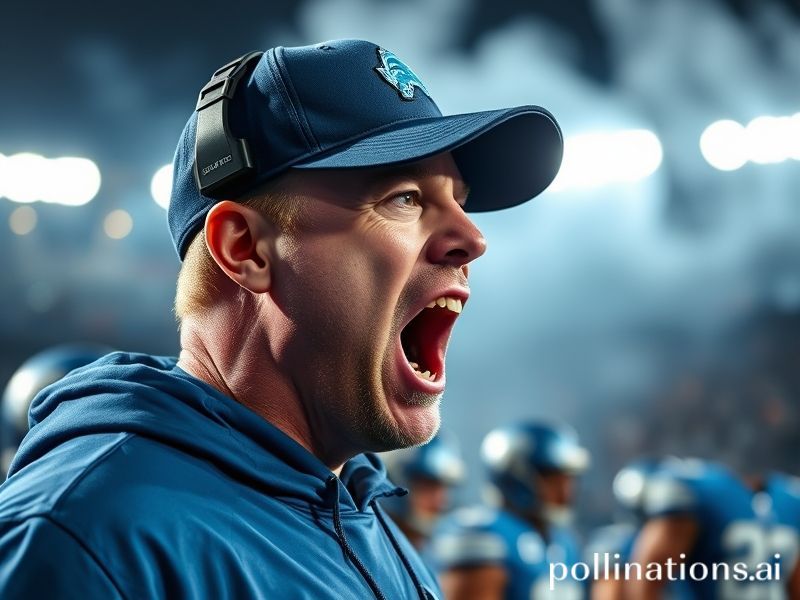
When the Detroit Lions finally clawed their way to a playoff win after 32 years, the man they hoisted like a victorious warlord was Dan Campbell—former third-string tight end, Texan carnivore, and living embodiment of the phrase “run through a wall for this guy.” To the rest of the planet, a Midwestern American football coach might seem as globally relevant as competitive corn husking, yet Campbell’s rise is a perfectly timed parable for our era: a moment when the world’s traditional superpowers are sputtering, and people everywhere are desperate for any leader who can convincingly fake optimism.
Across the Atlantic, Europeans who once mocked the NFL as “rugby for people who need a nap” now binge YouTube clips of Campbell’s locker-room sermons. Why? Because the Continent’s own would-be emperors—Macron with his pension arithmetic, Scholz with his mysteriously disappearing climate goals—keep delivering spreadsheets instead of fire. Campbell, meanwhile, offers pure serotonin: a 47-year-old man screaming about biting kneecaps, tears streaming, veins bulging like Eurozone debt. In a year when Germany officially entered recession and the UK discovered it had accidentally sold its last working power station for NFTs, the spectacle of a coach promising to “burn the boats” feels almost Roman. Bread, circuses, and a two-point conversion.
Asia watches with equal parts fascination and confusion. Chinese social media platform Weibo translates Campbell’s sound bites into Mandarin, where “We’ll tread water as long as it takes” becomes a motivational hashtag for overworked tech employees who already tread water 14 hours a day. In South Korea, K-pop managers study Campbell’s “team culture” seminars the way Jesuits once studied Latin: a foreign language that might unlock the secret to group cohesion—and, more importantly, merchandise sales. Even the Japanese, who perfected the art of stoic suffering centuries ago, find themselves oddly moved by a man who openly weeps when his kicker makes a 54-yard field goal. Samurai stoicism is fine; Texan catharsis sells T-shirts.
Down in Latin America, where whole economies rise and fall on the price of soybeans and the mood swings of the Fed, Campbell’s populist flair lands like a norteamericano telenovela. Argentinian talk-radio hosts compare him to a young Maradona, if Maradona had eaten the entire opposing team. Brazilian influencers splice his speeches over baile funk beats; the refrain “We’re built for this!” becomes a rallying cry in Rio’s favelas, where residents are indeed built for power outages, police raids, and the occasional plague. The irony is thicker than chimichurri: the same Global North that spent two centuries exporting imperialism is now exporting motivational bumper-sticker slogans back to the Global South. Progress, sort of.
The Middle East, meanwhile, sees Campbell as a geopolitical Rorschach test. Gulf-state sovereign wealth funds, bored with soccer and increasingly skeptical of European soccer coaches who keep losing to farmers on weekends, quietly ask U.S. intermediaries whether Campbell might consider a $50 million guest stint in a dome where it’s 120°F and the only running game is escaping air-conditioning bills. Israeli podcasters debate whether Campbell’s hyper-aggressive fourth-down philosophy could be adapted to regional negotiations. Spoiler: it cannot.
All of this circus raises the question: why does a man whose playbook contains roughly 17 offensive concepts captivate a planet wrestling with AI displacement, climate collapse, and the return of great-power war? Simple. Campbell provides what every other institution has exhausted: the illusion of control. While central banks pivot like drunken ballerinas and militaries pivot like drunken central bankers, the Lions line up and run the same power play until it works—or until the universe collapses into heat death, whichever comes first. The joke, of course, is that Detroit still may not win the Super Bowl. But in 2024, the bar for global leadership has been lowered to “looks like he gives a damn.” By that metric, Dan Campbell is already emperor of a world that badly needs new myths—even ones spoken with a drawl and delivered through tears and dip spit.