Paddy Pimblett and the Global Gladiator Economy
By Dave’s Locker International Desk
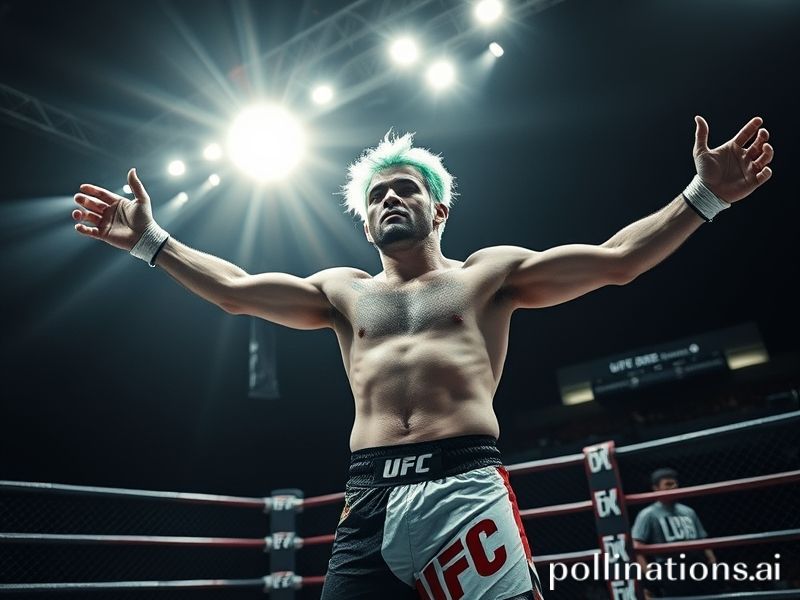
Liverpool’s own Paddy “The Baddy” Pimblett, a man whose hairline looks like it’s been negotiating Brexit since 2016, walked into the Octagon last Saturday night and did what the World Bank, the IMF, and three successive U.S. administrations have failed to do: he briefly made everyone forget about inflation. From a sticky-floored sports bar in Lagos to a rooftop in São Paulo, millions stared at screens, transfixed by a scouser in green shorts who fights like he’s still trying to collect a bar tab in Toxteth. For twelve minutes and thirty-seven seconds, the planet’s anxieties—climate, debt ceilings, the inevitability of another Elon tweet—were replaced by a single Englishman attempting to persuade gravity to look the other way.
The UFC has always sold violence as universal language, but Pimblett is the first dialect that actually translates. In Manila, jeepney drivers replay his spinning elbow on cracked phones. In Dubai, finance bros in thawbs debate whether his guillotine choke could subdue a soft-currency crisis. Even the French have granted him a grudging shrug, which is basically a standing ovation anywhere else. The appeal is partly technical—he scrambles like a cat in a washing machine—but mostly anthropological. Pimblett is the living embodiment of the global working class: underpaid, overexposed, and weirdly hopeful that if he just keeps swinging, the algorithms might finally tip in his favor.
Consider the economics. Pimblett’s disclosed purse for his last outing was a modest $100,000, less than the annual coffee budget of a mid-level Goldman Sachs intern. Yet his post-fight bonus buys him something the intern will never purchase: narrative equity. Within minutes, crypto exchanges from Malta to Montevideo were listing “BaddyCoin,” a speculative token whose white paper is literally a GIF of Pimblett eating a pizza. El Salvador’s president—never one to miss a populist bandwagon—tweeted a doctored image of himself in Pimblett’s green shorts, captioned “Making Bitcoin fight.” The currency dipped 3%. No one was surprised.
Meanwhile, China’s state broadcaster cut away from the bout the moment Pimblett’s cauliflower ear began leaking like a faulty Huawei battery. Censors cited “excessive barbarism,” which is Mandarin for “we can’t monetize the merch.” Instead, viewers were treated to a looping montage of pandas practicing tai chi. The irony wasn’t lost on the 1.4 billion citizens who’ve just been told to prepare for a “frugal New Year.” Somewhere in Beijing, a mid-ranking official Googled “how to grow cauliflower ear” and immediately regretted it.
Back in the West, legacy media wrestled with how to classify Pimblett. The BBC called him “a working-class hero,” which is what the BBC calls anyone north of Watford with a gym membership. CNN opted for “global influencer,” a phrase that used to require a UN passport but now apparently just needs 2.3 million Instagram followers and a catchphrase spelled incorrectly. Fox News, meanwhile, invited him to discuss fiscal responsibility, a move roughly equivalent to asking a tornado for landscaping tips. Pimblett politely declined, citing “a prior commitment to carbohydrates.”
The broader significance, if we must pretend there is one, is that Pimblett has become a Rorschach test for late-stage capitalism. To the British tabloids, he’s proof the empire still exports something tougher than queuing. To Silicon Valley, he’s a case study in micro-celebrity monetization. To Qatar, he’s a cautionary tale about what happens when you let people drink beer before noon. And to the rest of us, he’s a reminder that in an age of drone strikes and data breaches, the oldest form of diplomacy—two humans agreeing to punch each other in the face till someone falls down—still has better ratings than the nightly news.
When the final horn sounded and Pimblett draped himself in a Liverpool flag that looked suspiciously like a repurposed IKEA bag, the world exhaled in unison. Somewhere in Kyiv, a soldier paused a livestream of incoming artillery to watch the replay. In Washington, a senator drafting sanctions on…well, someone…let the phone go to voicemail. And on a container ship idling off the coast of Los Angeles, a Filipino crew member updated his status: “Baddy wins. Cargo still stuck. Balance restored.”
The planet spun on, slightly lighter, slightly poorer, and marginally more entertained. Until the next pay-per-view, that is—because if history teaches us anything, it’s that peace never sells out the T-Mobile Arena.