2026 Lexus IS: A Luxury Sedan for the End Times (or at Least the Next Recession)
By Our Correspondent Somewhere between the Duty-Free and the Apocalypse
Let us begin with a universal truth: every nation believes its traffic is the worst. From Jakarta’s scooter tsunamis to Los Angeles’ parking-lot freeways, drivers worldwide cling to the steering wheel like it’s the last lifeboat off the Titanic. Into this global slow-motion evacuation slides the 2026 Lexus IS, an automobile that promises not to end gridlock, but to make it feel marginally less existential. Think of it as a panic room with cupholders.
First, the geopolitical context. Toyota’s luxury division timed the IS refresh for the exact moment when half the planet is banning internal-combustion engines and the other half is subsidizing them to own the libs, the greens, or whoever the local boogeyman happens to be. The result is a car that hedges harder than a Swiss bank: a turbo-4 for markets still addicted to dinosaur wine, a hybrid-6 for jurisdictions that prefer their emissions like their political scandals—well-hidden—and, for the truly optimistic, a battery-electric variant whose 300-mile range is perfectly adequate for escaping a collapsing city until you remember the chargers are all on the wrong side of the barricades.
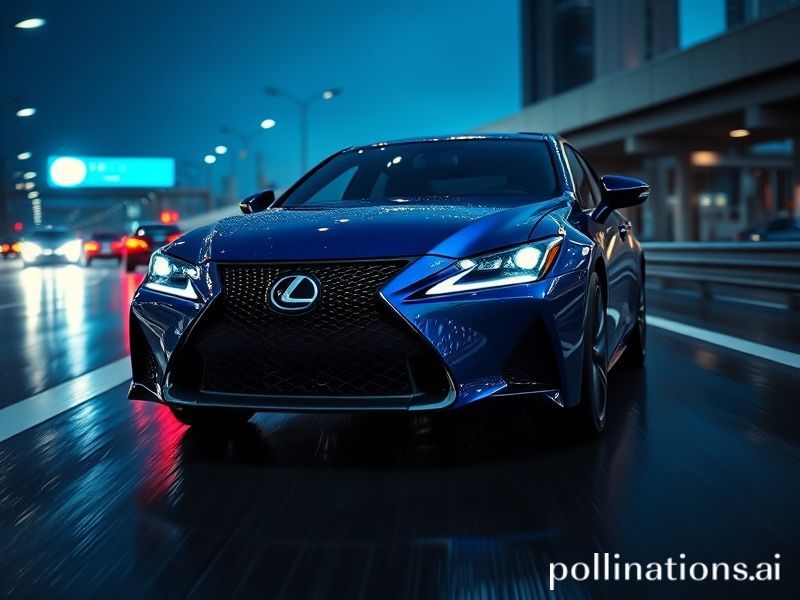
Design-wise, the spindle grille has grown so aggressive it now qualifies for NATO membership. Park one in front of any European café and watch pedestrians instinctively reach for their passports. Inside, Lexus has replaced every physical button with a touchscreen the size of Liechtenstein, because nothing soothes international tensions like taking your eyes off the road to hunt for the defroster icon. The ambient lighting can cycle through 64 colors, one for every failed climate summit.
Underneath the quilted leather lies a chassis tuned on the Nürburgring, that Teutonic temple of speed where manufacturers chase lap times the way hedge funds chase distressed currencies. The car corners flat, accelerates briskly, and rides with the composure of a Swiss diplomat—right up until you hit a pothole the size of a small Balkan republic, at which point the adaptive dampers surrender faster than a French general.
Global implications? Consider the supply chain. The lithium in the hybrid battery is mined in Chile, refined in China, assembled in Japan, and financed by a sovereign wealth fund in Norway—an international relay race where every runner is simultaneously suing the others for labor violations. The leather, meanwhile, is “ethically sourced,” a phrase that means whatever you need it to mean, like “strategic ambiguity” in defense treaties.
And yet, for all its planetary entanglements, the 2026 IS remains a profoundly personal cocoon. The seats massage you in 17 different ways, which is 16 more than most governments manage. The 17-speaker Mark Levinson stereo can drown out both the climate crisis and your conscience. Over-the-air updates ensure the infotainment never goes obsolete, unlike the economic system that allowed you to afford it.
Sales projections are bullish in markets where conspicuous understatement still passes for taste: think Zurich asset managers, Seoul crypto barons, and Toronto real-estate dynasts who list “philanthropist” on LinkedIn. In the United States, it will compete against the BMW 3-Series and the Mercedes C-Class in that eternal struggle to see which badge best distracts from the driver’s encroaching mortality. In China, the IS will be cross-shopped with Nio, BYD, and whatever new marque a provincial billionaire has conjured up this week. In India, it will be bought by exactly three people and photographed by everyone else.
One cannot ignore the elephant—or perhaps the endangered rhino—in the room. The 2026 IS arrives at a time when the very concept of private car ownership is being re-litigated by city planners, environmental courts, and an entire generation that views a driver’s license the way their grandparents viewed polio: a relic of a crueler age. Lexus’s answer is to make the relic so alluring you’ll gladly sign up for another decade of payments, climate be damned. It’s the automotive equivalent of lighting a Cuban cigar with a burning stock certificate: decadent, slightly nihilistic, but oh-so-satisfying.
So, should you buy one? If you still believe borders will remain open long enough to take delivery, why not. The 2026 Lexus IS won’t save the world, but it will cushion the fall—at least until the repo man learns to hot-wire biometric ignition. Until then, enjoy the heated armrests. They’re the warmest thing most of us will feel this side of global upheaval.