Earth to Athens: When the Cradle of Civilization Rocks and Rolls
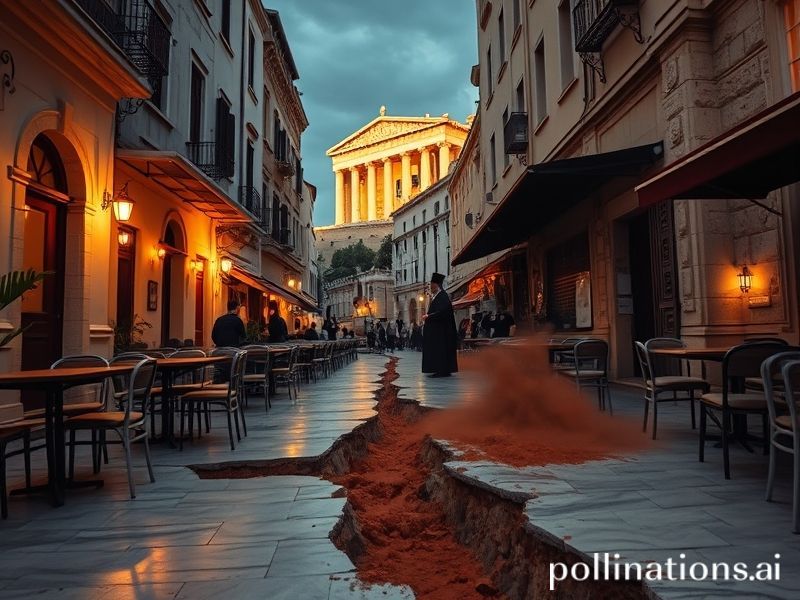
The earth moved in Athens this week, and for once it wasn’t because of another austerity protest. A 5.2 magnitude earthquake rattled Greece’s capital, sending residents fleeing into the streets and reminding everyone that while democracy may have been born here, Mother Nature remains the ultimate autocrat.
The quake struck at 2:38 AM local time—because even seismic events have a flair for dramatic timing—jolting millions awake and providing a free, if unwanted, early morning workout. The epicenter lay 22 kilometers northwest of Athens, near the town of Magoula, proving that even sleepy suburbs can achieve international fame through the universal language of tectonic violence.
Greek authorities, displaying the kind of optimism that only comes from dealing with economic collapse and refugee crises simultaneously, quickly declared “no serious injuries.” This assessment, while technically accurate, somewhat overlooks the psychological trauma of watching your collection of ancient Greek pottery pirouette off its display shelf. The Acropolis, that eternal symbol of human achievement, remained steadfast—a 2,500-year-old monument outlasting modern buildings, which is either a testament to classical engineering or an indictment of contemporary construction standards.
The international response followed the familiar choreography of modern disaster theater. Italy, still recovering from its own recent earthquake dramas, offered assistance with the knowing solidarity of someone who’s been there. Turkey, Greece’s occasional frenemy across the Aegean, extended helping hands—a diplomatic gesture that probably required less effort than their usual territorial disputes. The European Union’s emergency response team, presumably fresh from dealing with Brexit-induced continental drift, stood at the ready.
But this tremor reverberates beyond its immediate impact. Greece sits at the confluence of the African and Eurasian tectonic plates, making it essentially the geological equivalent of a fault-line family reunion. The country experiences about 100 earthquakes daily, though most are too gentle to interrupt anyone’s afternoon frappe. This particular quake serves as a reminder that the Mediterranean, for all its sun-soaked tourism brochures, remains one of the world’s most seismically active regions.
The timing proves exquisitely ironic. As Greece struggles beneath the weight of economic pressures, refugee influxes, and the general indignities of 21st-century European politics, the earth itself decided to literally shake things up. It’s as if the planet, tired of watching Greece bear the brunt of humanity’s various crises, decided to administer its own form of stress testing. The gods of Olympus, presumably, are having a good laugh.
For the international community, Athens’ earthquake offers a convenient metaphor for our collective precariousness. If the cradle of Western civilization can be rattled by forces beyond its control, what hope for the rest of us? Climate change, pandemics, economic inequality—our modern afflictions make plate tectonics seem almost refreshingly straightforward. At least earthquakes don’t require parliamentary approval or international summits.
The broader significance lies not in the damage done, but in the reminder delivered. We build our cities, erect our monuments, and conduct our affairs with the confident assumption that the ground beneath our feet will remain, well, beneath our feet. Athens’ early morning wake-up call suggests otherwise. In an era when human civilization seems intent on self-destruction, it’s almost quaint when nature joins the party with such classical simplicity.
As Athens returns to its usual concerns—tourism, economics, and the eternal question of whether to have another coffee—the earth continues its slow, indifferent grind. The city will rebuild, tourists will return, and life will resume its familiar rhythms. Until next time, when the planet decides to remind us that every paradise comes with a price, and sometimes that price is paid in tectonic currency.