Kinshasa and Dakar are not, to the casual eye, obvious rivals. One is a humid sprawl of eight million souls perched on the Congo River, where traffic lights are decorative suggestions and power cuts arrive with Swiss punctuality. The other is a breezy Atlantic capital where the ocean smells of fish, hip-hop, and the faint whiff of French tax euros still being laundered into beachside condos. Yet when the Democratic Republic of Congo and Senegal square off—on a football pitch, at an IMF board meeting, or simply in the global imagination—the encounter is less a match than a morality play with lounge music and mineral royalties.
Let us begin, as all modern tragedies do, with resources. The DRC could pave the moon with cobalt and still have enough coltan left to make every smartphone in the world vibrate simultaneously. Senegal, meanwhile, has phosphate, peanuts, and a newly discovered puddle of offshore gas that European diplomats now describe in the hushed tones usually reserved for teenage poets. When European Commission President von der Leyen drops by Dakar, she smiles the smile of a woman who has just secured another decade of slightly-less-Russian LNG. When she lands in Kinshasa, she wears the pained expression of a dentist about to drill without anesthetic. The difference is subtle but visible to connoisseurs of neo-colonial body language.
On the geopolitical chessboard, Senegal plays the role of the reliable subcontractor: stable currency, French air base, and a president who can quote both Nietzsche and the Nasdaq. The Congolese state, by contrast, behaves like a baroque opera house on fire—dramatic, multilingual, and structurally unsound. Western embassies in Kinshasa keep evacuation drills on the calendar like yoga classes; in Dakar they debate whether to serve petits fours or spring rolls at the next climate-finance reception. Both capitals understand that the question is never whether foreign powers will interfere, only which timezone the Zoom call will use.
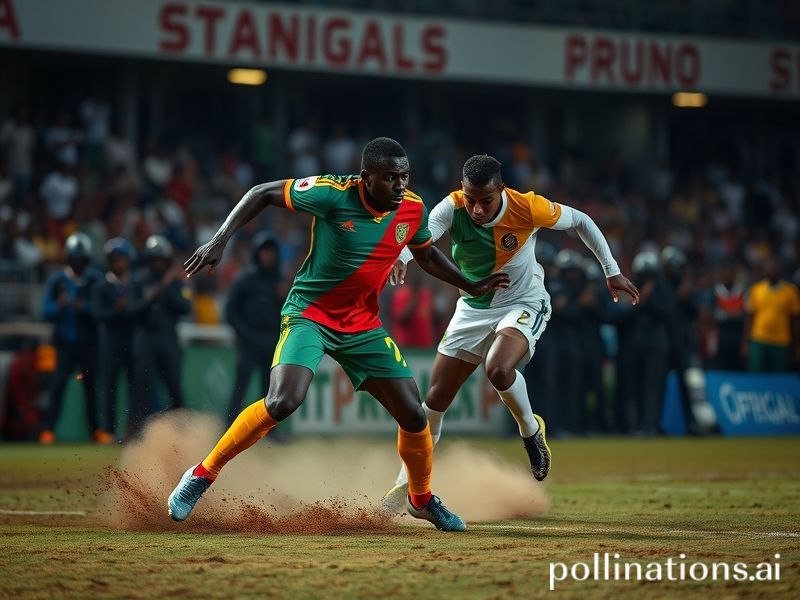
The football pitch, mercifully, strips all this down to twenty-two legs and a single ball. When DR Congo’s Leopards face Senegal’s Lions of Teranga, the match is broadcast from Lagos to La Paz because nothing says “universal human values” quite like unpaid African athletes generating ad revenue for European beer brands. Senegalese fans arrive draped in couture flags; Congolese supporters bring drums carved from timber that probably violated three environmental treaties. If Senegal wins, Dakar’s nightclubs throb until the muezzins give up. If Congo wins, Kinshasa’s power grid courteously collapses so no one can watch the victory speeches.
Yet beyond the spectacle lies a more sobering symmetry. Both countries are young—median age under twenty—and both are governed by men old enough to remember when “the cloud” referred only to weather. Dakar’s shiny new commuter train glides past slums whose residents will never afford a ticket; Kinshasa’s Chinese-built elevated boulevard ends abruptly in a swamp, like a sentence interrupted by bureaucracy. In each capital, the future is being mortgaged for present applause, and the compounding interest is denominated in restless teenagers with TikTok accounts.
The world, naturally, watches with the detachment of a man scrolling through other people’s vacation photos. Western investors hedge their bets by buying Senegalese Eurobonds and Congolese cobalt futures in the same afternoon. Gulf sovereign wealth funds tour both capitals in air-conditioned motorcades, quietly wondering whether Islam or infrastructure offers the better ROI. Meanwhile, the same global press that yawned through decades of carnage in eastern Congo will dispatch correspondents to Dakar the moment a single ballot box wobbles.
In the end, DR Congo vs Senegal is less a contest than a mirror. One side reflects the resource curse in its purest, most operatic form; the other shows how a modest endowment can still be leveraged into polite international applause. Both are playing a game rigged long before the whistle blew, and both know the score only matters until the next coup, commodity shock, or Instagram filter. If there is a punchline, it is that the rest of us keep watching—half horrified, half entertained—because the alternative is admitting we’re complicit. And that, dear reader, would ruin the halftime show.