Blake Cashman and the Geopolitics of a Tackle
By our man in the cheap seats, watching empires collapse between downs
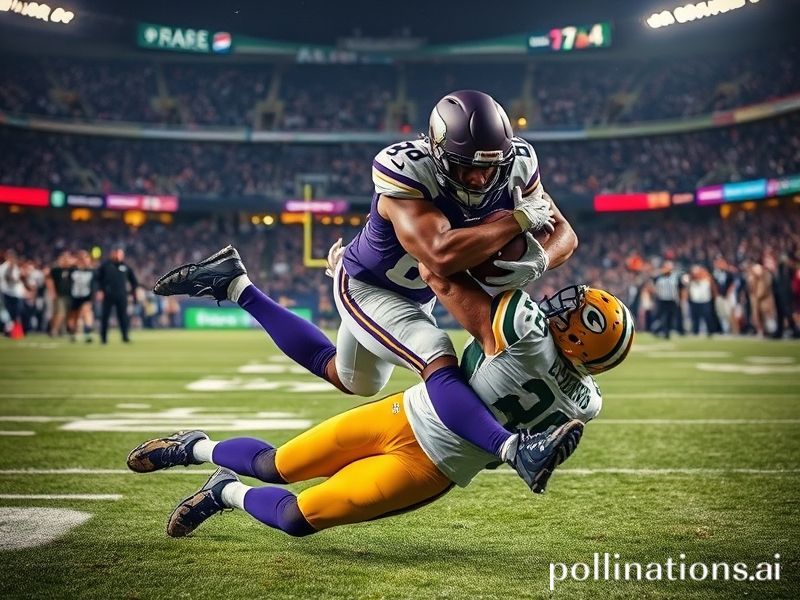
Houston—While diplomats in Vienna argue over the exact placement of commas in a nuclear treaty, 6’1″, 235-pound Blake Cashman was busy rerouting the AFC South hierarchy with nothing more than a helmet and the sort of cheerful disregard for personal safety usually reserved for base jumpers or cryptocurrency investors. The Texans’ linebacker—formerly a Minnesota Viking, formerly a New York Jet, formerly a fifth-round afterthought—recorded 18 tackles last Sunday, a franchise record that also doubled as a quiet reminder that the global order is held together by people most conference rooms couldn’t pick out of a police lineup.
Internationally speaking, Cashman’s performance matters for three reasons, none of which appear on the stat sheet. First, the NFL’s foreign broadcast rights are a $5-billion annual export, eclipsing the GDP of Fiji and confirming that the United States’ most reliable trade balance is violence wrapped in spandex. Second, every extra tackle keeps Houston’s playoff hopes alive, which keeps jersey factories in Honduras humming, which keeps container ships steaming through the Panama Canal, which keeps Chinese banks interested in the long-term viability of American spectacle. And third—most darkly amusing—Cashman’s sudden relevance is a living rebuttal to every European think-tank paper that claims the U.S. is incapable of upward mobility.
Consider the optics: a kid from Eden Prairie, Minnesota, population 64,000, slightly smaller than Reykjavik but with worse weather, becomes—overnight—the most productive human in a multibillion-dollar supply chain that stretches from Nike sweatshops in Vietnam to gambling apps licensed in Malta. If that isn’t globalization in shoulder pads, what is? One can almost picture a Bavarian efficiency expert watching the film and sighing, “Ach, so this is how you redistribute opportunity without raising taxes.”
Cashman’s ascent also offers a bleak little parable about timing. In a year when the World Bank warns of synchronous global slowdown, when the yen is staging a kamikaze dive, and when even Swiss banks are discovering that “neutral” is just another word for “complicit,” the one commodity appreciating faster than enriched uranium is competent linebacker play. Analysts who last month argued over whether the planet could survive without Russian gas are now arguing over whether the Texans can survive without a man whose college scouting report included the phrase “high-motor, marginal instincts.” Somewhere, Henry Kissinger is Googling “wide-9 technique” and wondering where it all went wrong.
There is, of course, the obligatory human-interest angle: Cashman overcame two season-ending surgeries and the bureaucratic indifference of two franchises that treated him like a printer cartridge—useful until empty, then tossed into the recycling bin of free agency. His perseverance is heartwarming, the broadcasters tell us, a testament to grit. Cynics might note that grit is what the gig economy calls health insurance, but let’s not spoil the narrative. Every civilization needs its myths; the Romans had Horatius at the bridge, we’ve got a special-teamer who can bench-press a small Fiat.
The broader significance? In an era when nations weaponize microchips and wheat futures, the ability to bring down a 230-pound running back becomes a cultural aircraft carrier. Each tackle projects stability, broadcasts dominance, reassures allies that the empire still produces citizens who can chase down fleeing objectives—literal ones, not the metaphorical kind that keeps escaping the UN Security Council. Should the Texans sneak into the postseason, expect the State Department to cite “increased American optimism” in some backgrounder, quietly omitting that optimism wears a tinted visor and answers to “Blake.”
By the fourth quarter on Sunday, the crowd was chanting his name, an authentically American ritual that feels increasingly surreal when you realize the same cadence is used at political rallies and auction houses. Cashman waved once, awkwardly, like a man who understands that celebrity is just unemployment with better lighting. Then he disappeared into the tunnel, presumably to ice everything that still bends and to contemplate the fragile absurdity of a world that can be recalibrated by one well-timed shoulder to someone else’s ribcage.
History may not remember the final score, but the shipping containers will. Somewhere in the South China Sea, a freighter packed with fresh “Cashman” jerseys steams westward, proof that even in 2023, the most portable currency is still a good hit.