From Apia to Abu Dhabi: Jey Uso’s Slow-Motion Rebellion as a Global Mood Ring
The first time I watched Jey Uso shoulder-check Roman Reigns on a grainy stream in Nairobi, the power flickered twice—once for the city’s aging grid, once for the narrative earthquake rippling outward from Tampa. Half the planet away, a cousin in Naples texted me the same meme of Jey’s incredulous face, captioned in four languages. Somewhere between the twin cyclones of climate anxiety and crypto crashes, the entire world had apparently decided that a Samoan wrestler screaming “I’m not your little cousin no more” was the most honest geopolitical statement of the year.
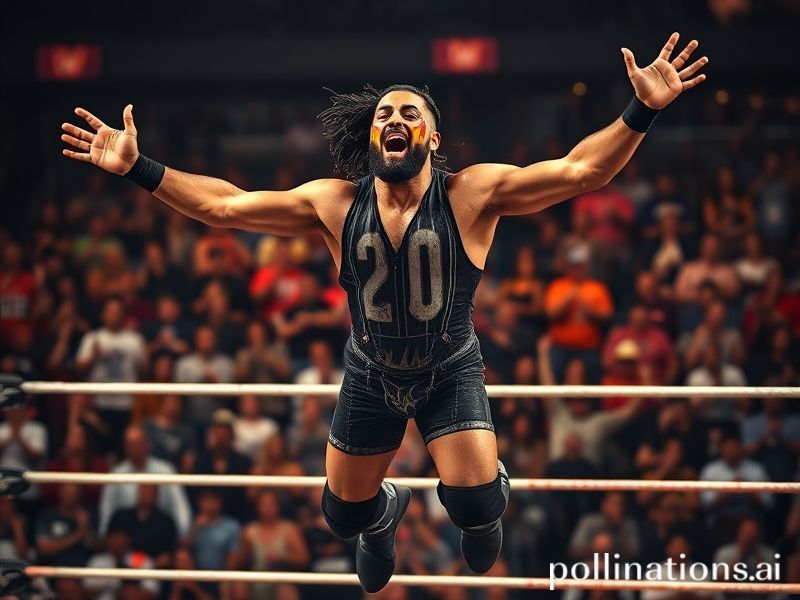
Let’s not kid ourselves: professional wrestling is still the red-light district of sports, a scripted fever dream where grown men cosplay as demigods and the audience pretends not to notice the zipper on Thor’s cape. Yet Jey Uso’s gradual, reluctant insurrection against his own flesh-and-blood tribal chief is playing out like a serialized metaphor for every half-baked secession movement from Catalonia to Bougainville. The difference, of course, is that the WWE’s Bloodline saga has better lighting and a more coherent plot than most real-world separatist campaigns.
From the vantage point of a bar in Dubai—where the only thing rising faster than the skyline is the price of a watered-down mojito—viewers parse the drama the way Kremlinologists once decoded May Day parades. Is Jey’s hesitation noble or merely brand management? Does Roman’s smirk conceal hubris or quarterly-earnings guidance? The Saudis in the VIP section, who’ve just bankrolled yet another pay-per-view, couldn’t care less about kayfabe; they’re here for soft-power optics the same way Qatar bought the World Cup and Paris rents out the Mona Lisa’s smile. In an era when truth is auctioned by the click, scripted sincerity starts to feel almost refreshingly transparent.
Zoom out and the tribal motif becomes a Rorschach test for whatever post-colonial baggage you’re schlepping. In Lagos, fans read Jey as the prodigal son rejecting imported imperial swagger; in Glasgow, he’s the underdog Celt finally sticking it to the Anglo overlord. Tokyo audiences, seasoned by centuries of filial-piety cosplay, watch with the polite detachment of people who’ve seen actual shoguns lose their heads. Meanwhile, an Australian colleague informs me that in Melbourne’s lockdown-addled suburbs, Jey’s defiance is binge-watched alongside footage of anti-vax riots—because nothing says universal catharsis like a man in face paint power-bombing his cousin through a commentary table.
The irony, naturally, is that the Uso family drama is itself a product of global capital’s centrifuge. Vince McMahon may have retired in disgrace, but the new regime still ships the same blood-spattered soap opera to 180 countries, subtitled and sanitized for local censors. Jey’s rebellion is brought to you, in part, by a streaming service headquartered in Amsterdam, a merchandising arm in Shenzhen, and a board of directors who wouldn’t know a coconut from a shareholder revolt. If that sounds familiar, congratulations: you’ve spotted late-stage capitalism’s signature move—monetize the revolution, sell it back at 9.99 a month.
Still, one watches the slow fracture of the Bloodline and detects a faint pulse of something authentically human. Jey doesn’t want the throne; he just wants acknowledgment that the throne exists only because his ancestors dragged it out of the ocean. That tension—between inherited loyalty and self-definition—echoes from Belfast to Bamako. In a world where every border is simultaneously too porous and too rigid, where grandmothers FaceTime from refugee camps, the spectacle of a man publicly weighing kinship against identity feels almost quaint. Almost.
So when Jey finally—inevitably—superkicks Roman into next quarter’s earnings report, half the planet will cheer. The other half will roll its collective eyes, then retweet a slow-motion replay set to reggaeton. And somewhere in Suva, a kid will watch, wide-eyed, and decide that maybe the family business isn’t destiny after all. If that’s not soft power, it’s at least a harder truth than most of what passes for diplomacy these days.