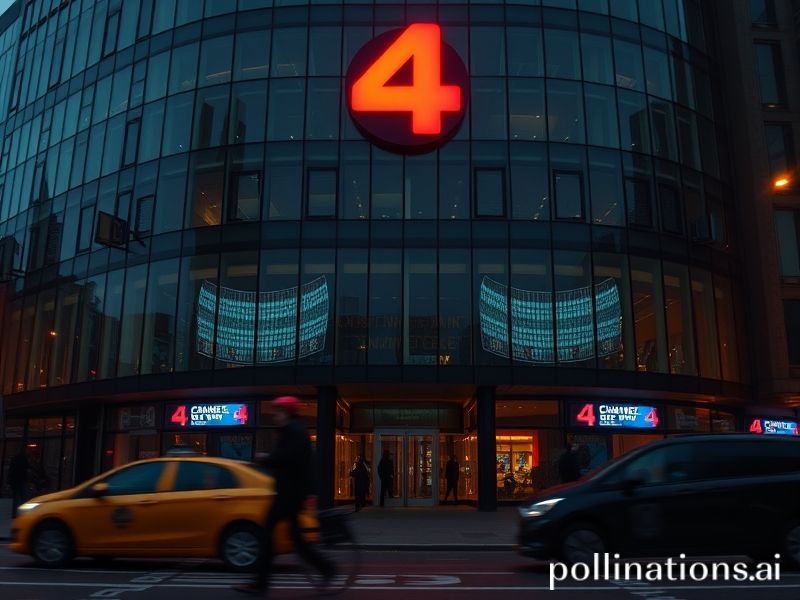
Channel 4: Britain’s Publicly-Owned Misfit and the Global Spectacle of Selling Your Weird Uncle
By the time you finish this paragraph, at least three governments on three separate continents will have floated the idea of flogging their state broadcasters to the highest bidder. Yet only the United Kingdom has managed to turn the ritual into a recurring farce worthy of its own late-night satire slot—ideally on Channel 4, the very asset it keeps trying to auction off.
For international readers, Channel 4 is best imagined as the BBC’s eccentric cousin who went to art school, experimented with hallucinogens, and still insists on showing Scandinavian noir at 2 p.m. on a Wednesday because “audiences crave authenticity.” Created in 1982 as a publicly owned, advertising-funded “publisher-broadcaster” (translation: it commissions everything and produces almost nothing in-house), the channel was Thatcher-era Britain’s attempt to prove that public service media could survive without a compulsory licence fee. The result was a carnival of outsiders, regional accents, and enough swearwords to make a sailor blush—delivered, of course, in the public interest.
Globally, the model looks like an act of accidental genius. While America was busy letting Reagan gut the Fairness Doctrine and Russia was discovering the joys of state-run infotainment, Channel 4 was quietly exporting formats that would colonise living rooms from Seoul to São Paulo. “Big Brother” started here—yes, the Dutch may have conceived it, but only Britain could turn 24-hour surveillance into a national water-cooler sport and then sell the emotional wreckage back to the world as “reality television.” Likewise, “Black Mirror” began life on Channel 4 before Netflix wrapped it in bigger budgets and existential dread, proving that paranoia travels well if the Wi-Fi is fast enough.
Now cue the latest Tory government (or, as Europeans call it, “this week’s Tory government”) announcing yet another consultation on privatising the channel. The stated rationale—competition, efficiency, fiscal prudence—reads like a greatest-hits album of neoliberal greatest misses. Critics counter that flogging Channel 4 to, say, Discovery+ or the Murdoch empire is roughly equivalent to donating the Louvre to Disneyland Paris because the gift shop margins look better. Meanwhile, the American streamers circle like well-dressed vultures, armed with algorithms and a sincere belief that nothing says “British creativity” like a limited-series drama starring a Hemsworth.
The international implications are deliciously perverse. Privatisation would turn a uniquely British experiment into another global content mill, commissioning documentaries about artisanal cheese while quietly shelving investigative exposés on, well, artisanal tax avoidance. It would also mark a decisive moment in the worldwide retreat from public service ideals: if even the UK—birthplace of the BBC and therefore of the very concept of nationally funded culture—decides that television is best left to the invisible hand of the market, other nations may follow. Picture Canada selling the CBC to Amazon, or Australia hawking the ABC to whichever media baron hasn’t been indicted yet.
Yet the channel’s defenders have an ace up their sleeve: cold, hard, advertising cash. Channel 4 currently turns a profit, reinvests it in programming, and still manages to fund regional news in places Westminster forgot existed. It’s the rare public entity that actually works, which, in the current political climate, may be its most damning flaw. Governments across the planet have become allergic to success stories that don’t involve a convenient IPO.
And so the debate staggers on, a late-capitalist tragicomedy in which the audience is both critic and product. International investors watch, popcorn in hand, as Britain wrestles with whether to keep its misfit broadcaster or trade it for a quick buck and a promise of “synergies.” Whichever way the axe falls, one thing is certain: somewhere, a commissioning editor in Copenhagen or Mumbai is already sketching out a six-part docuseries on the whole sorry saga. With any luck, Channel 4 will still exist to air it—right after the Great British Bake Off, subtitled in five languages and sponsored by a fintech start-up you’ve never heard of.