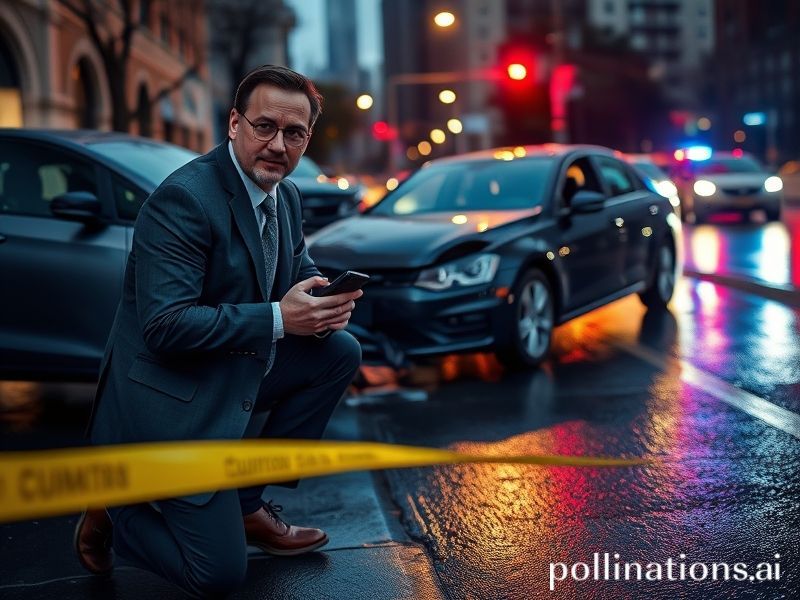
Somewhere between the first crunch of metal in São Paulo rush-hour and the eleventh WhatsApp ping from a Lagos “claims specialist,” the accident attorney has become the new traveling diplomat of our battered planet. Their briefcases now contain more passports than most spies: one for each jurisdiction where human error meets human litigiousness. From the neon corridors of Tokyo’s Kabukichō to the diesel-choked ring roads of Delhi, they practice the same universal tongue—part legalese, part ambulance-chasing lullaby.
It wasn’t always so. In the 1970s a fender-bender in Rome usually ended with two men gesticulating over espresso, not with a multilingual Zoom deposition. Yet globalization, that cheerful euphemism for everything getting faster and more fragile, has turned every scratch on a bumper into a potential cross-border asset seizure. Enter the accident attorney: half lawyer, half logistics firm, half trauma therapist—yes, that’s three halves; mathematics is optional in this line of work.
Consider the case of the Dutch tourist who rear-ended a Tesla on the Pacific Coast Highway. Within 48 hours, Amsterdam’s finest personal-injury boutique had subcontracted a Beverly Hills firm, which promptly hired a Shanghai actuary to calculate “lifetime loss of influencer potential” after a minor whiplash. The billable-hour hydra grew heads on three continents; the tourist’s neck, meanwhile, healed in two weeks. Somewhere an insurance adjuster weeps quietly into a spreadsheet.
The profession’s rise tracks neatly with humanity’s insistence on moving itself around at ever-greater speeds in ever-more-crowded spaces. China adds 30 million cars a year; India loses 150,000 citizens annually to road mishaps. Each statistic is a retainer fee waiting to be invoiced. And because accidents—like bad pop songs—respect no borders, attorneys now study comparative negligence the way Cold War spies studied dead drops. A Berlin lawyer can quote Alabama’s guest-statute doctrine before breakfast; a Buenos Aires litigator knows the precise decibel level at which a London siren becomes contributory factor.
Technology has only greased the skids. Dash-cams in Vladivostok capture footage that ends up as Exhibit A in a Madrid courtroom, subtitled and monetized on TikTok before the victim has left intensive care. Meanwhile, AI-driven settlement bots in Silicon Valley negotiate with AI-driven settlement bots in Singapore, achieving in 0.3 seconds what used to take billable decades. One bot recently demanded “emotional distress damages for fear of future software updates.” Its creator received a promotion and a nervous breakdown.
The ethical scenery, never pretty, resembles a Hieronymus Bosch painting viewed through an Uber windshield. In Mexico City, “vultures” on motorbikes race to crash sites with pre-printed power-of-attorney forms, like paramedics delivering paperwork instead of plasma. In Moscow, slick firms run Telegram channels that push pushy ads before the airbags deflate. Yet even critics concede the service fills a vacuum: when public healthcare is threadbare and police reports read like absurdist theater, someone must coax compensation from the rubble.
Global insurers, those great funnels of collective dread, have responded with a strategy known internally as “litigation tourism.” They forum-shop for courts as casually as backpackers choose beaches. Plaintiffs’ attorneys retaliate with “medical tourism” in reverse—flying clients to jurisdictions where an MRI costs less than a Big Mac but a pain-and-suffering verdict costs more than a fighter jet. The result is a perverse frequent-flyer program: rack up enough air miles, earn a titanium knee and a beach condo in Cyprus.
Looming above the fray is the meta-problem: the planet itself is becoming one vast accident scene—melting ice, buckling roads, lithium batteries performing unscheduled fireworks. Attorneys are already drafting briefs on “climate-contingent collision causation.” Picture the class action: seven million drivers versus a recalcitrant Gulf Stream. The retainer alone could refinance the International Space Station.
So the accident attorney strides on, briefcase bulging with jurisdiction clauses and gallows humor. They are the cartographers of calamity, mapping every new pothole in the human condition. When the last autonomous car finally crashes into the last lawyer, one suspects the lawyer will still find a way to bill for the overtime.