The Crane That Shrank: Lufthansa’s Global Glide from Flag-Carrier to Flagellant
By Our Correspondent, Somewhere above the North Atlantic with a plastic cup of “Château de Terminal”
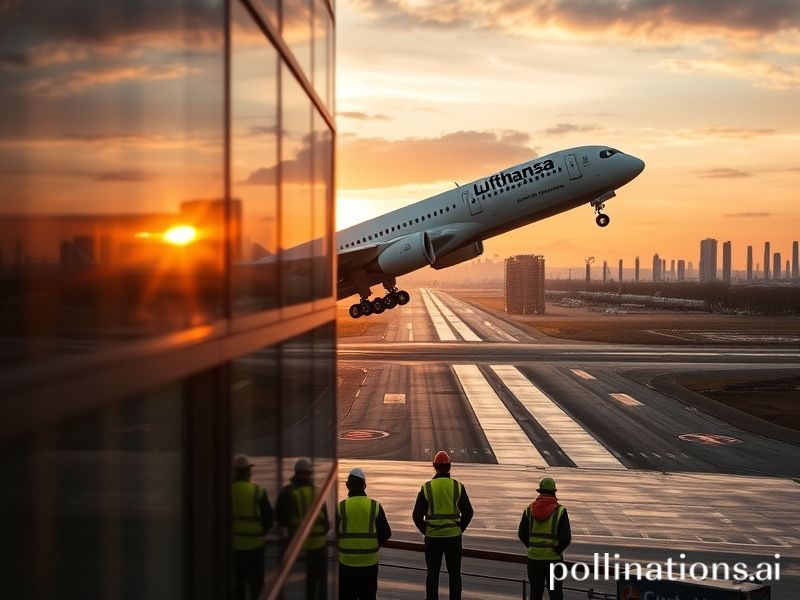
There was a time—ask anyone who still clutches a battered Senator card like a rosary—when Lufthansa’s stylized crane suggested something almost mythic: an airborne Teutonic phoenix, immaculately on time, flapping above the petty chaos of lesser airlines. Today, the same bird looks more like a budget origami pigeon, pecking for worms amid the detritus of post-pandemic aviation. The transformation is not just a German story; it is a cautionary fable for every flag carrier from Sydney to São Paulo, a masterclass in how global shocks turn national icons into multinational punchlines.
Lufthansa’s latest quarterly report reads like a therapy session transcribed by an accountant. Passenger numbers are up, yields are down, and somewhere in the middle management labyrinth a PowerPoint titled “Re-imagining The Journey” is surely being tortured into its fifteenth revision. The airline that once ferried Cold War diplomats between Bonn and Jakarta now spends its afternoons begging Brussels for landing-slot forgiveness and explaining to hedge funds why its loyalty program is suddenly worth more than its fleet. If symbolism still matters, the crane has developed a pronounced limp.
Global implications? Start with the fuel hedges: Lufthansa locked in prices back when oil was flirting with triple digits, presumably under the quaint assumption that the world would still be commuting to conferences in 2024. The result is that every time a Gulf carrier sips discounted crude, Lufthansa’s margins hemorrhage like a tourist who forgot travel insurance. Meanwhile, China’s outbound wave—once counted on to fill every Business Class seat between FRA and PVG—has been replaced by a trickle of poker-faced quarantine veterans who refuse to remove their masks long enough to sip the complimentary Riesling. Asia’s revenge travel is real; it just isn’t boarding a German bird.
Then there is labor, that evergreen German passion play. Verdi union bosses, looking like they’ve stepped out of a 1970s poster for worker solidarity, wave placards warning of strikes “until the last pretzel crumb is pensionable.” Lufthansa’s counteroffer—fewer pretzels, more precarity—has the elegance of a Ryanair press release written in Kantian prose. Across the Atlantic, Delta’s pilots just inked a 34-percent raise, proving that American capitalism can occasionally be more generous than European social democracy, provided the shareholders are sufficiently medicated. Lufthansa’s cockpit crews watch this spectacle the way medieval peasants once gazed at cathedral frescoes: with awe, envy, and the dim awareness that their own salvation narrative has been outsourced.
And yet, the airline’s greatest existential threat may be its own hubris about hubs. Frankfurt—an airport designed by someone who clearly believed walking was a moral failing—has become a geopolitical chokepoint. When climate protesters glue themselves to Runway 18, the delay ripples to Lagos, Lima, and Lahore. The global South now learns of European weather via “LH 568 is running 3 hours late” rather than the BBC. A single crane’s hiccup becomes a planetary delay, a reminder that in the networked age, inefficiency scales faster than efficiency ever did.
Still, one must admire the sheer Teutonic persistence. While British Airways tries to rebrand itself as a boutique wellness start-up and Air France experiments with in-flight mime, Lufthansa doubles down on its core competency: looking mildly disappointed in you. The new Allegris cabins—billed as “a revolution in sleep economics”—promise lie-flat beds so narrow you can contemplate your life choices in fetal position. Somewhere a consultant is already pitching “Grief Class,” where bereaved passengers receive a 10-percent discount for flying next to their recently repatriated carbon offset.
Conclusion: Lufthansa’s saga is the airline industry’s version of late-stage capitalism in a Hauptbahnhof bathroom: brightly lit, vaguely antiseptic, and yet somehow you still leave feeling soiled. The crane will keep flapping, subsidized by taxpayers too polite to ask why they’re bankrolling half-empty flights to “maintain connectivity.” The rest of us will keep boarding, seduced by the hope that, somewhere above the clouds, punctuality and dignity still share an armrest. Spoiler: they don’t. But at least the pretzels are reliably stale, a small mercy in a world where everything else expires before the use-by date.