Daiyan Henley and the Global Supply Chain of Hope
By the International Desk, Dave’s Locker
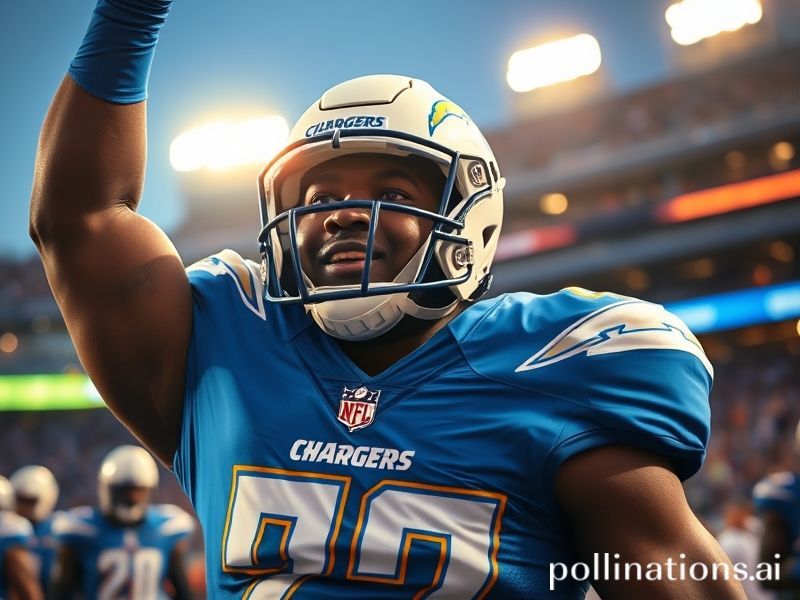
PARIS—While delegates in Brussels argue over Russian gas pipelines and the UN Security Council debates who still has enough credibility left to chair a meeting, a 22-year-old linebacker from Los Angeles has become an unlikely pressure gauge for planetary anxiety. Daiyan Henley, freshly drafted by the Los Angeles Chargers, is not exactly preventing World War III, but he is doing something almost as improbable: making people in 37 countries voluntarily watch American football past midnight and feel something other than existential dread.
Henley’s backstory reads like a UN development report ghost-written by Quentin Tarantino. His father, Bobby Henley, spent eleven seasons catching baseballs for money until the game politely asked him to leave; his mother, a probation officer, specialized in second chances. Together they produced a son who speaks fluent French (thanks to a Mormon mission in Paris that ended the moment he discovered croissants), owns a degree in criminal justice, and tackles quarterbacks with the polite violence of someone who has read the Geneva Conventions for fun.
From Lagos to Lisbon, insomniac fans have latched onto Henley the way drowning sailors grab driftwood. In Nigeria, where the national grid collapses more often than a cheap folding chair, viewing parties huddle around diesel generators to watch him chase down ball-carriers. Across Southeast Asia, illegal streaming sites list Chargers games under “Therapeutic Content,” right between whale sounds and videos of Japanese trains arriving exactly on time. The appeal isn’t just athletic; it’s anthropological. Henley offers a rare export that doesn’t require semiconductors or rare-earth minerals: unfiltered optimism.
Of course, the NFL—an organization that fines players for wearing the wrong shade of sock while cheerfully accepting gambling ads—has noticed. League executives now talk about “international human capital conversion rates,” which roughly translates to monetizing hope before the next recession eats it. Plans are underway for a regular-season game in Mexico City, where locals can watch millionaires risk CTE under the same smog that gave their grandparents asthma. Henley, with his bilingual interviews and unthreatening smile, is the poster child for this soft-power offensive.
Europeans, naturally, are skeptical. French sports daily L’Équipe ran a headline calling Henley “Le nouveau colosse qui n’a pas encore lu Bourdieu,” which roughly means “the new giant who hasn’t read enough critical theory.” German commentators worry that American football is simply imperialism with shoulder pads. But even the cynics tune in, if only to confirm their worst suspicions about late-stage capitalism. Ratings spike every time Henley records a sack, proving that schadenfreude is the one commodity still immune to inflation.
Meanwhile, geopolitical implications multiply like rabbits on Adderall. The Chinese government, ever alert to foreign influence, recently banned NFL livestreams during sensitive anniversaries, fearing that Henley’s post-game interviews might inspire citizens to demand…well, post-game interviews. In Russia, state television edits out footage of Henley’s pink gloves (worn for breast-cancer awareness) lest viewers get dangerous ideas about voluntary charity. Even Canada—Canada!—has floated the notion of drafting Henley as a goodwill ambassador to negotiate softwood lumber disputes, reasoning that anyone who can survive Pac-12 referees can handle Quebec separatists.
Back home, Henley remains endearingly oblivious to his symbolic burden. Asked by a Tokyo reporter whether he feels responsible for global morale, he laughed and said, “I just like hitting people legally, man.” Somewhere, a State Department intern updated a PowerPoint slide titled “Non-Military Diplomacy Assets” and moved Henley’s name higher than the Peace Corps.
So here we are, citizens of a planet where supply chains snap, glaciers sulk, and democracy auctions itself to the highest bidder—pinning a fraction of our remaining optimism on a kid whose greatest talent is redirecting kinetic energy. It’s absurd, undignified, and probably doomed. Then again, so is everything else these days. Might as well watch the rerun at 3 a.m. with strangers who also can’t sleep.
After all, hope is the only commodity still shipped overnight, and Daiyan Henley just delivered another crate.