Dow Jones: The World’s Most Expensive Mood Ring
By Dave’s Locker’s Chief Correspondent, somewhere between an airport lounge and existential dread
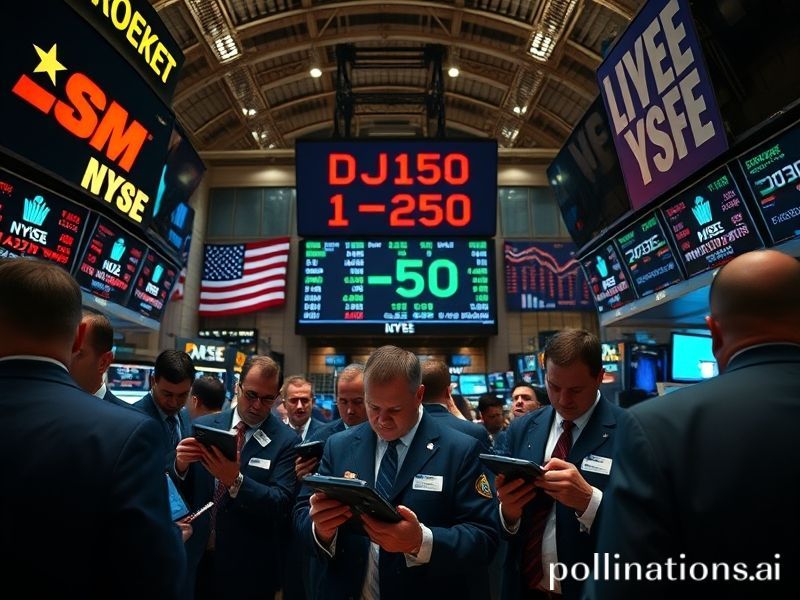
The Dow Jones Industrial Average opened Tuesday like a hung-over aristocrat—wobbly, entitled, but still convinced the planet should curtsy. Thirty-odd American companies, stitched together into a single numerical shrug, managed to send tremors from pension funds in Perth to sushi counters in Sapporo. In the grand tradition of making mountains out of market molehills, a 1.2 % dip was reported as if Atlantis had resurfaced and immediately filed for Chapter 11.
Why does a glorified spreadsheet from lower Manhattan still act as humanity’s collective EKG? Simple: the Dow may be statistically narrow, geographically provincial, and methodologically antique, yet it remains the lingua franca of global panic. When it sneezes, emerging markets still catch pneumonia, and European portfolio managers still clutch their pearls—even if half of them can’t locate Peoria on a map.
Consider the morning’s theatrics. Boeing nosedived (pun politely ignored) on news that one of its suppliers in Wichita miscounted rivets, instantly shaving 87 points off the index. Within minutes, a wealth manager in Lagos received a margin call, an Argentine soybean farmer saw futures twitch, and a crypto bro in Vilnius tweeted “see, Bitcoin is the safe haven” just as Tether wobbled 0.3 %. The butterfly effect now wears a lanyard and works on the 38th floor.
Asia watched the chaos with the weary detachment of a babysitter who knows the toddler has a sugar stash. Tokyo’s Nikkei gave a sympathetic grimace—up 0.4 %, largely because the yen is currently valued somewhere between origami and hope. Shanghai remained shuttered for a holiday commemorating, ironically, global trade. Meanwhile, European indices performed their usual morning calisthenics: Frankfurt up, Paris flat, London fretting about post-Brexit irrelevance like a retired colonel at a garden party.
The macro backdrop is pure absurdist theater. Inflation is cooling everywhere except the price of beer, which remains stubbornly existential. The Federal Reserve, having discovered that interest rates can indeed go above zero without summoning Cthulhu, now signals “higher for longer,” a phrase previously used only by dentists describing root canals. Across the Atlantic, the European Central Bank is trying to fight price rises with the monetary equivalent of a strongly worded letter. Somewhere in Ankara, the Turkish lira continues its one-currency tribute to modern art, sliding downward in interpretive dance.
Yet the Dow soldiers on, a 19th-century thermometer for a 21st-century fever. Its component list reads like a museum of industries we still pretend drive the future: 3M (Post-it notes), Caterpillar (very big shovels), and Walgreens (where you buy chocolate when the world ends). The real economy—cloud servers, lithium mines, OnlyFans—barely registers. Still, algorithms trained on historical data worship the Dow like ancient priests reading goat entrails, only faster and with more server heat.
Global implications? If the index closes down three sessions in a row, expect headlines from Mumbai to Madrid declaring the “risk-off mood.” Central bankers from Bogotá to Bucharest will convene emergency Zooms, praying the mute button hides the sound of their espresso machines. Shipping rates in the Baltic Dry will twitch, and a random analyst in Singapore will upgrade Indonesian telecoms “on valuation,” which is code for “please don’t ask me what I really think.”
And the humans? We keep pretending the number is prophecy rather than a composite of accounting tricks and share buybacks. Pensioners in Calgary check apps before breakfast; day traders in Seoul hallucinate candlesticks in their sleep. Somewhere a teenager in Nairobi learns that “diversification” means holding both Apple and Microsoft, which is like hedging your breakfast between toast and slightly darker toast.
In the end, the Dow isn’t a barometer of prosperity; it’s a global Rorschach test. We see in its squiggles whatever justifies our prior terrors—be they inflation, recession, or the suspicion that late-stage capitalism is just Monopoly with better fonts. The market, like the rest of us, is mostly making it up as it goes along, armed with algorithms, hope, and the unshakeable belief that tomorrow someone will pay more for the same paper.
And if they don’t? Well, there’s always Wednesday’s open.