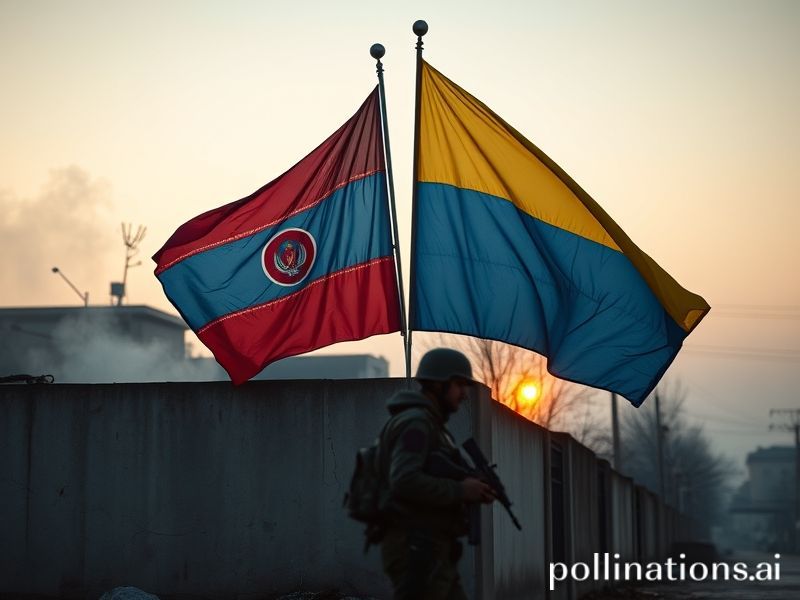
In the grand theater of international relations, where every handshake is a potential dagger and every pipeline a geopolitical jugular, the sudden romance between Azerbaijan and Ukraine is less a love story than a mutually beneficial hostage situation. One country sits atop enough oil to make a Saudi prince blush, while the other has become the world’s most expensive live-fire exercise. Together, they form an axis of “please don’t hurt us” that would make Machiavelli reach for the popcorn.
The timing, as always, is exquisite. Just as Europe collectively realizes that Russian gas comes with more strings than a marionette convention, Azerbaijan has graciously offered to play the role of the less psychotic dealer. Their new energy deal with Ukraine isn’t just about keeping Ukrainian hospitals lit—though that’s a nice bonus—but about showing Brussels that there’s more than one authoritarian regime willing to take their money. How refreshingly democratic.
Meanwhile, in the background, Turkey performs its usual role as the geopolitical equivalent of a friend who insists on setting you up with their “totally stable” cousin. Ankara’s fingerprints are all over this arrangement, because nothing says “regional stability” quite like Turkish mediation. It’s like having your divorce mediated by someone currently dating both parties’ exes.
The weapons trade flowing between Baku and Kyiv adds another layer of irony to this geopolitical lasagna. Ukraine, fighting for its life against a petrostate, is buying drones from another petrostate, which learned everything it knows about military aggression from watching Russia’s greatest hits. Somewhere in a Geneva think tank, a junior analyst just updated their thesis titled “Hypocrisy as Foreign Policy: A User’s Guide.”
For the international community, this partnership offers the delicious hypocrisy of supporting democracy through the kindness of dictatorships. Western diplomats can now tweet about “supporting Ukraine’s sovereignty” while their governments sign trade deals with Azerbaijan’s ruling family, whose concept of term limits is “until my son gets bored.” It’s multitasking at its finest—promoting human rights while ensuring the gas keeps flowing, like hosting an AA meeting in a brewery.
The broader implications ripple outward like oil on water. China watches with interest, calculating how many authoritarian partnerships it can string together before someone notices the pattern. India takes notes on how to maintain plausible deniability while profiting from everyone’s misery. And somewhere in Washington, a congressional aide drafts legislation to “promote democratic values” while simultaneously approving arms sales to anyone who promises to hate our enemies more than they hate us.
As climate change accelerates and the Arctic shipping routes open, Azerbaijan’s strategic position becomes even more absurdly valuable. They’re not just selling energy; they’re selling the last drops of a dying planet’s lifeblood, and Ukraine is buying because what choice does it have? It’s like watching someone sell water at a premium during a house fire—technically supply and demand, but morally questionable at best.
In the end, the Azerbaijan-Ukraine partnership represents everything beautiful and terrible about modern geopolitics: the pragmatic embrace of necessary evils, the transactional nature of survival, and the uncomfortable truth that in a world where might makes right, even the righteous must sometimes dance with devils. It’s not cynicism if it’s true, and it’s not hypocrisy if everyone’s doing it.
As the deal gets signed in some neutral venue with excellent catering, one can almost hear the ghost of Bismarck chuckling in the corner. The great game continues, the players change, but the rules remain depressingly consistent: when you’re drowning, you don’t question the politics of the life preserver.