If you drew a diagonal across South America from Quito to Buenos Aires, you’d slice through roughly 4,000 kilometres of Andean vertigo, pampas melancholy, and the sort of political pendulum swings that would make Newton reach for stronger coffee. Ecuador versus Argentina, then, is not merely a fixture on the Copa América group-stage bingo card; it is a continental mood ring that the rest of the planet keeps glancing at while pretending to read the fine print on lithium contracts.
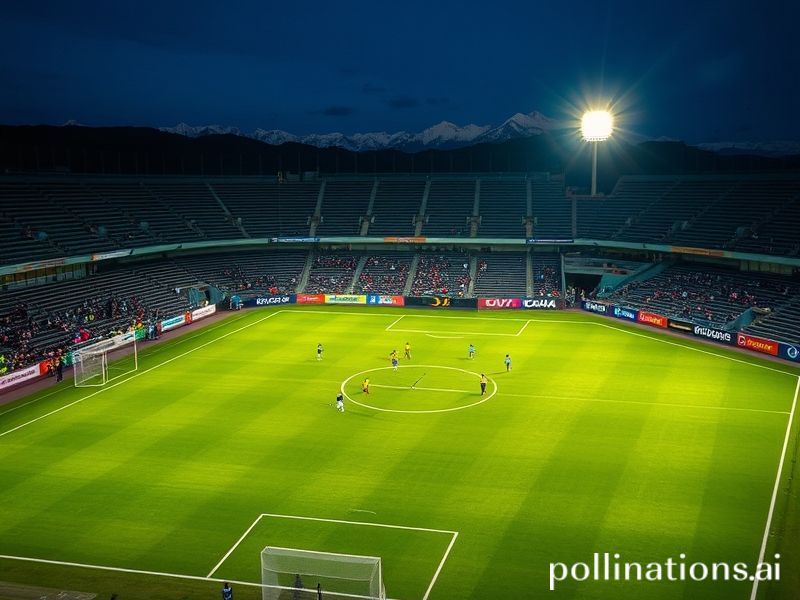
On paper the match is an underdog story: plucky Ecuador (population: one Tokyo Tuesday) against Lionel Messi & Co., who still travel with more brand value than some medium-sized European nations. Yet the global stakes have less to do with who nutmegs whom than with what this meeting telegraphs about the hemisphere’s nervous system. In an age when supply chains are treated like holy scripture and China buys soybeans by the cubic ton, Ecuador’s bananas and Argentina’s beef are no longer breakfast staples; they’re geopolitical poker chips. Every sliding tackle is therefore freighted with the unspoken question: who gets to stay on the adults’ table when the resource music stops?
Consider the recent script. Ecuador arrives having dollarised itself decades ago—an economic surrender so complete that locals now refer to their own currency as “Monopoly with portraits.” Meanwhile Argentina, never a slouch in the self-sabotage department, has managed to invent three different exchange rates before breakfast, each one more theoretical than the last. If Ecuador is the straight-A student who photocopied the final exam, Argentina is the prodigy lighting the exam room on fire to see how flames curve in hyperinflation. And still both countries find themselves courted by the same hedge-fund suitors who speak in polite euphemisms about “macro tailwinds” while quietly betting on which economy detonates first.
The match therefore doubles as an audition for IMF sympathy. Ecuador needs greener credentials to unlock “debt-for-nature” swaps—essentially turning hummingbirds into collateral—while Argentina needs, well, everything. Each successful dribble is thus a PowerPoint slide for potential investors, each yellow card a footnote in a sovereign-risk report. When Enner Valencia squares up against Cristian Romero, somewhere in midtown Manhattan an analyst spills cold brew on a spreadsheet titled “LATAM Contagion Scenarios.”
Beyond the balance sheets, there’s the migration subplot. Roughly half a million Ecuadorians now ship remittances from Madrid and Queens; Argentina, for its part, has become the world’s most scenic departure lounge. The stadium on Saturday night will contain cousins who WhatsApp across hemispheres, united by the shared conviction that the grass is literally greener wherever you currently aren’t. Kick-off is scheduled for prime-time European television, because nothing says “post-colonial solidarity” quite like scheduling your national identity around German ad revenue.
And then there is the weather—specifically, El Niño, that mischievous child who warms Pacific currents and electoral rhetoric in equal measure. Ecuador’s coastal infrastructure is already budgeting for biblical rainfall; Argentina’s breadbasket is baking in drought. Climate change has turned the region into a cosmic joke where the setup is “two countries walk into a bar” and the punchline is “only one exits with potable water.” Should Ecuador win, coastal ministers will hail it as cosmic justice; should Argentina triumph, porteños will claim it proves drought is merely a mindset.
In the end, the actual score will be forgotten by Wednesday. What lingers is the snapshot: tiny Ecuador with its Galápagos swagger, and wounded Argentina still wearing the number 10 like inherited royalty. The world will watch because it always watches when Latin America performs its favourite tragicomedy: the simultaneous declaration that everything must change and that nothing ever will. Whichever anthem is butchered loudest by the brass band, the real winner is the global spectator class—safely insulated, mildly titillated, and reassured that somewhere south of the equator the beautiful game still distracts from the ugly arithmetic.