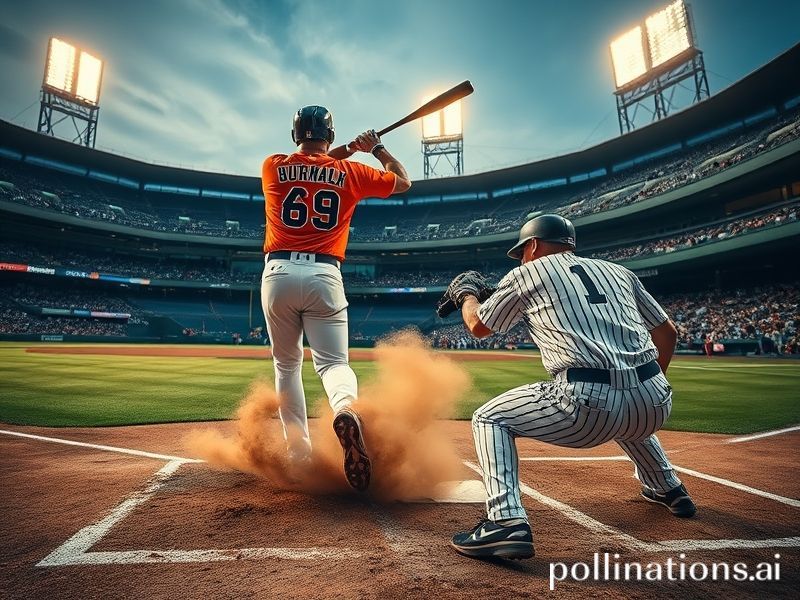
Tigers vs Yankees: A Proxy War in Pinstripes and Whiskers
By Our Man in the Cheap Seats, Somewhere over the Pacific
If you squint hard enough from the press box of the Tokyo Dome, the Detroit Tigers look less like a baseball team and more like a floundering nation-state: rich in nostalgic glory, poor in present-day relevance, and currently accepting bailouts in the form of waiver-wire arms. Across the diamond, the New York Yankees appear as the United States of Cash: an aircraft-carrier payroll that keeps steaming into every harbor broadcasting the same message—“We’re here to liberate your best players, and we’ll pick up the check.”
Tonight, the Tigers and Yankees are only scheduled for three games, yet the planet seems to be keeping score. Bookmakers from Macau to Malta have issued lines so delicate they might have been etched on rice paper by a Swiss watchmaker with tremors. In Istanbul, a barista live-streams the game to a roomful of Galatasaray ultras who have decided, for reasons known only to them and their bookies, that the over/under on Aaron Judge’s RBIs is a more reliable economic indicator than Turkish inflation data.
The international stakes are absurd, of course, but so is everything else these days. The Tigers—owned by a pizza-franchise oligarch who once tried to trademark the phrase “Motor City”—now rely on a 42-year-old designated hitter whose knees sound like bubble wrap in a blender. Meanwhile, the Yankees’ rotation features a Japanese ace, a Dominican fireballer, and a German import who throws sliders so filthy they violate several clauses of the Geneva Conventions. It’s globalization with pine tar.
One cannot discuss this rivalry without acknowledging the soft-power implications. Every time the Yankees’ bullpen gate swings open, it’s less a pitching change than a cultural invasion: Metallica’s “Enter Sandman” blaring like an air-raid siren, warning smaller-market franchises that resistance is futile. The Tigers counter with their own propaganda loop—an Eminem track from 2002—because nothing says “future” like a 22-year-old Slim Shady reference. Diplomats call this “public diplomacy.” Baseball calls it “between-innings entertainment.” Same difference.
In the stands, the scene looks like a Model UN field trip gone rogue. A delegation of Korean tech executives compares exit velocities over $17 craft beers, while a trio of Norwegian teenagers live-tweet every Gerrit Cole fastball in accented English peppered with TikTok slang. Somewhere in the concourse, a British tourist wearing a Red Sox cap “for the irony” is explaining to a bewildered vendor why cricket is superior because “it takes five days and still ends in a draw.” The vendor, no stranger to existential futility, simply hands over a chili-cheese dog and wishes him luck.
Back on the field, geopolitics plays out in miniature. The Tigers’ catcher—recently acquired from the Reds for two prospects and a crate of medical tape—frames pitches like a UN peacekeeper trying to keep two warring Balkan villages from noticing the border. The Yankees’ leadoff man fouls off borderline sliders the way certain nations veto Security Council resolutions: not because it helps, but because it’s habit.
By the eighth inning, the score is tied, the bullpens are smoking, and somewhere in Brussels a bureaucrat is updating an EU white paper titled “Transatlantic Sporting Hegemony: Implications for Single-Market Broadcasting Rights.” The document will be 200 pages long and completely ignored by everyone except the interns who printed it.
In the end, the Yankees walk it off via a 420-foot Judge missile that lands in a Lexus display sponsored by a Japanese conglomerate, insured by a London firm, and live-streamed to 73 countries. The Tigers’ manager tips his cap with the weary grace of a deposed monarch boarding a midnight flight to exile.
Baseball, like democracy, is beautiful, broken, and broadcast worldwide—often with Spanish commentary and dubious strike zones. The final score is 5-4, but the real tally is measured in ad buys, diplomatic eye-rolls, and the quiet understanding that tomorrow the same circus will roll into another city and pretend it matters. Because it does, right up until the moment it doesn’t.