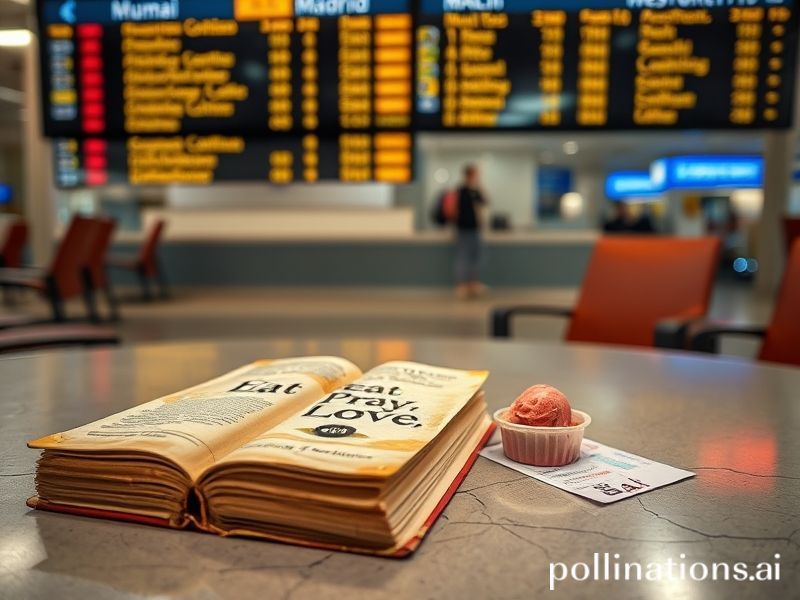
Elizabeth Gilbert, the American author whose passport now contains more stamps than an Italian post office, has become the de-facto cartographer of the modern soul’s grand tour. Ever since she dragged 10 million readers through the trattorias of Rome, the ashrams of India, and the rice paddies of Bali, her memoir “Eat, Pray, Love” has functioned as both Lonely Planet and holy scripture for a planet that can’t decide whether it’s starving, praying, or swiping right. From Manila hostels to Helsinki co-working spaces, dog-eared copies of EPL still circulate like contraband, promising that enlightenment is only a visa and a carbohydrate binge away.
The book’s global success is, of course, a masterclass in market timing. It arrived just as the world economy was detonating in 2006-2008, offering an escapist fantasy in which personal bankruptcy could be rebranded as spiritual divestment. While Greek pensioners watched their life savings evaporate, Gilbert was counseling them—via Oprah satellite—to simply love themselves harder. The irony was not lost on Athenian booksellers, who reported brisk sales even as Molotov cocktails arced overhead. One could almost hear Zeus chuckling at the cosmic punchline: Western civilization collapses, but hey, have another gelato.
Gilbert’s later works—fiction, memoir, TED talks, podcasts—continue to globe-trot with the restless energy of someone perpetually on the run from an immigration officer of the psyche. “The Signature of All Things” gave us Alma Whittaker, a botanist whose moss samples are more emotionally articulate than half the UN Security Council. “City of Girls” flits through 1940s New York theater culture with the same wide-eyed entitlement that once devoured Neapolitan pizza. Each dispatch from Planet Liz is packaged for maximum translatability: the Dutch edition comes with tulip-scented endpapers, the Japanese with a complimentary packet of matcha, because nothing says spiritual awakening like monetized merch.
Critics—especially those scribbling in cramped apartments above kebab shops from Istanbul to Jakarta—note that Gilbert’s worldview is essentially neoliberal mysticism: trauma is merely an unpaid internship for the soul, and every setback can be invoiced to the universe. Meanwhile, actual refugees, lacking both trust funds and literary agents, continue to drown in the Mediterranean. The juxtaposition is bleakly comic: one woman’s year-long sabbatical becomes a multimillion-dollar empire while entire nations queue for water. Somewhere in the afterlife, Joseph Conrad is updating his LinkedIn.
Yet dismissing Gilbert as merely a lifestyle influencer with a Pulitzer-friendly vocabulary misses the larger geopolitical undercurrent. Her brand of curated vulnerability has become soft power in an era when traditional diplomacy tweets itself into oblivion. State tourism boards from Bali to Bhutan now court “Gilbert-adjacent” influencers, hoping a single Instagram story will rescue GDPs flattened by pandemic. The Indonesian government even floated a literal “Eat, Pray, Love” visa—processing time: 24 hours, enlightenment not included. Nothing screams spiritual authenticity like a bureaucratic fast-track.
And so we arrive at the present moment, where Gilbert’s latest revelation is that she’s in love with her female best friend, a plot twist promptly memed from Lagos to Lima. Some applaud the honesty; others roll eyes so hard they glimpse their own brain stems. Both reactions are valid in our algorithmic coliseum, where every confession is content and every heartbreak a KPI. The planet burns, markets convulse, and still we scroll for guidance from a woman who once mistook Ketut Liyer for Yoda.
In the end, Elizabeth Gilbert remains the perfect mirror for a world that outsources introspection to best-selling paperbacks. She’s neither saint nor charlatan, just the most successful travel agent the psyche has ever hired. And as long as borders stay porous and Wi-Fi stays free, her gospel of self-discovery will keep boarding passes printing from Tegucigalpa to Tbilisi. Because when reality disappoints, there’s always another memoir—and another stamp in the passport of the perpetually searching.