Kathmandu, City of Perpetual Reboot
By Dave’s Far-Eastern Correspondent, still slightly dusty from the last aftershock
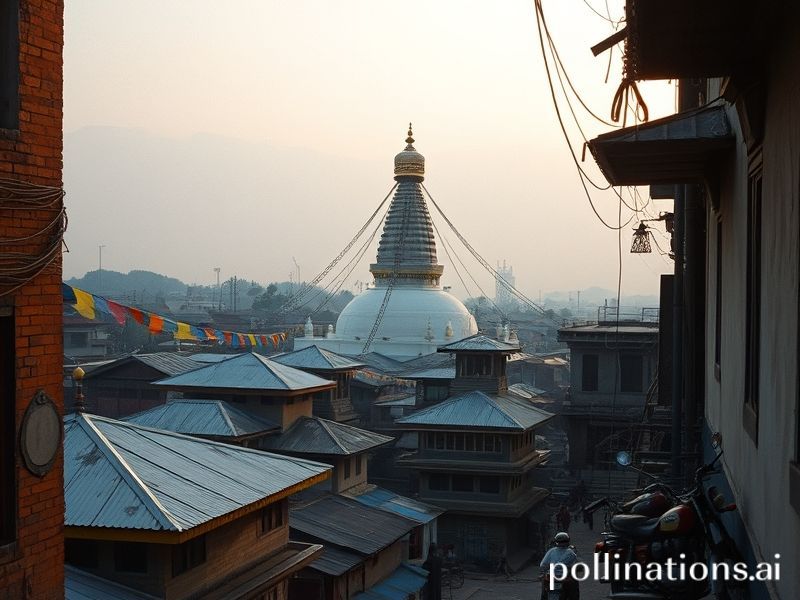
The first thing an international visitor notices about Kathmandu is that it smells like the entire planet decided to hold a garage sale in a chimney. Sandalwood, diesel, momo grease and the faint whiff of existential dread swirl together in an aroma the UN has yet to classify. Somewhere between the prayer flags and the power cuts, the city has quietly become the world’s most efficient metaphor for the 21st century: overcrowded, under-wired, spiritually accessorized and permanently on the verge of either enlightenment or total collapse—whichever comes with Wi-Fi.
Global finance, that shy retiring beast, has already sniffed the incense. Singaporean venture capitalists now fund Nepalese fintech apps while their own city-state bans chewing gum. Silicon Valley coders, exhausted by their own disruption, fly in to “find themselves” and discover that finding yourself here usually involves losing your passport in Thamel and gaining a parasite. Meanwhile, remittance flows—roughly a quarter of Nepal’s GDP—make Kathmandu the only capital where grandmothers receive more reliable income from Uber drivers in Dubai than from the finance ministry at home. In other words, the city runs on the kindness of cousins with 5G.
Climate change, never one to miss a party, has set up a permanent stall in the Kathmandu Valley. The once-reliable monsoon now behaves like a drunk tourist: arrives late, leaves early, occasionally punches a hole through a historic temple. Glacial lakes 100 kilometres north threaten to flash-flood the Bagmati River, an event that would instantly solve the city’s traffic congestion by converting it into Venice-on-the-Roof-of-the-World. International insurers, ever the optimists, have priced “Himalayan Tsunami Rider” policies just below “Martian Dust Storm Coverage.”
Yet it’s the civic choreography that truly dazzles. UNESCO World Heritage squares—elaborate open-air museums of medieval brickwork—double as impromptu motorcycle stunt tracks. Tour guides explain Tantric cosmology in the same breath they recommend where to buy knock-off North Face jackets stitched by the same kids who should be in school learning Tantric cosmology. The United Nations Development Programme issues glossy reports lamenting this, then retreats to a five-star hotel whose nightly tariff exceeds the average civil servant’s monthly salary. Progress, after all, is best observed through bulletproof glass.
For the wider world, Kathmandu operates as an early-warning system. When India coughs, the valley reaches for an inhaler; when China sneezes, half the trekking industry develops pneumonia. The city’s politics—an endlessly looping telenovela of coalition, betrayal and resurrection—prefigure the parliamentary chaos now fashionable from Westminster to Washington. If you want to see how liberal democracies die of embarrassment rather than coup d’état, book a seat at Singha Durbar on budget-debate day; the popcorn is subsidised.
Still, there is something indecently resilient here. After the 2015 earthquake reduced entire neighbourhoods to Jenga towers, citizens rebuilt within weeks using YouTube tutorials and salvaged rebar. When India blockaded fuel the same year, the valley learned to cook momos on solar cookers made from discarded satellite dishes—catapulting Nepal to the top of the Global MacGyver Index. These improvisations, filmed on smartphones and uploaded for the diaspora, now serve as instructional content for disaster zones from California to Caracas. Kathmandu, accidental YouTube professor of urban survival.
So what does the city portend for the planet? Quite simply, the future will look like Kathmandu long before it looks like Tokyo. It will be polyglot, precarious, wired yet intermittent, ancient yet addicted to novelty, running on gossip, grit and the hope that tomorrow’s power cut might finally coincide with the day you planned to give up screen time anyway. The valley’s greatest export is no longer yak wool but a lifestyle brand of beautiful dysfunction—hashtag #PeakChaos, now trending from Lagos to Lisbon.
As your plane banks away, the smog forms a perfect halo around the valley, as if the gods themselves needed a filter. Below, the city shrinks to a shimmering circuit board of temples, traffic and tenacity. Somewhere down there, a teenager is live-streaming a street protest while charging his phone from a micro-hydro rig he built in science class. The world rolls on, but Kathmandu keeps rebooting—each time with slightly better graphics and the same fatalistic sense of humour. Buckle up, dear reader; the rest of us are just lagging behind.