World Cup Qualifiers Europe: Where National Hopes Go to Die (and Occasionally Resurrect)
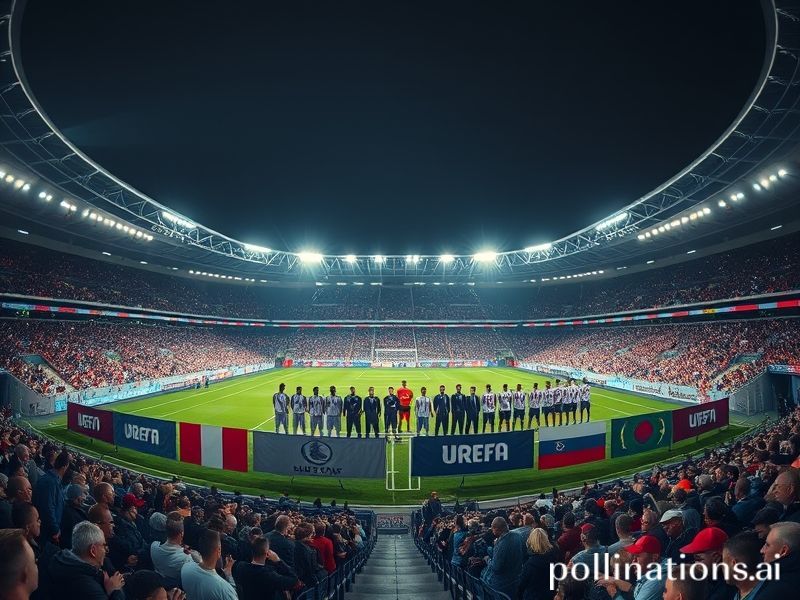
The biennial continental bloodletting known as the UEFA World Cup qualifiers is back, and with it the reassuring spectacle of 55 nations pretending their geopolitical relevance hinges on 22 men chasing a ball. From Reykjavik to Tbilisi, passports are brandished like swords as Europe’s most combustible grievances—some dating back to the Treaty of Westphalia—are re-enacted with VAR and soft-power hashtags.
For the uninitiated, the format is simple: twelve groups, ten matchdays, and one existential crisis per federation. First place secures a direct ticket to the 2026 North American jamboree—conveniently scheduled to maximize jet lag and carbon emissions—while second place earns the privilege of a single-elimination playoff, UEFA’s answer to Russian roulette but with more diving.
The global implications are, of course, enormous. A successful campaign can prop up a ruling party’s approval rating by up to four percent, according to political scientists who apparently get paid to study such things. Conversely, elimination has been known to trigger cabinet reshuffles, currency devaluations, and—if you’re England—an emergency inquiry into why nobody can take a penalty without consulting a therapist.
This cycle’s marquee subplot is the return of Russia, freshly rebranded from global pariah to “team everyone pretends not to notice.” Their matches are played in empty stadiums, a policy that has the accidental benefit of finally silencing the vuvuzela once and for all. Meanwhile, Ukraine plays every fixture away from home, turning the continent into a traveling memorial service with a surprisingly catchy terrace chant. Neutral observers have taken to calling Group C “the geopolitics seminar nobody enrolled in.”
Elsewhere, the usual developmental fairy tales are trotted out. Gibraltar—population 34,000 and roughly the same GDP as a mid-tier TikTok influencer—fields a squad composed mostly of English semi-pros who discovered a long-lost Gibraltarian grandmother the moment FIFA rankings became negotiable. Their 0-0 draw against France was hailed as “historic,” proof that even the most lopsided David-versus-Goliath narratives can be sustained if you define “victory” loosely enough.
The Asian Football Confederation watches from afar with the weary envy of a sibling whose parents bought the smaller television. AFC’s 46-team qualifying marathon stretches across four years and roughly nine climate zones, yet still can’t manufacture the brand of schadenfreude Europe produces every October. South America, meanwhile, limits itself to ten nations and 18 matchdays, a model of efficiency that somehow feels unpatriotic in its restraint.
FIFA, ever the benevolent cartel, has expanded the 2026 tournament to 48 teams, a move officially justified as “growing the game” and unofficially as “growing the revenue.” The by-product is that European qualification now resembles a Black Friday sale: more slots, more pushing, roughly the same quality of merchandise. Scotland, having perfected the art of glorious failure since 1998, senses an unprecedented opportunity to exit at an earlier stage than usual.
In the boardrooms of streaming giants, executives salivate over the continent’s unrivaled capacity for self-immolation. Nothing drives subscriptions like a Croatian defender head-butting a goalpost in the 94th minute, or the sight of Italian fans discovering mathematics for the first time while calculating coefficient permutations on the back of a napkin. The numbers are staggering: 1.2 billion cumulative viewers, 4.3 billion social interactions, and exactly one fan who actually understands the Nations League’s impact on the playoff draw. He lives in Luxembourg and refuses interviews.
All of which brings us, inevitably, to the human element—the part broadcasters package in slow-motion montages set to mournful indie rock. For every Erling Haaland hat-trick there’s a Faroese fisherman filing unpaid leave to watch his nation lose 4-0 on a Tuesday in Tórshavn. Teenagers in Kosovo stream matches on cracked phones while their grandparents recall when the only “qualifier” involved dodging conscription. And somewhere in Warsaw, a retired striker sells insurance and tells clients he once hit the post against Portugal in 2005; the clients nod politely, because everyone knows the post is undefeated.
When the final whistle blows in November, 13 European flags will flutter in Canadian, Mexican, and American stadiums. The rest will return to their day jobs, their debt crises, their border disputes—comforted, at least, by the certainty that failure on the pitch is still less embarrassing than failure off it. For now, though, the continent remains united in its preferred ritual: 90 minutes of choreographed hope, followed by a lifetime of selective amnesia.