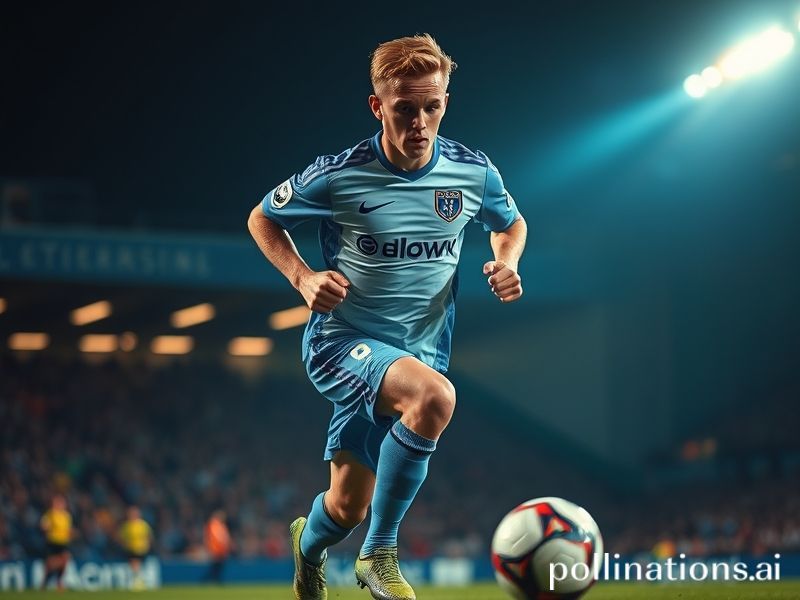
Wigan Athletic’s Norwegian teenager, Thelo Aasgaard, has spent the past fortnight doing something no Scandinavian export has managed since flat-pack furniture: forcing the world to read the assembly instructions. One dazzling League One hat-trick later and the 20-year-old’s name is being Googled from Lagos to Lima by people who previously thought “Aasgaard” was either an IKEA shelving unit or the after-party Valhalla forgot to advertise.
From an international vantage point, the fuss is both comical and instructive. Here is a player born in Oslo to a Gambian father and Norwegian mother, polished in Wigan’s academy (a place historically better at producing pies than prodigies), and suddenly elevated to the same breathless transfer-rumor tier as Brazilian toddlers with better agents than reading skills. The global game’s talent supply chain has always been ruthless; now it’s just openly ridiculous. If Aasgaard’s left foot were a commodity future, Goldman Sachs would already be short-selling it.
Yet the broader significance is less about the kid himself and more about the conveyor belt beneath him. Europe’s middle-class clubs—your Wigans, St. Paulis, Reims of this world—have become the thrift shops where superpowers go bargain-hunting. The Premier League’s petrostates and sovereign wealth retirees need fresh meat that hasn’t yet learned the going rate for a soul, and the Championship-to-League-One corridor is basically the duty-free aisle. Aasgaard, with his dual citizenship and Instagram-ready cheekbones, is a walking passport stamp for whatever multinational conglomerate decides to monetize him first.
Meanwhile, the Norwegian press treats his rise as proof that their player development model—essentially “let them play until frostbite sets in”—is superior to England’s pay-per-touch academies. The English counter that any actual improvement is purely coincidental and probably weather-related. Both sides miss the point: globalization has turned national identity into a marketing hook, like gluten-free labeling for footballers. Aasgaard can be Norway’s future, Gambia’s diaspora jewel, or England’s adopted son depending on which flag the sponsor needs waved that week.
Down in Africa, the Gambian FA reportedly keeps his number on speed-dial, hoping he’ll reverse the ancestral brain-drain before Qatar 2030 qualifiers. Across the Atlantic, MLS clubs have begun the ritual “we can offer him game time” mating call, blissfully ignoring that game time in MLS currently resembles a spirited U-12 tournament with better pyrotechnics. In Asia, a K-League team has already Photoshopped him into their jersey, because nothing says long-term planning like a mock-up.
Economically, the kid is a floating currency. His next contract will likely contain more release clauses than a Cold War spy novel, each payable in euros, pounds, crypto, or, if the Saudis get involved, barrels of light crude. Agents are circling like vultures who’ve read the Financial Times. One imagines them descending on the DW Stadium with laminated pie charts showing projected shirt sales in Jakarta.
And still, the most poignant detail is that Aasgaard himself appears almost pathologically normal. He still lives with his mum, lists “grandma’s fish stew” as his favorite meal, and recently asked the club physio whether a “hat-trick ball” is something you’re supposed to inflate. In an era when teenagers brand themselves before they can legally brand cattle, his bewildered smile is refreshingly human—like finding an honest hedge-fund manager or a diplomatic tweet.
Which, of course, means the clock is ticking. Modern football doesn’t tolerate innocence for long; it monetizes it, chews it up, and spits out a perfectly marketable husk. By the time you finish reading this, some algorithm has probably already trademarked “Thelo™” in six alphabets.
So enjoy the fairy tale while it lasts. Somewhere between the Norwegian snow, the Lancashire rain, and the Qatari desert sun, a kid who still looks both ways before crossing the road is about to become a global asset class. And if that doesn’t sum up the beautiful game in 2024, nothing does.