The Left Arm That Shook the Globe
By Diego “Digger” Santangelo, International Correspondent
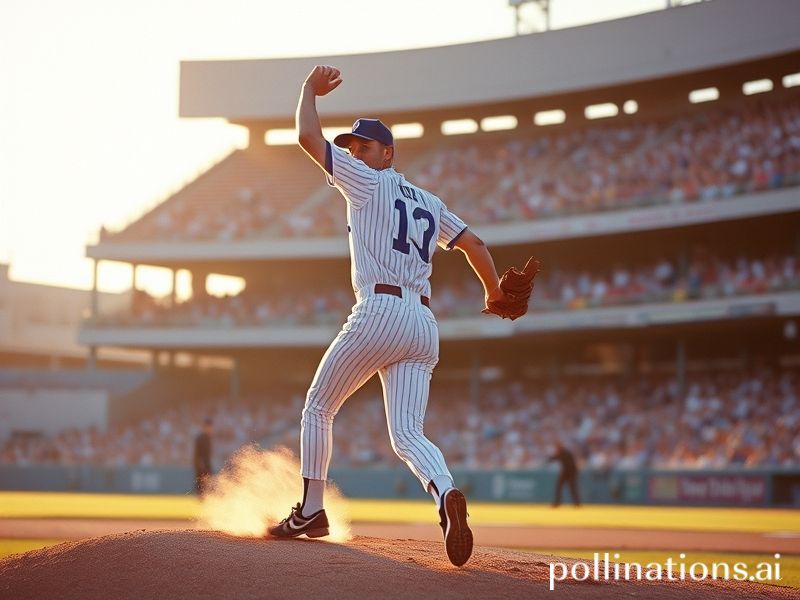
Somewhere above the Mediterranean, on a chartered El Al flight in October 1965, Sandy Koufax told the captain he would not be pitching Game 1 of the World Series. The reason? Yom Kippur, the holiest day in the Jewish calendar. Up in business class, a pair of Tokyo sportswriters looked up from their Nikon cameras, blinked, and quietly began rewriting the mythology of American baseball for the Japanese morning editions. In that moment—halfway between Tel Aviv and Minneapolis—a lanky left-hander from Brooklyn became the first truly global sports conscience, proving that even the most parochial of pastimes could be hijacked by inconvenient principle.
Back then, the planet was busy: the Soviets were installing missiles in Cuba like drunken IKEA shoppers, France was detonating bombs in the Sahara because apparently sand isn’t already hot enough, and Indonesia was perfecting the art of losing half a million citizens to an anti-communist purge. Against that cheerful backdrop, Koufax’s refusal to pitch was less a sports footnote than a geopolitical tremor. Overnight, the phrase “Koufax sits” ping-ponged across wire services in six languages, inspiring cocktail-party arguments from Buenos Aires to Bombay about whether God or gate receipts deserved higher billing.
The implications were deliciously subversive. In the United States, Koufax’s strike zone suddenly expanded to include questions of identity politics, corporate greed, and the quaint notion that athletes might possess vertebrae. Abroad, his gesture translated into whatever local grievance needed airing. For the Irish, he was a Gaelic striker boycotting the Queen’s Cup; for Algerians, a midfielder refusing to play on Ramadan; for Czechs, a hockey goalie who wouldn’t skate during the anniversary of the ’48 coup. The Dodgers lost the opener 2-1, but somewhere in Leningrad a refusenik taped Koufax’s protest to his kitchen wall and felt, perhaps for the first time, that the free world could include a Jewish southpaw with a curveball sharp enough to slice the Iron Curtain.
Fast-forward six decades and the gesture has metastasized. Colin Kaepernick kneels, Naomi Osaka steps away from microphones, and the Norwegian beach-handball team swaps bikinis for shorts—each citing “personal reasons” in the polite argot of our age. Every one of them owes royalty checks to the man who once declined a World Series start because the universe’s oldest monotheistic deity had dibs on his calendar. Meanwhile, the global sports-industrial complex—now valued at roughly the GDP of Belgium plus a small moon—has responded by packaging dissent into branded content. Nike’s latest spot features slow-motion footage of a generic athlete staring pensively at a sunrise while subtitles whisper “Courage is inconvenient.” Somewhere, Koufax is probably sipping coffee, arching an eyebrow, and wondering when exactly courage became a market segment.
Yet the deeper legacy is messier. Koufax’s stand coincided with a brief, shining period when the United States still exported moral exemplars rather than democracy-branded munitions. Today, as Saudi Arabia bankrolls golf tours and Qatar air-conditions stadiums built by Nepali indenture, the idea that a player might forfeit cash for conscience feels almost sepia-toned. In Latin America, kids who can’t spell “Dodgers” still mimic his wind-up in dusty barrio lots, unaware that the man they’re imitating once told CBS, “I’m not a role model, I’m a pitcher,” which is exactly what a role model would say if he possessed both humility and a 100 mph fastball.
And so Koufax remains the patron saint of inconvenient integrity, his legend growing in inverse proportion to our collective willingness to accommodate it. Every time a star athlete pockets a blood-soaked sponsorship or a league relocates to a petro-state with better tax breaks, the old lefty’s ghost throws another invisible strike across the moral plate. The world, ever the expansion franchise in ethics, keeps fouling it off.
Conclusion:
Sandy Koufax never threw a pitch in the Tokyo Dome, never signed a jersey deal in Dubai, and never tweeted a single emoji. Yet his fastball still circles the globe annually—breaking not on seams but on conscience. In an era when everything is for sale, including the naming rights to our better angels, Koufax endures as the quiet reminder that sometimes the most devastating pitch is the one you refuse to throw. History, like baseball, is a game of inches; his inch was taken on a day of atonement, and the reverberations have been measured not in runs, but in the slow, grinding metric of human dignity. The box score won’t show it, but the planet is still rounding third.