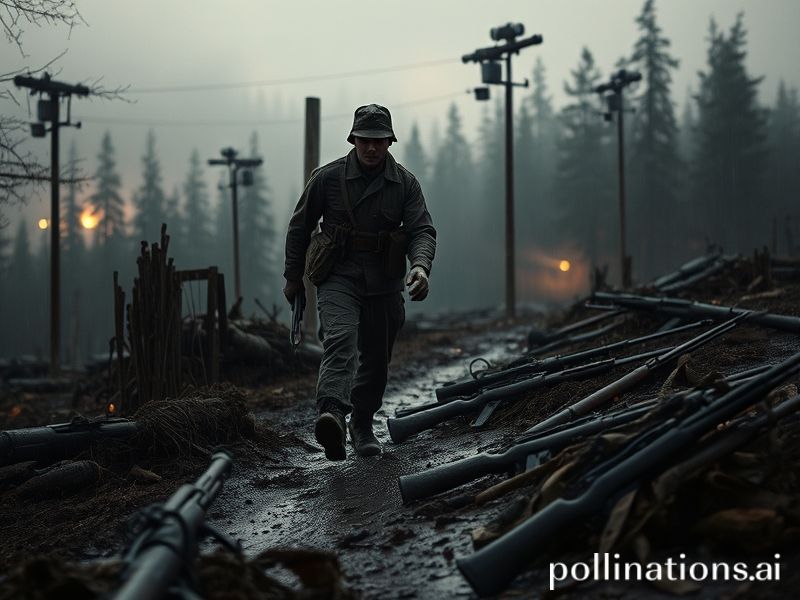
The planet has always been a messy chessboard, but lately it feels as though someone upended the pieces, set the board on fire, and then demanded we keep playing. From the Black Sea to the South China Sea, from the Sahel to the Amazon, the refrain is the same: one battle after another, each marketed as “decisive,” “historic,” or—most ominous—“the last one before peace.” The marketing department of geopolitics clearly skipped its ethics seminars.
Start with Europe, where the Ukrainian steppe has become the world’s most subsidized open-air arms expo. NATO members are emptying their cupboards of legacy Soviet ordnance so fast that antique dealers in Prague are being asked for price quotes on 1970s grenade fuses. Meanwhile, the EU’s latest round of sanctions—package number 14 for those counting at home—has reportedly achieved the impossible: making Russian diesel cheaper for India to buy than for Germany to refine. Somewhere in Brussels, a Eurocrat is drafting “package 15” with the same solemn intensity a medieval monk once reserved for illuminated manuscripts on plague prevention.
Swing south and you’ll find Sudan politely reminding everyone that civil wars still come in analog. No hypersonic missiles here—just Toyota Hilux technicals and Facebook Live broadcasts of looted grain. The global response has been a masterclass in bureaucratic yoga: emergency Zoom sessions scheduled at 2 a.m. to respect every time zone, ending with a unanimous resolution to “monitor the situation closely.” The monitors, one suspects, are now monitoring their own rapidly depleting coffee supplies.
Cross the Atlantic and the United States is busy reenacting its favorite historical re-run: the budget ceiling cliffhanger. Every few months Congress stages a hostage drama so predictable it could be syndicated. The ransom note this time is a national debt that now exceeds the GDP of Earth (give or take Jupiter). Rating agencies have begun downgrading U.S. treasuries with the same enthusiasm teenagers reserve for unboxing new phones. International investors respond by buying yet more dollars—because in a burning theater, the exit sign that says “ inflammable” is still technically a sign.
Asia, not to be outdone, offers its own double feature. In Myanmar, the junta has recycled the medieval playbook: burn a village here, schedule a rigged election there, blame “foreign interference” everywhere. Further east, China’s live-fire exercises around Taiwan have become so routine that Taiwanese stock traders now schedule lunch breaks to coincide with the sonic booms—efficiency being the sincerest form of deterrence. Analysts call it “grey-zone warfare”; local fishers call it Tuesday.
Even the planet’s lungs are trading punches. The Amazon is locked in a slow-motion bar fight between cattle ranchers, miners, and the concept of oxygen. Satellite images look like dermatology slides of a smoker’s lung. European consumers soothe their eco-guilt by purchasing “sustainable” beef certified by an NGO whose headquarters is a WeWork in Luxembourg. Somewhere, a cow belches and the carbon offset market twitches.
The common denominator in all these skirmishes is not ideology or religion or even oil; it’s the seductive simplicity of the next battle. War, like any addiction, promises a clean resolution that politics can never deliver. Every leader swears this campaign will be “short and decisive,” the geopolitical equivalent of “I can quit anytime.” Meanwhile the arms dealers, crypto-bros, and disaster-relief consultants quietly update their LinkedIn profiles.
And so the carousel spins, faster each year, powered by a renewable resource: human amnesia. We forget that yesterday’s final victory is today’s endless insurgency. We forget that the peace treaty signed on live television is tomorrow’s collectible napkin on eBay. The planet’s true superpower isn’t nuclear; it’s the ability to wake up every morning and say, with perfect sincerity, “This time it will be different.”
Until, of course, it isn’t. And then we queue up, credit cards in hand, for the next ticket on the same ride. The line, as always, stretches around the block.