Adam Driver and the Global Cult of the Unlikely Leading Man
By Dave’s Locker Foreign Correspondent (currently self-exiled in a Reykjavik basement)
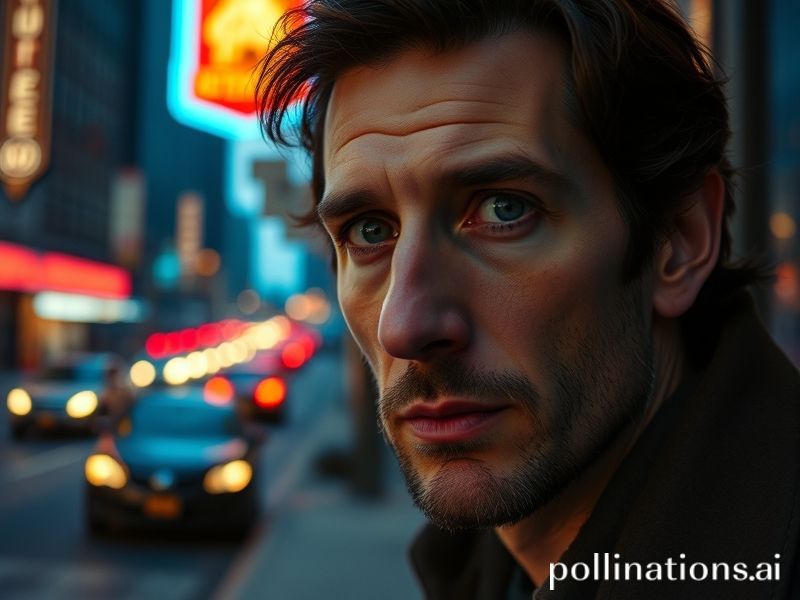
PARIS—Somewhere between a NATO summit and the collapse of the third streaming platform this week, the planet decided its most bankable export is a 6-foot-3 former Marine with the gait of an irritated giraffe and the face of a Renaissance statue that just remembered unpaid parking tickets. Adam Driver, the man who looks like he’s perpetually calculating the exact cost of your disappointment, has become the international symbol of everything we claim to hate in celebrities—until, of course, we binge-watch him at 1:00 a.m. with cheap ramen and a creeping sense of personal inadequacy.
To understand Driver’s planetary reach, start with the numbers: “Ferrari” revved its engines in 73 markets last quarter; “65” crash-landed on Netflix in 190 countries; Kylo Ren’s helmet alone has been 3-D-printed illegally from Lagos to Vladivostok. The cumulative GDP of the merchandising shadow economy surrounding Driver probably exceeds that of three Baltic nations—none of which, for the record, can currently afford to heat their public pools.
But the phenomenon is more insidious than mere ticket sales. Driver represents a new class of soft power: the aggressively un-Hollywood Hollywood star. While traditional American exports—fast food, drone diplomacy, algorithmic anxiety—lose their shine abroad, Driver lumbers through Cannes like a reluctant demigod, radiating a peculiar sincerity that Europeans mistake for existential depth and Asians read as stoic honor. In Tokyo, pop-up cafés serve “Kylo Latte” (black sesame, edible gold flakes, tiny edible Vader helmet; price: your dignity plus ¥1,200). In Berlin, graduate seminars deconstruct his monologue in “Marriage Story” as a post-Brechtian cri de coeur against late-capitalist domesticity. Meanwhile, back in Indiana, his high-school drama teacher still wonders why the kid who once stapled his own head for art class now gets invited to the Vatican to discuss “the spiritual burden of villainy.”
The UN, ever eager to stay culturally solvent, recently floated the idea of appointing Driver as a “Goodwill Ambassador for Conflicted Masculinity.” The leaked memo reads like Ionesco on downers: “Subject exhibits global appeal across hostile demographics; potential to rebrand toxic male rage as artisanal introspection.” The proposal stalled when Russia threatened a veto, citing Driver’s “persistent pro-Ukraine eyebrow twitches.”
Of course, the real dark magic lies in how his every career twitch mirrors geopolitical anxiety. When Driver signed on to “Star Wars,” the West still believed in heroic trilogies with tidy redemption arcs. By the time he wrapped “Annette,” a singing-puppet opera about celebrity nihilism, the liberal order was busy ghosting its own citizens. Now, with “Megalopolis” rumored to depict a decadent empire devouring itself, the metaphor feels less like science fiction and more like a Tuesday.
International financiers have noticed. French tax shelters, Korean chaebols, and Saudi image-laundering funds now court Driver the way Cold War spies once flipped ballerinas. Each new co-production becomes a miniature trade agreement: Italian speed, Japanese precision, American angst, all wrapped in a Fendi coat two sizes too small. The man himself reportedly negotiates via terse emails written entirely in lowercase—an affectation that studio executives interpret as either Zen minimalism or quiet contempt. Both focus-group well.
Yet the joke is ultimately on us. While the world projects its neuroses onto Driver’s furrowed brow, he appears to be playing an even longer con: using international stardom to fund Arts in the Armed Forces, a nonprofit that brings theater to bored soldiers who’d rather be anywhere else. The same audiences who once cheered Kylo Ren’s tantrums now find themselves subsidizing nuanced readings of Sophocles in a Fort Hood mess hall. Somewhere, a Pentagon accountant is quietly sobbing into an Excel sheet titled “Unforeseen Cultural Blowback.”
So here we are: a planet of eight billion people, orbiting a single man who looks like he’d rather be fixing drywall. The takeaway, dear reader, is that globalization has officially run out of new gods. We’ve recycled the old ones into moody character actors and called it progress. When the inevitable biopic drops—working title: “The Driver Doctrine”—remember you heard it first in Dave’s Locker, right between the cryptocurrency obituaries and the weather report for impending civilizational collapse.
In the end, Adam Driver is not just a movie star; he is the last honest mirror we have left, and it’s cracked in exactly the shape of our collective unease. Try not to cut yourself on the reflection.