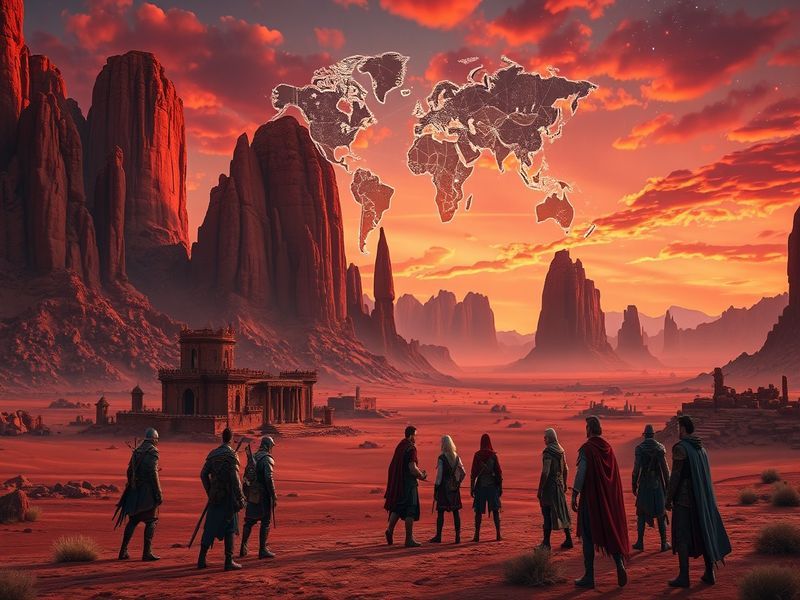
Crimson Desert Review: How This Open-World RPG Connects Globally
Pearl Abyss’s Crimson Desert arrived quietly in late 2023, yet its influence on the open-world RPG genre has already begun to ripple across global gaming communities. Unlike the immediate hype surrounding some blockbuster titles, this release unfolded with a measured presence—one that prioritizes depth over spectacle. As players from Seoul to São Paulo to San Francisco have explored its vast deserts and dynamic ecosystems, a nuanced conversation has emerged about what makes the game resonate differently across cultures.
The Game’s Design Philosophy: A Blend of Eastern and Western Influences
At its core, Crimson Desert is a synthesis of narrative ambition and world-building precision. The game’s art direction draws heavily from Korean aesthetics—vibrant color palettes, exaggerated character proportions, and a mythological undercurrent that feels familiar to fans of Korean RPGs. Yet its open-world mechanics and player freedom align more closely with Western titles like The Witcher 3 or Elden Ring.
This duality isn’t accidental. Pearl Abyss, the studio behind the game, has emphasized its commitment to creating a “living world” where every action has visible consequences. For instance:
- Dynamic ecosystems: Herds of animals migrate, predators stalk prey, and weather systems shift unpredictably, creating a world that feels reactive rather than static.
- Cultural storytelling: The game’s lore is deeply rooted in a fictionalized version of medieval Korea, but its themes—such as the struggle between tradition and progress—transcend geography.
- Player-driven narratives: Side quests evolve based on choices, allowing players to shape their experience in ways that feel personal and culturally adaptable.
This fusion has allowed Crimson Desert to appeal to a global audience without diluting its identity. Western players praise the game’s combat and exploration, while Eastern audiences connect with its visual storytelling and cultural depth. It’s a rare case where localization isn’t about translation—it’s about resonance.
Global Reception: From Steam to Seoul
The game’s reception has varied by region, reflecting broader trends in how different cultures engage with open-world RPGs. In North America and Europe, critics have highlighted the game’s technical achievements—particularly its seamless integration of action combat with RPG mechanics. Sites like IGN and PC Gamer awarded it high scores for its fluid movement, expansive map, and attention to detail.
In Asia, however, the conversation has been more nuanced. South Korean players, accustomed to polished single-player experiences from domestic studios, have embraced Crimson Desert as a point of national pride. Streaming platforms like AfreecaTV and Twitch have seen a surge in Korean content creators showcasing the game, often pairing it with commentary on its historical inspirations.
Meanwhile, in Japan, where open-world RPGs are a staple of the market, the game has been met with cautious optimism. Japanese players, known for their high standards in storytelling and gameplay balance, have noted that while Crimson Desert excels in visuals and exploration, its narrative pacing can feel uneven. This critique speaks to a broader cultural preference in Japan for tightly structured storytelling—a contrast to the Western emphasis on player freedom.
The Cultural Significance of Its Setting
One of the most compelling aspects of Crimson Desert is its setting—a fictionalized version of medieval Korea, reimagined with fantastical elements. The game’s world, known as Pywel, is a land of towering cliffs, sprawling deserts, and ancient ruins, all steeped in a richly developed lore that draws from Korean mythology and history.
This choice of setting is not without precedent. Games like Nioh and Ghost of Tsushima have also turned to East Asian history for inspiration, but Crimson Desert distinguishes itself by avoiding the “samurai trope” that often dominates Western perceptions of the region. Instead, the game’s world feels uniquely Korean—its architecture, clothing, and even its monsters are drawn from indigenous folklore, such as the Dokkaebi (goblins) and Gumiho (nine-tailed foxes).
For Korean players, this representation is validating. For international audiences, it offers a fresh perspective on a culture often reduced to stereotypes in global media. The game’s success in this regard underscores a growing demand for diverse narratives in gaming—one that doesn’t rely on Western-centric stories.
The Future of Open-World RPGs in a Globalized Market
Crimson Desert may not have dominated headlines like some of its contemporaries, but its impact on the industry is already evident. As gaming continues to globalize, the lessons from its development and reception are clear:
- Localization is more than translation: True cultural adaptation requires an understanding of what resonates emotionally with different audiences.
- Technical excellence is universal, but storytelling is personal: Players worldwide appreciate polished gameplay, but their attachment to a game often hinges on how well it reflects their own experiences or introduces them to new ones.
- Diversity in setting enriches the genre: Open-world RPGs no longer need to default to European or fantasy medieval aesthetics to captivate players.
Looking ahead, the success of Crimson Desert could pave the way for more regionally inspired games to gain international traction. Studios in Asia, in particular, are taking note of how Pearl Abyss balanced cultural authenticity with global appeal. Meanwhile, Western developers are increasingly seeking collaborations with artists and writers from other cultures to bring fresh perspectives to their worlds.
“The key to Crimson Desert’s success isn’t just its world—it’s the way that world feels alive in a way that’s both familiar and foreign. It’s a reminder that the best open-world games don’t just let you explore; they let you belong, even if only temporarily.” — GameSpot
As the gaming industry continues to evolve, Crimson Desert stands as a case study in how to navigate the complexities of a global audience. It’s not just a game about slaying monsters or completing quests; it’s a game about discovery—of a world, of a culture, and of oneself.