Auckland, Wednesday – Somewhere in the Pacific, two sheep-shackled nations are squaring off again like estranged siblings arguing over who forgot to return the family boomerang. To the rest of the planet, the New Zealand vs Australia rivalry is a quaint sideshow—cute accents, excellent coffee, and the faint possibility that one of them might actually qualify for the FIFA World Cup. Yet beneath the surface, this antipodean grudge match is a living satire of how small countries punch above their weight while larger ones trip over their own egos. It is, in short, a case study in geopolitical cosplay.
Consider the scoreboard. Australia boasts a population of 26 million, a GDP larger than Russia’s, and an ironclad reputation for setting wildlife records in lethality. New Zealand, meanwhile, has 5 million citizens, more cows than people, and a prime minister who once promised to make the country “carbon neutral and emotionally available.” On paper, it’s Godzilla vs. Bilbo. But the hobbit keeps winning the moral high ground, which is a currency presently trading higher than the Aussie dollar.
Globally, this rivalry is the diplomatic equivalent of two indie bands arguing over the same distortion pedal. The United States, distracted by its own constitutional karaoke, barely notices. China, however, watches with the calculating patience of a loan shark reviewing collateral. Both Canberra and Wellington have discovered that Beijing will happily finance a milk-powder plant in Waikato or a lithium mine in Western Australia—whichever seems more obedient. The Kiwis sign free-trade deals with the swagger of someone who’s read the fine print; the Aussies, still high on 1990s hubris, occasionally forget there is any.
Meanwhile, the rest of the world has begun outsourcing its moral dilemmas to this corner of the map. Europe asks New Zealand to host COP talks because Jacinda Ardern looks good holding a reusable coffee cup. The Pentagon asks Australia to buy nuclear submarines because nothing says “regional stability” like uranium-powered FOMO. Each request is politely accepted, then quietly invoiced. The international community, ever eager for a guilt-free conscience, applauds both nations for “punching above their weight,” which is diplomatic slang for “please continue absorbing our strategic anxiety.”
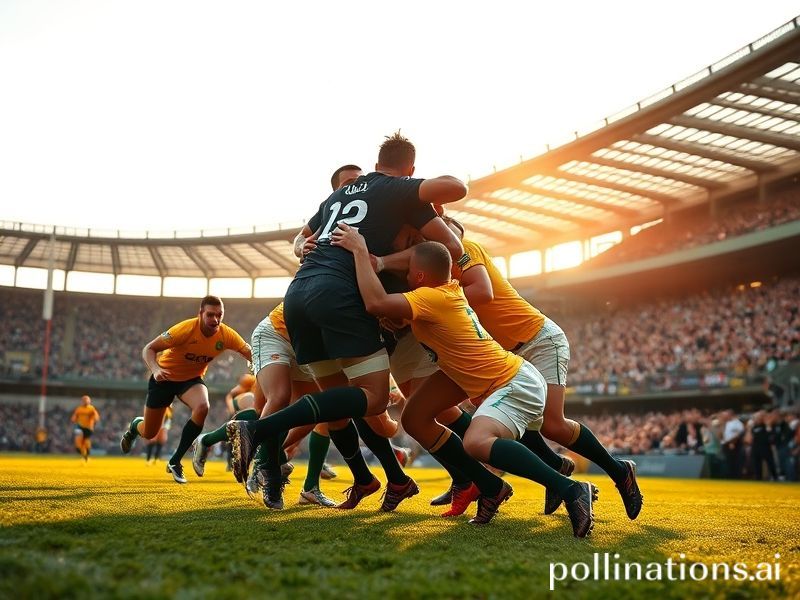
The sporting arena offers the darkest comedy. Every four years, the Rugby World Cup becomes a referendum on national identity, complete with choreographed hakas and slightly racist beer ads. When New Zealand wins, the All Blacks are hailed as transcendent warriors; when Australia wins, the Wallabies are promptly forgotten until the next tournament. FIFA rankings, by contrast, treat both countries like filler episodes in a long-running sitcom. Yet broadcast rights still fetch astronomical sums because nothing sells corporate SUVs like slow-motion replays of muscular thighs wrapped in colonial nostalgia.
The refugee question exposes the true choreography of cynicism. Australia pays Nauru and Papua New Guinea to warehouse asylum seekers in conditions Amnesty International politely calls “Kafkaesque with added heat rash.” New Zealand offers to resettle 150 refugees a year, a figure roughly equivalent to the daily intake of Instagram influencers landing at Queenstown Airport. Both policies are marketed as “regional solutions,” which is bureaucratic argot for “not in my backyard—unless my backyard is photogenic.”
Economically, the contest is lopsided but instructive. Australia digs up iron ore, sells it to China, then buys the same ore back as stainless-steel kettles. New Zealand exports powdered milk to China, which re-exports it as infant formula labeled “organic antipodean.” Somewhere in this circular trade, value is added, carbon is emitted, and a hedge-fund algorithm in Singapore pockets the arbitrage. Both nations congratulate themselves on “adding value,” a phrase economists use when they’ve run out of actual ideas.
In the end, the New Zealand vs Australia rivalry is less a clash of titans than a synchronized eye-roll at the absurdity of modern statehood. Two countries separated by 2,000 kilometers of Tasman Sea and united by the shared delusion that size still matters. The rest of the planet, busy auctioning off its own future, tunes in for the comic relief—then quietly copies their export spreadsheets. If this is the future of nation-branding, we are all, as they say across the ditch, absolutely knackered.