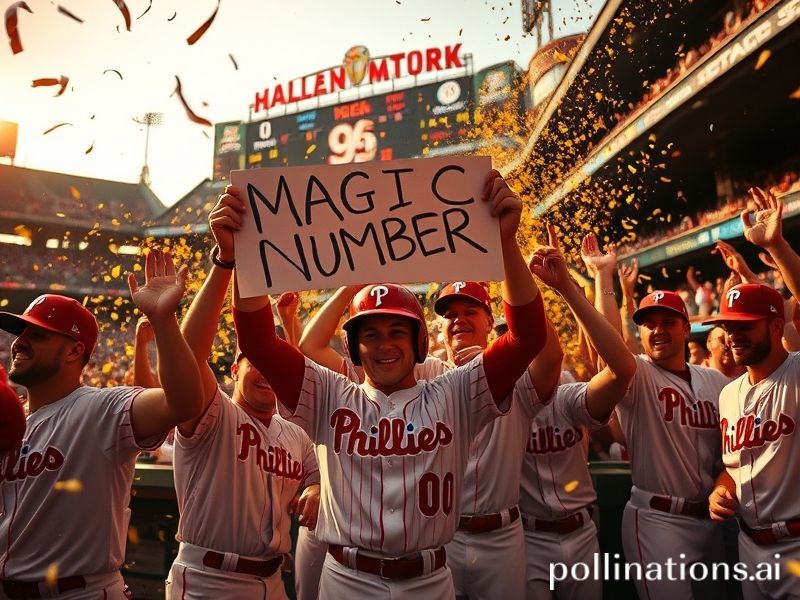
Phillies Magic Number: When a Baseball Stat Becomes the Planet’s Faint Pulse
By the time most of the world had finished doom-scrolling news of yet another currency free-fall and a renegade super-typhoon doing donuts in the Pacific, a quiet, almost quaint phrase began trending on English-language timelines from Lagos to Lahore: “Phillies magic number.” For the uninitiated, the phrase is baseball’s polite euphemism for a countdown to mathematical certainty—how many more Philadelphia wins (or competitor losses) are needed to clinch a playoff berth. Currently it hovers around the mid-teens, give or take, depending on which algorithm you trust and whether the intern updating the spreadsheet remembered to carry the one.
Yet in a week when the UN General Assembly resembled an open-mic night for apocalypse cosplay, the Phillies’ tidy little integer has taken on geopolitical symbolism. Imagine, if you will, a world so battered by inflation, drought, and influencers that it collectively decides to fixate on a sports metric involving grown men chewing sunflower seeds for six hours. That is where we are. The magic number is no longer about the Phillies; it’s about all of us—an international Rorschach blot onto which we project our last remaining hopes for orderly causality.
In Seoul, office drones stream the scoreboard on silent phones during mandatory overtime, measuring the shrinking integer the way bond traders watch the yen. In Nairobi’s rush-hour matatus, DJs wedge game updates between Afrobeats and tear-gas alerts, because nothing says “traffic jam” like a metaphor for incremental progress. Over WhatsApp voice notes in São Paulo, uncles argue whether the number will drop faster than the real against the dollar; the punch line is that both are plummeting, just on different time zones.
Of course, the Phillies themselves remain blessedly oblivious to their status as planetary pacifier. They chew, they spit, they occasionally launch a baseball into low-earth orbit, blissfully unaware that their every at-bat is being interpreted by foreign policy think tanks as a proxy for American soft-power resilience. Somewhere in Brussels, an analyst has already produced a 40-page memo titled “The Geopolitical Utility of Late-Inning Heroics,” concluding that if the number hits zero before October, NATO’s eastern flank can probably hold until spring.
The darker joke, naturally, is that the magic number is only magic because everything else seems rigged. Supply chains are snarled, elections are circuses, and the planet’s thermostat is stuck on “rotisserie.” Against that backdrop, a clean arithmetic of wins and losses feels like sipping artisanal water in hell: refreshing, pointless, but at least quantifiable. You can’t hack a magic number—though by next season some crypto bro will no doubt sell you an NFT of it.
International bookmakers have taken note. London’s betting shops now offer odds on whether the Phillies clinch before Britain’s next prime minister resigns (currently a dead heat). Dubai’s sovereign wealth funds, ever on the lookout for exotic hedges, have reportedly inquired about securitizing the variable, presumably so they can short human optimism itself. Somewhere a quant is building a volatility model that correlates the number with wheat futures, TikTok trends, and the average humidity in Jakarta.
Still, the shrinking integer keeps ticking down, night after night, like a benign doomsday clock in reverse. Every update pings across continents, a pocket-sized reminder that somewhere, somehow, a definitive outcome is still possible—even if that outcome is merely the right to play more baseball while glaciers calve politely in the background. The world’s collective serotonin, long since rationed, spikes by imperceptible milligrams.
When the magic number finally hits zero, fireworks will detonate over the Philadelphia skyline, and for three glorious minutes, social media will drown out missile tests and market crashes with photos of grown men pouring Bud Light on each other’s heads. The rest of us, from Reykjavík to Riyadh, will exhale in vicarious relief, then return to our respective dumpster fires—comforted, however briefly, by the knowledge that somewhere, at least, the math still works.