Cupertino, California – The iPhone 17 was unveiled yesterday beneath an LED sky the color of a corporate sunrise, and within minutes the planet performed its annual synchronized swoon. From Lagos to Lahore, Berlin to Bogotá, the same ritual unfolded: thumbs hovering above “Add to Cart,” credit-card limits quietly recalculated, and a billion screens refreshed in unison like some devotional heartbeat. Apple’s marketing department calls this “magic”; the International Energy Agency calls it a 0.3 % spike in global electricity demand. Both statements are, in their own joyless ways, true.
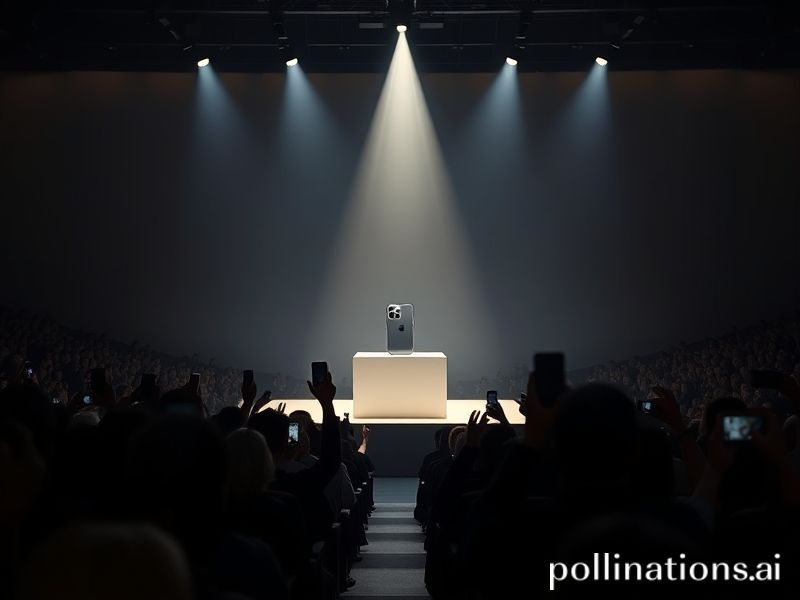
The keynote itself was a marvel of stage-managed intimacy, hosted in the Steve Jobs Theater—an underground concrete womb where optimism is manufactured at industrial scale. CEO Tim Cook emerged in his regulation dark polo, the global uniform of unthreatening power, and announced that the iPhone 17 is “crafted from 100 % recycled aluminum and even more recycled ideas.” The audience, a masked choir of influencers and institutional investors, applauded on cue. Somewhere in the gallery, a European commissioner quietly checked whether “recycled ideas” counts toward carbon credits. (It does not.)
What’s new? A camera bump that has finally achieved geopolitical significance: so large it can be seen from the International Space Station, prompting the Russian cosmonauts to file a complaint about orbital clutter. The device ships in four colors: Graphite, Starlight, Pacific Blue, and Late-Stage Capitalism Teal. Storage begins at 256 GB, scaling up to 1 TB for users who insist on filming every brunch in Dolby Vision HDR. The most arresting feature is “RealitySync,” a neural engine that edits your photos in real time to remove crowds, poverty, and—according to early testers—ex-partners. Apple calls it “empowering personal storytelling”; divorce lawyers call it “exhibit tampering.”
Global supply chains, those serpentine miracles of just-in-time suffering, flexed obediently to deliver the goods. Foxconn’s Zhengzhou plant—locally nicknamed iPhone City—briefly halted production last month when workers discovered that their dormitories were being sublet to ChatGPT servers to offset energy costs. The matter was resolved after management promised the A.I. would only listen, not judge. Meanwhile, Congolese cobalt miners greeted news of the 17’s enhanced battery life with the sort of weary shrug usually reserved for cease-fires that don’t last the weekend.
In Europe, regulators greeted the launch with the enthusiasm of a dentist confronting a new cavity. Brussels is already drafting the Digital Markets Act 3.0, subtitled “This Time We Mean It.” The proposed fine for pre-installed apps is set at 7 % of global turnover, or roughly three hours of App Store revenue—whichever hurts more. Across the Channel, post-Brexit Britain celebrated its regulatory independence by asking Apple to please install backdoors anyway, but with more polite signage.
Emerging markets offered the most poignant theater. In India, the iPhone 17 will retail for the equivalent of 1,400 USD, or one-third of the average urban salary, making it the perfect gift for that special someone you’d like to bankrupt. In Brazil, import tariffs push the price to 2,100 USD, ensuring the device remains a status symbol for politicians who insist they’re “living on a civil servant’s wage.” Meanwhile, Chinese consumers—the demographic Apple cannot afford to alienate—were told the 17 comes in a special “Harmony Red,” a shade suspiciously close to Huawei’s corporate palette. Analysts call this “diplomatic color theory.”
Environmentalists attempted a counter-programming event outside the theater, wielding signs that read “There Is No Planet Pro.” They were politely informed by Apple’s security team—outsourced from Pinkerton—that protest permits must be downloaded from the App Store, currently experiencing “higher than expected traffic.” The activists dispersed to tweet their outrage on devices they already owned. Somewhere, a polar bear filed the incident under “not my problem.”
As the sun set over Cupertino, the first pre-orders crashed Apple’s website in seventeen languages, proving that Schadenfreude is the only truly universal tongue. The company’s stock ticked up another two percent, adding $40 billion in market cap—roughly the GDP of Tunisia—because nothing says “innovation” like selling the same rectangle slightly faster than last year.
And so the world spins on, tilted 23.5 degrees but oriented perpetually toward a 6.1-inch OLED panel. The iPhone 17 is not merely a phone; it is a planetary passport, an anxiety pacifier, a talisman against the creeping suspicion that progress is just nostalgia in a thinner chassis. Tomorrow there will be unboxings, drop-tests, and earnest op-eds about screen-on time. The day after, the rumors begin for the iPhone 18. Somewhere in the dark, a landfill softly sighs.