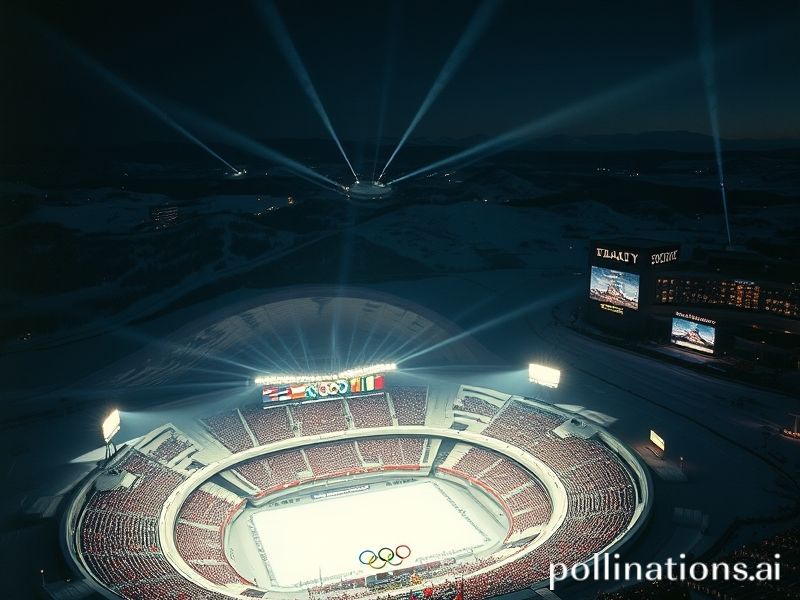
The 2002 Winter Olympics in Salt Lake City were billed as a celebration of human excellence, a moment when the planet’s finest athletes gathered in Utah to glide, spin, and occasionally face-plant for the greater glory of their flag-bearing overlords. From the vantage point of 2024—after two decades of pandemics, populist coups, and the slow-motion collapse of Twitter—the Games now look less like a triumph of the Olympic spirit and more like a dress rehearsal for the geopolitical sitcom we’re all trapped inside.
Let us rewind. In February 2002, the world was still digesting 9/11, the dot-com bubble had burst like a cheap piñata, and George W. Bush was busy dividing humanity into “with us” and “with the terrorists.” Salt Lake City—land of Mormons, mining fortunes, and arguably the planet’s largest per-capita stockpile of Jell-O—was tasked with proving that terror could not stop the planet’s premier pageant of spandex nationalism. The International Olympic Committee, still reeling from its own bribery scandal (who knew Swiss real estate and ski weekends could be so corrupt?), handed the keys to a city that had spent $2 billion to upgrade infrastructure the locals would spend the next twenty years still paying off. Nothing says “peace through sport” like municipal bond debt.
Globally, the event was a masterclass in narrative laundering. Russia, still licking wounds from its post-Soviet hangover, showed up hoping to remind everyone they could still ice-dance with the best of them. Germany arrived with precision-engineered sleds and the faint scent of reunification triumphalism. Norway, population 4.5 million, somehow left with more medals than several continents combined—proof that cross-country skiing is the Scandinavian equivalent of nuclear deterrence. Meanwhile, the United States, desperate for feel-good symbolism, parlayed home-snow advantage into a record 34 medals, prompting the sort of chest-thumping usually reserved for aircraft-carrier landings.
Yet the real spectacle was geopolitical kabuki. Security was tighter than a Mormon wedding chastity belt: F-16s patrolled the skies, Black Hawk helicopters hovered like anxious stage moms, and 15,000 law-enforcement officers turned downtown Salt Lake into a gated community with latte stands. The message to the planet: yes, you may watch the triple axels, but please ignore the Patriot missiles behind the bobsled track. International visitors, already jet-lagged and wallet-drained, gamely submitted to airport pat-downs that would make a TSA agent blush. Somewhere in Pyongyang, Kim Jong-il reportedly took notes.
The economic legacy is equally instructive. Local boosters promised a tourism boom that would last “decades.” In reality, hotel occupancy rates returned to baseline faster than you can say “bailout,” and the Olympic Village was converted into student housing for a state university whose football team still can’t crack the top 25. Salt Lake did inherit some spiffy light-rail lines—now prized by commuters who mutter about “those damn Olympians” every time property tax assessments arrive.
And then there’s the doping. The 2002 Games were the coming-out party for BALCO’s pharmacological buffet. A decade later, retroactive testing stripped medals from enough athletes to field a small nation. The lesson: if you’re going to cheat, do it in real time; history’s lab techs are relentless.
Still, for one fortnight the planet pretended that lycra-clad gladiators could transcend trade wars and drone strikes. Viewers from Lagos to Lahore rooted for underfunded underdogs whose governments couldn’t afford snow, let alone snowboards. The closing ceremony featured a giant icicle-shaped torch being extinguished while *NSYNC performed—an apt metaphor for early-2000s optimism now melting into whatever we’re calling the present era.
In the end, the Salt Lake City Olympics were neither apocalypse nor utopia, just another expensive reminder that humanity can briefly unite around the spectacle of near-naked people risking frostbite for metallic neckwear. The torch was passed, the debts lingered, and the world returned to its regularly scheduled hostilities—only now with better Wi-Fi.