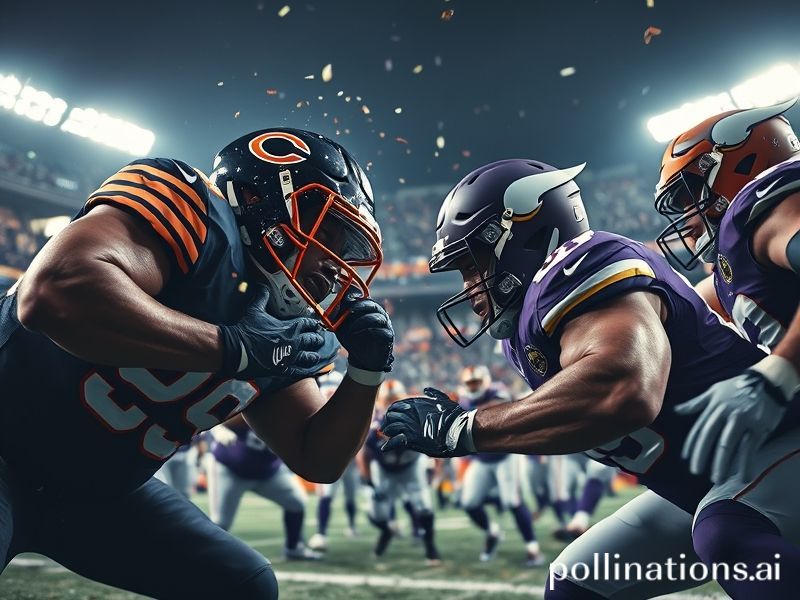
Chicago — It began, as most modern apocalypses do, with a push notification: “Bears vs Vikings: 3 p.m. local, 21:00 GMT, 06:00 tomorrow in Seoul.” Somewhere between the algorithmic chirp and the global reflex to refresh the scoreboard, the planet’s attention pivoted to a frozen rectangle of Midwestern sod where 106 padded mercenaries pretended the fate of the free world hinged on a misshapen leather lemon.
Of course, the free world wasn’t watching. It was doom-scrolling. In Kyiv, a commuter glanced at the livestream while sheltering from another drone ballet. In Lagos, a boda-boda driver balanced a cracked phone on the handlebars, half-hoping the Bears’ defense would hold the line better than his own government’s currency. In Sydney, an insomniac hedge-fund analyst used the game as white noise while shorting Nordic renewable ETFs—“for the irony,” he told his therapist later.
The broader significance, if one insists on finding meaning in millionaires cosplaying Norse berserkers and ursine carnivores, is that the spectacle has become the last universally translatable dialect of late capitalism. The NFL now beams its gladiatorial telenovela to 190 countries, a reach the UN envies and UNESCO deplores. Last season, the league’s international revenue cracked US $2 billion, comfortably exceeding Iceland’s GDP. Somewhere in Reykjavík, a junior minister for fisheries quietly weeps into a skyr.
Meanwhile, the geopolitical subtext writes itself. Chicago’s Bears—named for a city that can’t afford to keep its schools heated—face Minnesota’s Vikings, a franchise whose logo is literally a weaponized white guy. The mascots alone are a seminar in colonial nostalgia: one side celebrates the empire that pillaged Europe, the other the empire that gentrified it. Somewhere, a graduate student is already crafting a thesis titled “Skol Chants and Settler Anxiety: A Post-Colonial Reading of Third-and-Long.”
The game’s ripple effects are felt in real time on global markets. When Bears QB Justin Fields scrambles for 32 yards, micro-futures in DraftKings fluctuate like the lira. A single sack on Vikings passer Kirk Cousins triggers algorithmic sell-offs in Minneapolis-based Target Corp.—because nothing terrifies Wall Street like a concussed Midwesterner. In London, Premier League owners watch nervously: if Americans can monetize concussions this creatively, imagine what they’ll do with the Champions League.
Refugees in Gaziantep huddle around a flickering Turkish feed, bemused to learn that the word “blitz” can describe both a defensive scheme and what flattened their apartment block. A bar in Medellín offers two-for-one shots every time the broadcast cuts to a slow-motion replay—an innovation the DEA is studying for future psyops. Even Beijing’s censors allow the game, albeit with a ten-second delay to scrub any shots of fans holding “Free Hong Kong” signs disguised as play-call placards.
Back in the stadium, the halftime show features a pop star whose last album was ghost-written by ChatGPT and produced by a Danish collective using recycled glacier water. The drones overhead form the shape of a dollar sign, then morph into a polar bear hugging a longship—an image focus-grouped to appeal equally to climate-anxious Gen Z and crypto-bros who think “Nordic noir” is a stablecoin. The metaphor is so on-the-nose it qualifies as rhinoplasty.
By the fourth quarter, the cosmic joke becomes clear: whichever side wins, the trophy is still a silver football. No grain subsidies change hands, no border shifts, no war ends. Yet for three commercial-packed hours, the planet’s nervous system pulses to the same cadence: first down, punt, replay review, existential dread. The final whistle blows. Bears 24, Vikings 21. Futures in sadness futures tick upward; futures in hope remain suspended.
And then, as if choreographed by some sadistic deity, the feed cuts to a breaking-news chyron: “Arctic sea ice at record low.” Somewhere, an actual polar bear—unconcerned with nickel defenses, trademarked horns, or quarterly earnings—slips quietly into the water, indifferent to the score. The Vikings, one assumes, would respect the gesture. The Bears, being corporate mascots, will simply file it under “brand risk.”
The world exhales, re-opens Twitter, and forgets everything except the fantasy-league points it still needs on Monday. Same time next week, different costumes, identical absurdity. Skål.