Padres, Papas, and the Planet: A Dispatch from the Universal Fatherhood Front
By our Special Correspondent, still recovering from a three-continent Father’s Day bender
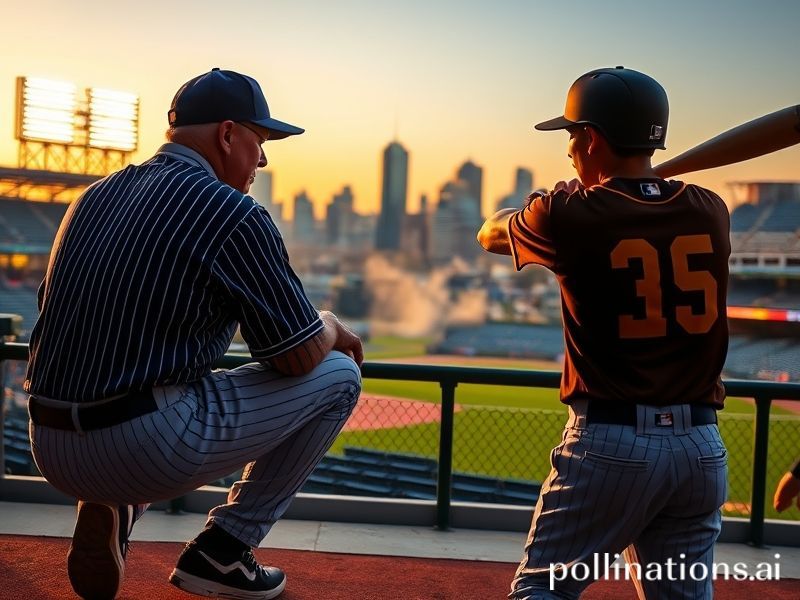
The word “padre” once conjured images of incense, guilt, and the sort of Latin-lover priest who could absolve you on Sunday and sell you discounted rosaries by Monday. Today it is more likely to appear on the back of a baseball jersey in San Diego, in WhatsApp voice notes from Caracas asking if you’ve transferred the rent money, or in an OECD spreadsheet measuring how much unpaid childcare is propping up the global economy. Somewhere between holy father and deadbeat dad lies the modern padre: a man whose authority has been downgraded from divine right to Wi-Fi password holder, yet whose failures still threaten to capsize civilisation one paternal grudge at a time.
Consider the macro view. In Japan, the government pays citizens to date so that future padres can be lured into reproduction before the last rice cooker turns itself off for good. In Sweden, paternity leave is so generous that new fathers have been spotted pushing prams through IKEA in a fug of cinnamon-scented egalitarianism—only to discover that the flat-pack instructions for parenting contain exactly 17 missing screws. Meanwhile, in Lagos, a “padre” may be the neighbourhood uncle who wires home Dubai dirhams so his niece can finish medical school, proving that remittances now outperform half the currencies in West Africa.
Globalisation has turned fatherhood into an outsourced gig. A Filipino nanny raises a banker’s children in London while the banker FaceTimes his own kids from a Singapore layover, promising—cross my heart—that he’ll make the next recital. The World Bank calls this “labour mobility”; the children call it “the Wi-Fi went out again.” Everyone agrees it’s cheaper than divorce.
The geopolitical stakes are higher than a teenager’s phone bill. China recently discovered that 30 million surplus men—literal “bare branches” on the family tree—make excellent cannon fodder for nationalist TikTok, but lousy consumers of nappies and private education. In response, state media has begun broadcasting soap operas in which buff cadres cradle newborns while reciting Confucian lullabies. The birth rate ticked up 0.0003 %. Party officials toasted with warm baijiu and quietly booked vasectomies for their sons.
Europe, ever the moral valedictorian, has pivoted to eco-fatherhood. German dads now compete over carbon footprints the way their grandfathers compared war wounds. “I cycled to the birthing pool,” boasts Tobias, 38, whose reusable nappies have the tensile strength of a Bundeswehr rucksack. His toddler will be able to reuse them as a parachute should the climate wars begin before potty training ends.
Of course, not all padres are created equal. In Texas, a legislature brimming with self-proclaimed family values has perfected the art of legislating wombs while dodging child-support payments; the hypocrisy is so dense it could be fracked for oil. Down in Argentina, inflation is so savage that fathers barter sacks of pesos for a single packet of cookies, teaching their kids a real-time lesson in monetary theory. “Papi, why is money sad?” asks little Valentina. “Because it remembers when it was worth something, mija,” he replies, tucking her in with a blanket of worthless banknotes—Argentine origami meets gallows humour.
Yet for all the jokes, the absence of fathers—or their overbearing presence—remains the single most reliable predictor of whether a boy will end up a Nobel laureate or a cartel lieutenant. The UN, ever fond of acronyms, has launched D.A.D. (Dads Against Despair), a programme that ships soccer balls and conflict-resolution manuals to post-conflict zones. Early results show a 12 % drop in teenage recruitment, offset by a 15 % rise in dads using the manuals as beer coasters.
Which brings us to the cosmic punchline: in the end, every culture, regardless of GDP or alphabet, arrives at the same bedtime story. The padre leaves, or stays, or pays, or forgets, or dies—but the child still asks the stars, “Was I enough?” And the stars, being indifferent gig workers in the galactic economy, subcontract the answer back to whichever exhausted adult is currently on duty.
So here’s to the padres: the saints, the scoundrels, the spectral figures haunting Western Union queues and baseball diamonds alike. May your jokes land softer than your promises, and may your children forgive you—if only because they’ll need someone to explain how the thermostat works when the planet finally melts.