Hasbro: How a Rhode Island Toymaker Became the Soft-Power Emperor of a Planet on the Brink
By the time the first Ukrainian kid unpacked a donated box containing a My Little Pony action figure still labeled in Cyrillic for the Moscow market, the cosmic joke was already complete. Somewhere in Pawtucket, Rhode Island, a middle manager was high-fiving the quarterly-earnings deck while, 4,500 miles east, children were reenacting the siege of Mariupol with Nerf darts and plastic princesses. Welcome to Hasbro’s twenty-first-century business model: exporting the distilled dreams of American suburbia to a globe that can’t decide whether to hug itself or blow itself up.
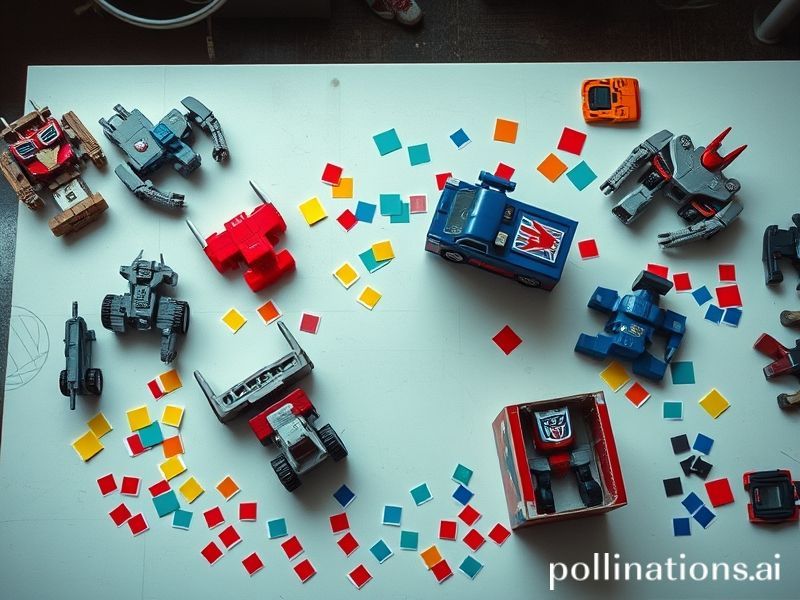
Hasbro is, on paper, a toy company. In practice it is a planetary mood-ring—its balance sheet fluctuating with every geopolitical tremor. When Beijing tightens regulations on “effeminate” cartoons, Peppa Pig tiptoes toward the exit. When Riyadh decides women can finally drive, a special-edition Monopoly: Saudi Arabia appears with a pink token shaped like a hatchback. The firm’s executives speak in the bland argot of “brand synergies,” but what they’re really trafficking in is portable ideology: the notion that buying a plastic Optimus Prime might somehow transform a Jakarta slum into a Spielberg suburb, complete with cul-de-sac and suspiciously white picket fences.
Consider the numbers. Roughly 45 percent of Hasbro’s $5.86 billion in revenue last year came from outside North America. That’s more than the GDP of Sierra Leone, funneled into molded ABS plastic and cardboard. The company’s supply chain is a sleepless circulatory system stretching from Shenzhen sweatshops to Dutch distribution hubs, where pallets of Play-Doh sit beside emergency shipments of baby formula—both, apparently, critical infrastructure now. When the Suez Canal got corked by the Ever Given, Hasbro’s stock dipped three percent. Analysts called it “transitory”; parents called it Christmas cancelled.
Darkly comic, then, that the same corporation selling Mr. Potato Head in rainbow drag is simultaneously the Pentagon’s monopoly supplier of licensed morale patches. Somewhere in Kabul, an American drone pilot calibrates coordinates wearing a Transformers velcro badge; back home, a six-year-old queues up Bumblebee on Paramount+. The military-industrial complex and the toddler-indoctrination complex share the same cinematic universe, and Hasbro collects royalties on both ticket windows.
The firm’s true genius lies in its ability to monetize nostalgia faster than societies can metabolize trauma. After two decades of forever wars, what’s the perfect balm? A $350 Millenium Falcon Lego—sorry, Hasbro—reissue. Climate anxiety keeping you up? Try the new “Eco-Edition” Monopoly made from 100 percent recycled paper. (The Community Chest still advises you to “Buy a Yacht.”) Even pandemic death cults were folded into the marketing plan: Hasbro’s 2021 “Together Apart” campaign featured plush Baby Yodas masked like ICU nurses. Nothing says global solidarity like a $29.99 plushie that went viral on TikTok while India’s crematoria ran overtime.
Meanwhile, the world’s children—those who haven’t been conscripted, trafficked, or simply priced out of play—are left to interpret this plastic Esperanto. A Syrian refugee in Berlin builds a LEGO—sorry, Kre-O—fortress that looks suspiciously like the Azaz crossing. A Brazilian favela kid stages coup scenarios with G.I. Joes rebranded as “Global Integrated Joint Operating Entity,” because “Real American Hero” tested poorly in focus groups south of the equator. Somewhere in the metaverse, Mark Zuckerberg is no doubt plotting NFT Ouija boards.
Hasbro will tell investors it’s merely “following the consumer.” A more honest slogan would be “weaponizing arrested development for cash.” But who among us is not complicit? Every time we buy a board game to stave off the existential dread of another lockdown, we’re voting for the continued export of a fantasy America that never quite existed—except on Saturday-morning television, which Hasbro also owns via Entertainment One. The vicious circle is complete: we purchase the dream because reality is unbearable; reality becomes unbearable because we’d rather purchase the dream.
And so the company sails serenely on, a plastic galleon in a sea of flaming garbage, guided by the North Star of quarterly guidance. One day, archaeologists will sift through the stratified layers of our landfills and find a fossilized Mr. Potato Head arm, still clutching a tiny American flag. They will wonder what ritual we performed, what god we appeased. The answer, of course, is ourselves.