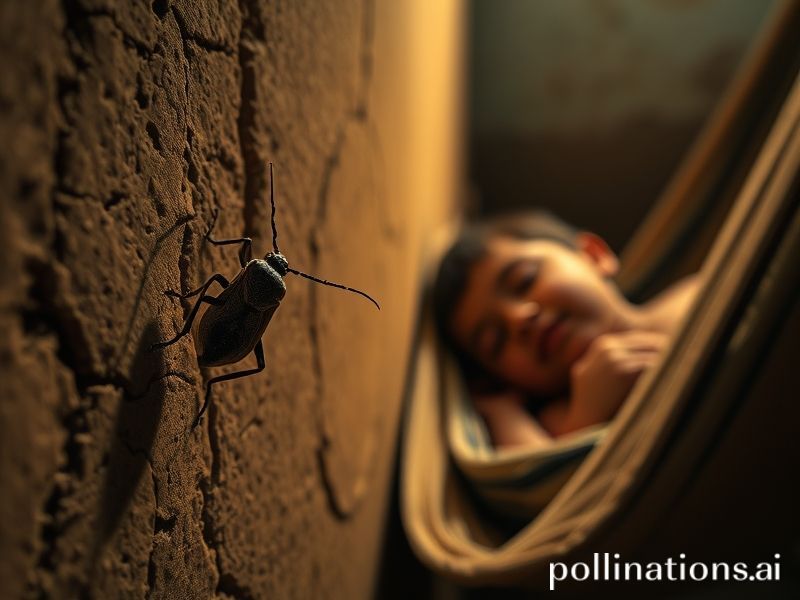
The Kissing Bug’s Grand World Tour: How a Latin American Parasite Became Everyone’s Problem
By the time you finish your morning espresso, three more people will have joined the 6–7 million already hosting Trypanosoma cruzi, the unicellar squatter that causes Chagas disease. Most of them won’t know it yet; the parasite is polite enough to wait decades before it detonates heart failure or digestive collapse. In other words, the perfect dinner guest—if your idea of a good party ends in sudden cardiac arrest.
For decades Chagas was the geopolitical equivalent of a regional indie band: huge in Latin America, invisible everywhere else. Then globalization did what it always does—export the local headache worldwide. Blood banks from Madrid to Sydney now screen for it. Neonatal units in Tokyo have diagnosed babies whose mothers never left Bolivia. And the kissing bug, the blood-sucking triatomine that doubles as a tiny, winged syringe, has been spotted in 27 U.S. states, probably enjoying the warmer winters climate change so thoughtfully provides. Nothing says “developed nation” like vector-borne diseases previously confined to adobe walls.
The World Health Organization calls Chagas a “neglected tropical disease,” a bureaucratic euphemism meaning “no profit, no press, no problem—until the corpses pile up.” Big Pharma produced exactly two drugs since 1969, both nearing retirement age themselves. Treatment works if you catch the parasite before it settles in for the long siesta; otherwise you’re left with palliative care and the knowledge that your heart might one day pull a Jenga move without warning. On the bright side, you’ll finally find out which friends read medical footnotes.
International migration is the reason your neighborhood cardiologist now knows how to pronounce “megacolon.” Roughly 75 % of infected people have left rural Latin America for cities where Chagas sounds like a trendy chili pepper. Spain alone estimates 50 000 cases, politely reminding the EU that fortress walls don’t stop protozoa. Italy offers free treatment—generous, considering it once imported Latin American labor to pick its tomatoes. Meanwhile, the United States screens only 60 % of donated blood, presumably because the free market prefers surprise endings.
The economic math is as elegant as it is grim. A 2020 study pegged global Chagas costs at US $7.2 billion annually, roughly the GDP of Malawi, spent on pacemakers, colon surgeries, and lost productivity. That figure doesn’t include the existential surcharge of knowing your heart could retire early because a bug defecated on you during childhood. For comparison, the world spends about the same amount yearly on chewable vitamins for pets. Priorities are adorable.
Solutions exist, but they require the rarest of international commodities: sustained attention. Brazil eliminated transmission via blood transfusion in the 1990s using tests that cost less than a Rio cocktail. Argentina sprayed two million houses and cut new infections by 78 %—proof that public health works when governments remember their day job. The hitch is that success stories don’t trend on Twitter unless they involve a celebrity and a shocking MRI. Trypanosomes are camera-shy.
Which brings us to the broader significance: Chagas is a preview of what happens when climate change, migration, and indifference share an Airbnb. Dengue in Paris, Zika in Texas, malaria in Greece—each was once a “foreign” problem until airplanes and rising temperatures delivered it gift-wrapped. The parasite’s slow burn makes it the perfect metaphor for every slow-motion crisis we prefer to ignore: pension time bombs, antibiotic resistance, that weird noise your engine started last Christmas. By the time symptoms show, the warranty has expired.
So here’s a toast—preferably not at dusk when kissing bugs are foraging—to the world’s most patient pathogen. It reminds us that borders are imaginary, markets are sociopathic, and human empathy rarely extends beyond the incubation period of a trending meme. If that thought makes your chest tighten, relax: it’s probably just existential dread. Probably.