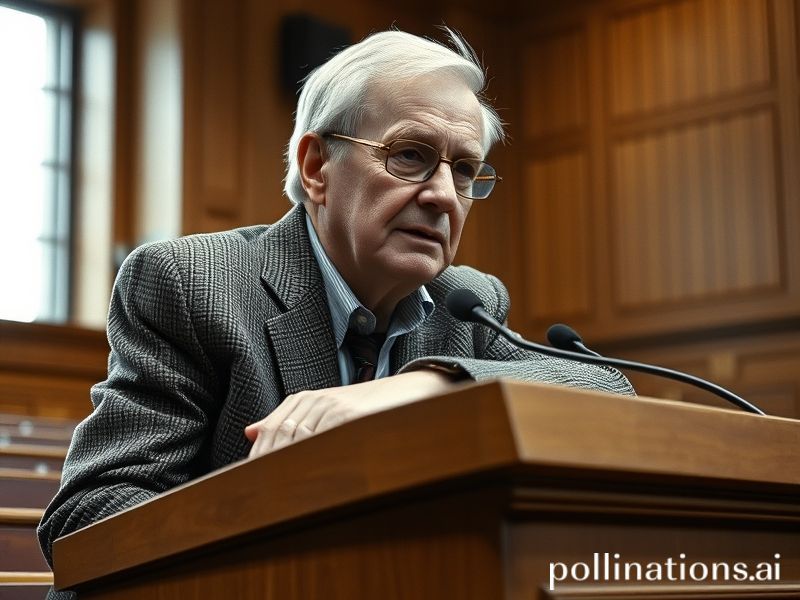
THE QUIET IMPERIALISM OF HENRY BIENEN, OR HOW A NORTHWESTERN PRESIDENT TAUGHT THE WORLD TO LOVE ITS NEOLIBERAL OVERLORDS
By Our Correspondent Somewhere Between the Quad and the IMF
It is tempting, in the age of instant outrage and TikTok summits, to dismiss Henry Bienen as a quaint Midwestern apparition: tweed, tortoiseshell glasses, and the faint whiff of library dust. Yet the man who steered Northwestern University from 1994 to 2009 is, in his understated way, one of globalization’s most successful export managers. While the World Bank was still cold-calling dictators and Davos was learning to spell “inclusive,” Bienen was quietly packaging the American research university as a turnkey soft-power franchise for every ambitious petro-state and Asian tiger with loose change. The curriculum? Meritocracy with a side of alumni donations; the exchange rate? One Rhodes Scholar equals two cement plants and a vague promise of academic freedom.
Born in 1939, Bienen came of age when decolonization was the cocktail chatter and “development economics” still sounded like a cure rather than a punchline. After a detour through Princeton’s Woodrow Wilson School—where idealism goes to get tenure—he spent the 1970s and ’80s hopscotching Africa like a polite gunboat, advising governments on how to liberalize without letting the lights go out. He returned stateside with a Rolodex thick enough to prop open the door of every underfunded humanities department in America and a conviction that universities, not missile silos, were the real long game of empire.
Appointed Northwestern’s fifteenth president, Bienen immediately ran the institution like a leveraged buyout in intellectual form. Endowment up 300 percent; satellite campus in Qatar (motto: “Education, Sponsored by Natural Gas™”); and the Kellogg School proudly minting MBAs fluent in both Excel and plausible deniability. Critics muttered about academic values being strip-mined; end-users from Lagos to Lahore simply shrugged and applied, recognizing a bargain when they saw one. After all, if you can’t have functioning democracy, at least you can have brand-name credentials—preferably embossed in purple and gold.
The global fallout has been exquisite. Today, a Bienen-blessed graduate sits on the board of every other sovereign wealth fund from Singapore to Santiago, quoting Clayton Christensen between sips of single-origin espresso. Western NGOs still wring their hands about brain drain; the exporting nations, meanwhile, have learned to call it “talent arbitrage” and invoice accordingly. The irony is textbook: the same institutions once tasked with civilizing the natives now rely on their full-tuition cash flows to keep the lights on in Evanston. Colonialism 2.0 comes with a 401(k) and optional dental.
Bienen himself stepped down in 2009, handing the baton just in time for the world to discover that unlimited growth was as imaginary as a liberal arts job market. Yet his legacy persists in every gleaming glass-and-steel “international branch campus” that sprouts like a mirage in the desert. They come equipped with Starbucks, gender-segregated study lounges, and a provost who can recite the U.S. News algorithm in his sleep. When those same outposts inevitably face faculty mutinies or diplomatic blowback—see: NYU Abu Dhabi labor strikes, Yale-NUS’s recent pre-mortem—the ghost of Bienen is somewhere chuckling into his endowment reports, having already banked the Qatari riyals.
Which brings us to the broader significance: Henry Bienen proved that the most durable conquests require no occupying army, merely a glossy brochure and a cooperative visa office. In a century when superpowers rise and fall with the volatility of crypto, the university president-cum-emissary has become the last reliable sovereign. He sells aspiration disguised as accreditation, garnished with just enough cosmopolitan rhetoric to let buyers believe they’re partners rather than clients. Meanwhile, back in Illinois, the lake still freezes, the football team still disappoints, and the tuition climbs—proof that the real genius of empire is convincing the colonies to fund their own indoctrination, semester by semester.
So when the next authoritarian darling cuts the ribbon on yet another “Global Institute for Innovation & Leadership,” remember the name stamped faintly on the cornerstone: Henry Bienen, the man who taught the world that the pen may be mightier than the sword, but the tuition invoice is mightier still.