Thin Mints as Soft Power: How Girl Scout Cookies Conquered a Planet That Can’t Agree on Anything Else
By [Name Withheld to Protect the Guilty], International Affairs Desk
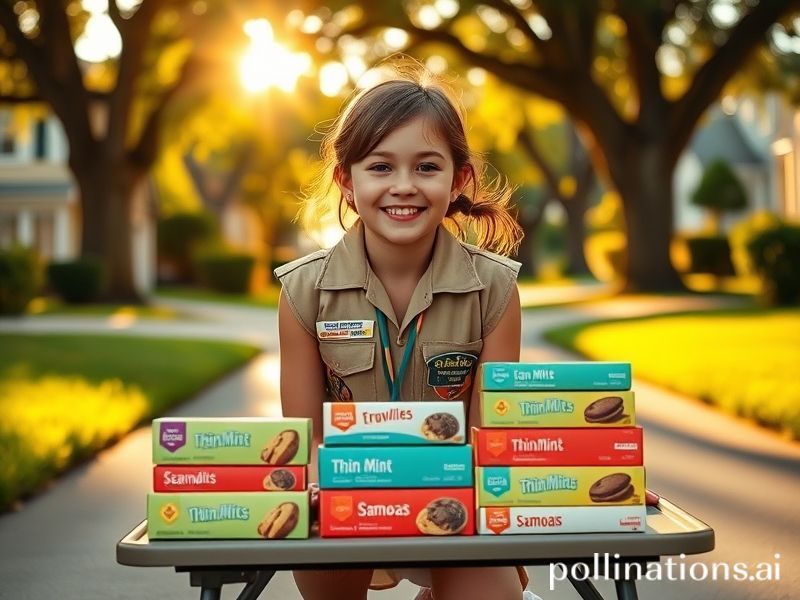
GENEVA—While the UN Security Council spends another evening locked in performative stalemate over whose war crimes are more “contextual,” a stealthier multilateral force has managed unanimous global buy-in: eight-year-old capitalists in sashes, pushing $6 boxes of chemically perfected nostalgia. Girl Scout Cookies—yes, those innocent, shrink-wrapped calories—have quietly become the most effective American export since the iPhone and, arguably, the more addictive of the two.
Start with the numbers. Each February-April, 1.7 million scouts in the United States sell around 200 million boxes, grossing roughly $1 billion. That’s double Iceland’s annual defense budget, achieved without a single F-35. Factor in diaspora relatives and black-market eBay resellers, and the cookies land in 130 countries, from Qatar duty-free lounges to Filipino call-center break rooms. Somewhere in Ukraine, a front-line medic is stress-eating frozen Tagalongs donated by a Kansas church group; in Shanghai, a hedge-fund analyst pays the equivalent of $18 for “seasonal American specialty wafers” to impress clients who’ve never seen a camping tent. Soft power, it turns out, tastes like discounted fudge.
The trans-national appeal is baffling until you remember three universal truths: humans love sugar, guilt, and the plausible fiction that cookies fund civic virtue. Never mind that only 75¢ of your $4 (U.S. price) stays with the troop; the remaining $3.25 is divvied among bakery conglomerates, transport middle-men, and the organizational bureaucracy that prints those cheery “All Abilities Welcome!” flyers. In other words, it’s a supply chain that would make Nestlé blush, wrapped in the moral bubble-wrap of youth empowerment. If Karl Marx were alive, he’d diagnose the phenomenon as “commodity fetishism with glitter stickers.”
Still, the branding works because the world desperately wants to believe children can still self-finance leadership seminars rather than, say, mine cobalt. France tried its own version—“Les Petites Eclaireuses Biscuits”—but surrendered after inspectors discovered the scouts outsourced production to a Breton factory already supplying frozen croissants to Saudi airlines. Japan’s Girl Scouts market dehydrated miso soup packets; sales remain tepid, proving umami can’t compete with high-fructose corn syrup and American soft-power nostalgia. Meanwhile, Canada’s Scouts ditched cookies entirely for environmentally themed popcorn, instantly losing half their membership to hockey. Lesson: planetary consciousness is admirable; planetary consciousness without chocolate is bankruptcy.
The dark magic lies in scarcity. Cookies are available only once a year, creating a panic reminiscent of Soviet breadlines, except with better marketing and sadder music on TikTok. In Berlin, expat parents bribe returning friends to act as mule couriers; one diplomat was caught invoicing the embassy for “strategic cultural outreach supplies (Samoas).” At Davos, an elite troop set up a pop-up stand between the Saudi and Ukrainian pavilions, selling a “bipartisan bundle” for €50 while explaining how proceeds teach girls to code. Attendees left clutching cardboard like it was enriched uranium. Nothing unites oligarchs and climate activists quite like shared childhood diabetes risk.
Nutritionists, those professional joy-kills, point out that two Thin Mints equal the sugar load of a can of Coke. But in a world where Coca-Cola sponsors COP water stations, hypocrisy is the daily special. The same European governments that slapped America with a 25 percent retaliatory tariff on Harley-Davidsons wouldn’t dare touch Do-si-dos; Brussels bureaucrats stash them in desk drawers labeled “sensitive documents.” Try explaining that to African cocoa farmers earning $1 a day so Minnesotans can practice arithmetic with cookie cash.
And yet, cynicism only buys you so many eye-rolls. Somewhere in rural Guatemala, a scout troop used cookie profits to install a communal water filter, lowering local infant diarrhea by 40 percent. That’s measurable good, even if the filter arrived via DHL’s carbon-spewing cargo fleet. The uncomfortable truth: capitalism’s most exploitative tricks occasionally finance something utopian. It’s like watching a pickpocket donate your stolen wallet to orphan relief—unsettling, but the orphans still eat.
So every spring, as headlines trumpet fresh supply-chain crises and novel war crimes, remember that the most frictionless global logistics network is operated by pigtailed salesgirls armed with QR codes. They’ve achieved what the WTO, UNESCO, and the Olympics combined have not: persuading humanity to overpay for the same four ingredients—sugar, flour, palm oil, disappointment—while calling it character development. If that’s not a metaphor for the modern world, you’re not chewing hard enough.