Portugal: Europe’s Charming Afterthought That Keeps Accidentally Mattering
By the time most foreigners remember Portugal still exists, the rest of Europe has already moved on to its next collective panic attack. Yet like a polite guest who shows up late but brings excellent wine, Lisbon keeps slipping back into global relevance just when the room needs a refill. While the continent obsesses over whether Germany will bail out another cousin or France will elect another Napoleon cosplayer, Portugal has been conducting an elegant experiment in how to matter without making a fuss—a skill the rest of us might want to study before the planet finishes melting.
The numbers tell a story that would make an economist blush: in the decade since Europe’s austerity fever dream, Portugal has quietly transformed from IMF charity case into the continent’s renewable energy overachiever. Last spring, the country ran on wind, solar, and hydro for six straight days—a feat that would sound like hippie fantasy if it weren’t documented by people who still use fax machines. Meanwhile, nations with ten times the resources are still debating whether climate change is a Chinese hoax or just God’s way of improving beach weather.
This green miracle arrives courtesy of a nation that spent half the 20th century under a dictatorship so backward it made Franco look progressive. The same engineers who once built monuments to colonial nostalgia now construct offshore wind farms with the precision of Swiss watchmakers who’ve discovered cocaine. It’s enough to make you wonder if national redemption is simply a matter of swapping imperial delusions for renewable kilowatts.
The global implications ripple outward like cheap port in a diplomatic reception. Every developing nation currently being lectured by the Global North can now point to Portugal and ask: “If the country that invented the transatlantic slave trade can go carbon-neutral, what’s your excuse?” The answer, invariably, involves something about “economic realities” and “special circumstances”—the international relations equivalent of claiming your dog ate your climate homework.
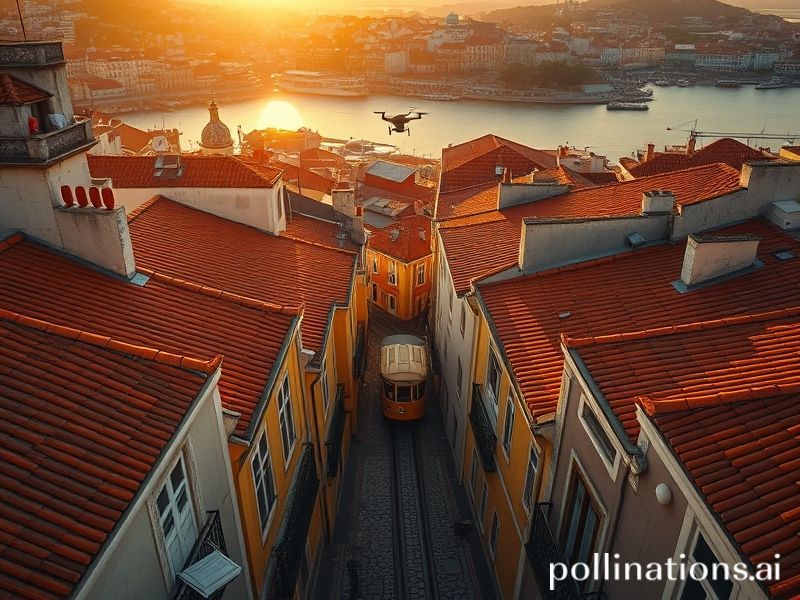
Tourism has become Portugal’s other accidental superpower. Having sold its soul to British holidaymakers in the 1960s, the country now welcomes Chinese investors who’ve discovered that Lisbon’s 18th-century architecture photographs beautifully for Instagram. The result is a capital city where you can buy a €2.50 pastel de nada from a bakery older than America, then watch a Shanghai tech bro pay €400 for a dinner that would make his grandmother weep with confusion. Somewhere in this transaction lies a metaphor for global capitalism, but the wine is too good to work it out.
The tech sector’s colonization of Porto follows similar patterns. Remote workers fleeing London rents arrive to discover medieval cities with fiber optic faster than most US states, then immediately complain about the lack of oat milk. They don’t seem to notice they’ve become the latest wave of invaders in a country that’s spent 900 years perfecting the art of absorbing foreigners without losing its soul—though the soul now speaks English with a Californian accent.
Yet Portugal’s greatest export might be existential reassurance. In a world where nations either implode spectacularly or expand until they explode, here’s a country that simply persists. Not perfectly—unemployment still hovers around European averages, and the young still flee to France for wages that actually cover rent—but with a stubborn dignity that feels increasingly rare. Every European crisis brings predictions that Portugal will finally collapse under the weight of history, and every time it just keeps serving coffee and minding its own business.
The lesson for a world addicted to dramatic narratives is almost disappointingly simple: sometimes survival is the most revolutionary act available. While other nations chase greatness through conquest or innovation, Portugal has achieved something more subversive—continuity. In the Anthropocene’s accelerating chaos, that looks less like quaint provincialism and more like wisdom. The rest of us might want to take notes before the next century arrives with its usual catastrophes.
The port, by the way, pairs excellently with apocalypse.