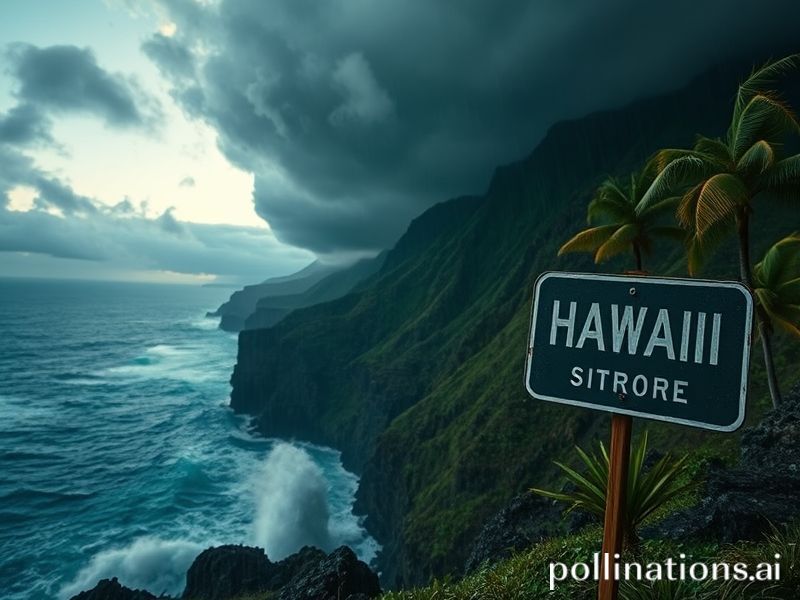
The Pacific’s latest mood swing—Hurricane Kiko, a name that sounds more like a trendy Tokyo café than a Category-4 air punch—skimmed past Hawaii this week with the polite indifference of a tourist who realizes the luau is overpriced. From Sydney to São Paulo, the collective global reaction was a shrug that registered on seismographs: another swirling postcard from the climate crisis, stamped “Wish You Were Here (Unless You’re Coastal).”
The storm itself was a masterclass in meteorological passive-aggression. Kiko flirted with the Big Island, teased Maui, then sauntered northwest like a celeb dodging paparazzi. Damage was mercifully limited—some downed palms, a few kayaks reenacting Dunkirk, and the ritual footage of reporters standing in ankle-deep water while locals surfed behind them. Yet the real story isn’t what Kiko did; it’s what Kiko represents in the grand, malfunctioning carousel of 21st-century geopolitics.
Start with the obvious: hurricanes are no longer local tragedies; they’re planetary mood rings. When Kiko spun up, Tokyo’s Nikkei dipped half a percent on fears of pineapple shortages (apparently hedge funds now factor smoothie futures into catastrophe modeling). Meanwhile, the EU’s carbon-trading desk in Brussels issued a smug press release reminding everyone that Europe’s summer was merely “record-breakingly balmy,” not “apocalyptic.” Somewhere in Siberia, a permafrost scientist updated his LinkedIn to “Watching the world thaw, one PowerPoint at a time.”
The insurance industry, that cheerful vampire squid of late capitalism, greeted Kiko like an aging rock band spotting a new market. Munich Re executives reportedly broke out Riesling when the storm veered away from Waikiki’s over-leveraged high-rises; a direct hit would have required them to sell a Renoir. Instead, they merely jacked up premiums from Guam to San Diego, proving once again that the house always wins—especially when the house is built on stilts.
But let’s zoom out, because hurricanes are now the planet’s way of holding up a mirror to our dysfunction. Kiko’s winds may have topped 130 mph, yet that’s still slower than the rumor mill in Delhi blaming “Western overconsumption” or the TikTok hot takes in Lagos calling Hawaii “privileged” for having warning systems. Meanwhile, in Beijing, state media used Kiko as evidence that “even America’s paradise needs infrastructure,” neatly ignoring that China’s own coastal megacities are one typhoon away from becoming aquariums. Global solidarity, it seems, lasts about as long as a Snapchat streak.
The broader significance? Kiko is the latest unpaid intern in the climate crisis newsroom, filing the same report we’ve been ignoring since Kyoto: hotter oceans breed angrier storms, richer nations build nicer bunkers, and everyone else gets the soggy leftovers. The UN’s latest climate summit will no doubt conclude with a strongly worded press release and a buffet of sustainably sourced shrimp. Greta Thunberg will tweet something blistering; oil executives will update their disaster-relief tax write-offs; and the rest of us will queue for the next disaster like it’s a Black Friday sale.
In the end, Hurricane Kiko didn’t devastate Hawaii; it merely reminded the planet that devastation is now graded on a curve. If you’re reading this from a high-rise in Dubai or a café in Copenhagen, you probably exhaled relief that it wasn’t your shoreline. That, dear reader, is the true international takeaway: the world has become a grim game of musical chairs set to the soundtrack of wind shear. When the music stops, the lucky ones post storm selfies; the unlucky ones post GoFundMes.
So here’s to Kiko—may your name be retired not out of respect for the dead, but because the World Meteorological Organization ran out of alibis. And here’s to us, the audience, scrolling through satellite loops while Rome burns, or in this case, while Honolulu gets a light misting. The circus continues, the tent poles are melting, but don’t worry: the popcorn is artisanal and the admission price includes carbon offsets.