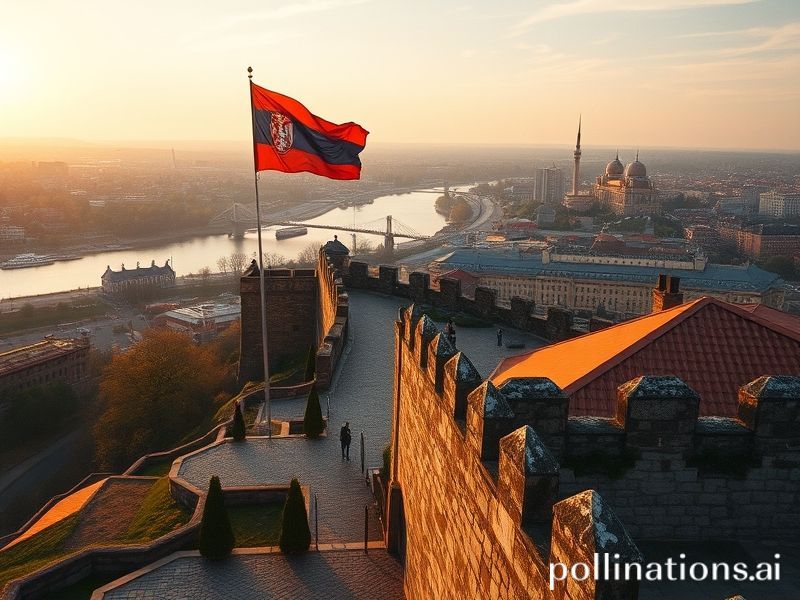
Balkans Roulette: Why the World Still Keeps One Nervous Eye on Serbia
BELGRADE—Walk the length of Knez Mihailova on any given afternoon and you’ll witness the full, glorious contradiction that is modern Serbia: teenagers in Supreme hoodies filming TikToks against 19th-century facades, pensioners feeding pigeons next to a Nike store, and—if you linger long enough—some politician on a flat-screen insisting Serbia has no friends except itself. The statement feels almost endearing until you remember it’s been the national mantra since 1389, when the Ottomans introduced the concept of “strategic ambiguity” at the Field of Blackbirds.
For the uninitiated, Serbia can look like a boutique difficulty—too small to tilt the global economy, too big to ignore when it sneezes. Yet the international reflex is Pavlovian: mention the Balkans and every foreign desk instinctively reaches for the 1990s playbook, the one stained with coffee rings and war-crimes indictments. It’s unfair, of course. It’s also geopolitically prudent. Because Serbia remains the place where great-power bingo—Russia, China, the EU, NATO, Turkey, the Gulf, God herself—still produces winners, losers, and that special Balkan consolation prize: everyone blames the dealer.
Take the Russian factor. Moscow’s affection for Belgrade is billed in Western capitals as a torrid, sanctions-busting romance: cheap gas, UN vetoes, Slavic brotherhood, the usual. In reality it’s more of a codependent situationship. Serbia gets discounted energy and diplomatic cover; the Kremlin gets a foothold inside NATO’s courtyard and the eternal hope that someone, somewhere, will recognise Crimea without giggling. Meanwhile Serbian officials sign EU integration papers with one hand and ink free-trade MoUs with Beijing using the other, practising a multilateral twerk that would rupture lesser spines. Brussels responds by opening new negotiating chapters the way anxious parents slip vegetables into a fussy child’s soup—quietly, repeatedly, and with low expectations of actual consumption.
The West’s dilemma is exquisite. Push too hard on Kosovo recognition and you inflame domestic nationalism, gifting local populists the rhetorical equivalent of a bottomless espresso. Push too little and you cede strategic space to competitors who still recall that the Balkans are conveniently positioned between Europe’s arteries and everyone’s holiday gas pipelines. The result is a diplomatic Groundhog Day in which every “final” dialogue produces another “final” dialogue, ensuring that printers in both Pristina and Belgrade never run out of red ink—or grievance.
But Serbia’s real export isn’t lithium, weaponised nostalgia, or even tennis prodigies who make Wimbledon’s Centre Court sound like a Belgrade nightclub. It is the lived demonstration that ambiguity sells. While other middle-tier states scramble to pick a side, Belgrade markets itself as the region’s premium outlet mall: tax-free access to 1.4 billion Chinese consumers, Russian security vetoes, EU structural funds, and American radar coverage—pick any two, get the third on a deferred payment plan historians will sort out later. Investors call it “flexibility”; traditionalists call it “survival”; cynics note the model has outlasted every ideological fad since the Habsburgs, suggesting the country may be less a fledgling democracy than a weathered hedge fund specialising in geopolitical arbitrage.
What does this mean for the wider world? First, that enlargement fatigue is contagious. If the EU cannot entice a small, adjacent, Orthodox Christian market of seven million, good luck selling the project in Tbilisi or Kyiv. Second, that the post-1945 security architecture is only as sturdy as its most ambivalent tenant; a Serbia embedded in Western institutions would clip Russia’s leverage from the Danube to the Donbas, whereas a Serbia left in limbo keeps the chessboard open for anyone with spare change and a Security Council veto. And third, that nationalism—once thought to be receding into kitschy folkore—has become a renewable resource, like solar power but with worse music.
None of which keeps ordinary Serbs up at night. They have inflation to survive, summers that now resemble Dubai with better rakija, and the universal suspicion that every government promises a future identical to the past, only more expensive. Yet precisely this weary resilience makes Serbia worth watching: if a place that has monetised its own trauma can still opt for the boring stability of rule-of-law, then maybe—just maybe—the rest of us can keep our own contradictions from catching fire.
Until then, the world will continue placing small, nervous bets on the roulette wheel that spins where the Sava meets the Danube. Red is Moscow, black is Brussels, zero is the status quo, and the croupier smiles like someone who’s seen it all before. Because he has. And because the house, as always, is renovation-ready.