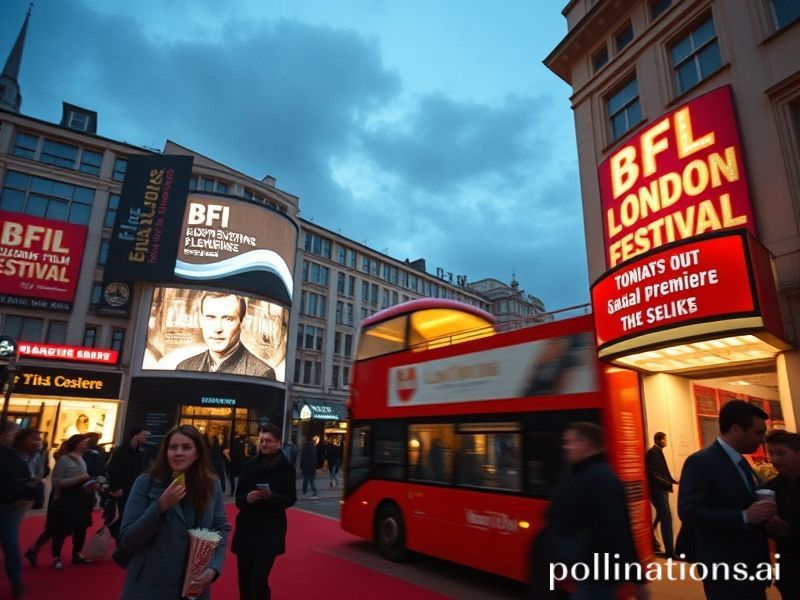
The London Film Festival kicked off last week under the usual autumn drizzle, which felt almost too on-the-nose: a grey sky weeping politely over a city that has perfected the art of pretending everything is fine. Inside the red-carpet bubble, however, the planet’s creative class was busy congratulating itself for surviving another year of algorithmic gatekeepers, shrinking budgets, and the slow-motion car crash politely labeled “the global streaming correction.” Delegates from Lagos, Lima, and Lahore queued for lukewarm prosecco while debating whether a TikTok dance trend now counts as “world cinema.” Spoiler: the algorithm says yes.
Let’s zoom out. Cannes may still have the yachts, and Sundance still has the snow, but London’s festival has quietly become the UN General Assembly of moving pictures. This year 215 features arrived from 67 countries, many of them places whose leaders would rather subsidize tanks than subtitles. Yet here they are, shipped in DCP cans like fragile cultural warheads, ready to detonate empathy in the minds of anyone who can still sit still for 97 minutes. The irony is delicious: nations that can’t agree on carbon emissions or extradition treaties somehow synchronize their premiere schedules.
Global implications? Start with the opening gala: an Afghan-Iranian co-production shot on location in Kabul during the Taliban’s sophomore album tour. The director, a 29-year-old woman who learned color grading on YouTube between power cuts, thanked the British Council for “keeping the lights on—literally.” Her film promptly sold to a U.S. platform that will bury it on page six behind a reality show about competitive dog grooming. Somewhere, soft power just coughed blood.
Meanwhile, the industry sidebar—euphemistically titled “Film Market”—resembles a Moroccan bazaar if the spices were tax credits and the camels were underpaid interns. South Korean sales agents huddle with Spanish producers to swap horror remakes like Pokémon cards. Nigerian executives, high on Nollywood box-office fumes, tempt Scandinavian financiers with “Afro-noir,” a genre defined as “Blade Runner but with better jollof.” Everyone pretends the Chinese theatrical market might reopen tomorrow; nobody believes it, but lying is cheaper than therapy.
Cynics will note the festival’s carbon footprint, roughly equivalent to a medium-sized volcanic eruption. Eco badges made of recycled bottle caps are handed out at parties lit by enough LED panels to guide aircraft. A panel on sustainable filmmaking is sponsored by an airline. The moderator thanks them “for flying our guests in business class so they can lecture us about emissions.” Nobody laughs; the microphone is solar-powered and lacks comic timing.
Yet the films themselves remain stubbornly alive. A Senegalese satire imagines a future where Europe’s climate refugees build walls to keep out British pensioners seeking cheap dentistry. The audience titters nervously, unsure whether it’s fiction or Tuesday’s headlines. A Ukrainian documentary, shot entirely on confiscated Russian bodycams, ends with a soldier quoting Tarkovsky while artillery whistles overhead. The Q&A is short; the director is on a 48-hour leave from the front and has to catch a dawn train back to Kharkiv. Applause lasts longer than the ceasefire.
What does it all mean? In a world where truth is paywalled and disinformation is open-source, festivals are one of the last surviving consulates of shared reality. London, with its imperial hangover and cosmopolitan present, is an accidental neutral zone: too broke to posture, too polite to brag. The festival doesn’t discover talent so much as grant asylum to it. Every subtitled frame is a tiny act of resistance against the flattening force of the feed.
So raise a glass of that corporate-sponsored prosecco to human folly. We may be circling the drain, but at least we’re arguing about aspect ratios on the way down. The credits will roll, the rain will keep falling, and somewhere a teenager in Jakarta is already pirating the winner. Art outlives empires; it just rarely outlives their streaming contracts.